

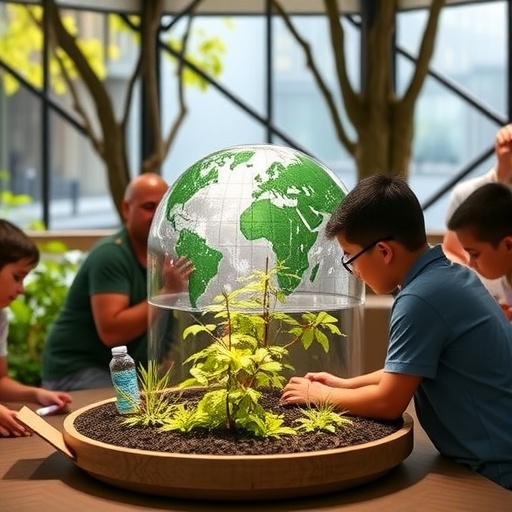
In a groundbreaking study published in Discov Educ, researchers have explored innovative methods to enhance environmental awareness among students in both rural and urban schools. This research is vital as it addresses the growing need for educational systems to integrate environmental consciousness into their curricula. The study, led by Syamsudin et al., employs a problem and design process-based learning model that intertwines science, technology, engineering, arts, and mathematics—collectively referred to as STEAM.
The research highlights the critical intersection of education and environmental advocacy, emphasizing that increased awareness among students can lead to responsible behaviors that positively impact the planet. By utilizing a STEAM approach, the researchers aim to engage students’ creativity and critical thinking skills, driving them to become proactive environmental stewards in their respective communities.
A significant aspect of this research is the methodology employed to bring about change in students’ perceptions and knowledge regarding environmental issues. The study involved diverse teaching strategies that allowed students to tackle real-world problems and design solutions collaboratively. This hands-on approach not only enriched the students’ learning experiences but also fostered a sense of ownership and responsibility toward their environment.
Both rural and urban schools presented unique challenges and opportunities for this study. In urban settings, issues such as pollution and waste management are prominent, while rural areas face challenges related to land use and conservation. By adapting the learning model to address specific local environmental issues, the researchers have demonstrated that tailored educational interventions can lead to more significant outcomes in raising environmental awareness.
In practice, the learning model encourages students to engage in research projects that investigate local environmental challenges. For instance, students may conduct field studies, surveys, and interviews to gather data about their communities. This hands-on research helps students connect theoretical knowledge with practical applications, reinforcing their understanding of environmental issues.
Additionally, the integration of art into the curriculum plays a crucial role in this educational model. By allowing students to express their understanding of environmental issues through various art forms, educators can tap into students’ creativity, making the learning process more engaging and impactful. For example, students might create murals that depict local environmental issues or develop campaigns to promote sustainability within their communities.
Engaging with stakeholders is another vital component of this research. By collaborating with local governments, environmental organizations, and community members, students can gain valuable insights and support for their proposed solutions. This connection not only enhances the educational experience but also helps students understand the importance of community involvement in addressing environmental challenges.
As the study progressed, researchers observed significant changes in students’ attitudes and behaviors toward the environment. Pre- and post-assessments revealed that students who participated in the STEAM-based learning model exhibited a marked improvement in their environmental knowledge and a more profound commitment to sustainable practices. This shift is particularly encouraging, as it suggests that educational interventions can effectively cultivate responsible future citizens.
The findings of this research hold far-reaching implications for educational policymakers and curriculum developers. As environmental issues continue to escalate globally, the integration of comprehensive environmental education into school curricula is imperative. This research demonstrates that by employing innovative teaching methods, educational institutions can prepare students to face complex environmental challenges head-on, fostering a generation equipped with the knowledge and skills necessary for sustainable living.
Moreover, the study underscores the importance of cross-disciplinary collaboration in education. By combining the insights and methodologies of various subjects, educators can create a more holistic learning experience that resonates with students on multiple levels. The STEAM framework offers an effective avenue for achieving this, demonstrating that integrating arts and sciences can lead to a richer and more meaningful educational experience.
Further research is warranted to explore the long-term impacts of such educational interventions on students and their communities. Upcoming studies could examine how these changes in awareness and behavior manifest in real-life scenarios and evaluate the potential for scaling such initiatives across other regions and schools. The hope is that as more educators embrace STEAM-based models, we may witness a collective shift in the next generation’s approach to environmental stewardship.
In conclusion, the research conducted by Syamsudin and colleagues highlights an essential movement towards promoting environmental awareness through innovative educational practices. By effectively combining technology, creativity, and critical thinking, the study demonstrates that it is possible to inspire students to take active roles in addressing environmental issues. As society faces unprecedented environmental challenges, educational approaches that empower the youth with knowledge and skills are vital for a sustainable future.
The implications of this research extend beyond just the classroom; they serve as a reminder of the powerful role education can play in shaping the next generation’s values and priorities. As this movement gains traction, educators, policymakers, and communities must work collectively to ensure that environmental education becomes a cornerstone of our global educational agenda.
Subject of Research: Enhancing Environmental Awareness
Article Title: Enhancing students’ environmental awareness in rural and urban schools through problem and design process based learning model with steam.
Article References:
Syamsudin, F.I., Saputro, S., Sarwanto et al. Enhancing students’ environmental awareness in rural and urban schools through problem and design process based learning model with steam.
Discov Educ 4, 555 (2025). https://doi.org/10.1007/s44217-025-01006-3
Image Credits: AI Generated
DOI: https://doi.org/10.1007/s44217-025-01006-3
Keywords: Environmental Awareness, Education, STEAM, Rural Schools, Urban Schools, Problem-Based Learning, Design Process, Sustainability.


