

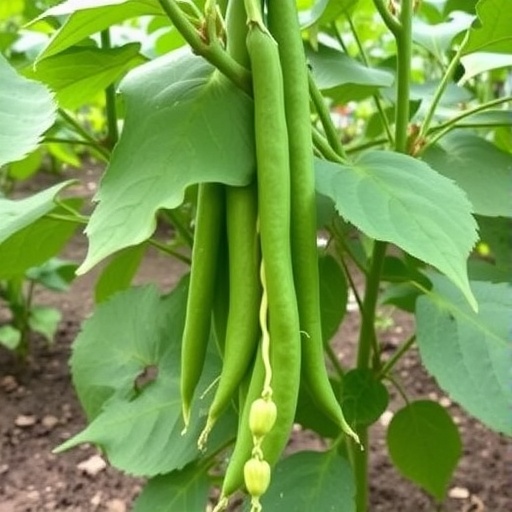
In an exponential race against time and environmental changes, the issue of drought resilience in crops is more pressing than ever. Recent findings from a team of researchers led by Hernández-Cortés and colleagues have unveiled the significant potential of a soil bacterium, Lysinibacillus sphaericus, in enhancing the drought resistance of the common bean, scientifically known as Phaseolus vulgaris. This breakthrough has the potential to not only bolster food security in arid regions but also open up new avenues in sustainable agricultural practices.
Drought conditions are becoming increasingly common due to climate change, leading to a worrying decline in crop yields around the globe. The common bean, a staple food in many developing countries, is particularly vulnerable to water scarcity. A reduction in yield can have dire consequences for nutrition and economic stability. Thus, exploring innovative agricultural strategies that could mitigate the harsh impacts of drought is essential. The latest research provides not only hope but also tangible methods that can be implemented to fortify crops against such challenges.
The Lysinibacillus sphaericus, a member of the Bacillaceae family, is known for its ability to enhance plant growth. Its application is not just limited to improving soil quality; it also fosters beneficial interactions with plant root systems. The researchers observed that when this bacterium was inoculated into common beans, there was a notable improvement in various physiological aspects of the plants. Increased root length and density were noted, promoting better water absorption during drought conditions. This augments the plant’s resilience and contributes to maintaining healthy growth despite limited water availability.
Field trials conducted by the research team highlighted the efficacy of Lysinibacillus sphaericus under controlled drought conditions. Beans that received the bacterium exhibited improved physiological traits, such as enhanced stomatal conductance and higher photosynthetic rates. These traits are crucial for utilising water more efficiently, allowing the plants to maintain metabolic processes necessary for growth and development even when faced with water stress. This adaptive capacity could translate into more reliable yields for farmers through periods of insufficient rainfall.
Alongside improved water uptake, the research team also noted changes in the biochemical responses of the plants. For instance, the inoculated beans demonstrated elevated levels of stress-related hormones, which play a critical role in the plant’s defense mechanism. These hormones help regulate various physiological pathways that enhance water-use efficiency and stress tolerance. Such enhancements suggest that Lysinibacillus sphaericus not only aids in immediate physiological improvements but may also induce long-term resilience in plants.
The findings also underscore the importance of microbial inoculation in driving sustainable agriculture. Rather than relying solely on chemical fertilizers or pesticides, integrating beneficial microbes into farm management offers a robust alternative that not only improves plant health but also supports soil biodiversity. This shift towards biological means of enhancing crop resilience aligns with current trends in sustainable farming, aiming to reduce environmental impacts while maintaining productivity.
Further investigations revealed that the benefits of bacterial inoculation extend beyond just moisture management. The study highlighted improvements in overall yield, nutrition, and disease resistance among common beans treated with Lysinibacillus sphaericus. Farmers could, therefore, expect not only healthier plants during drought periods but also increased profitability through enhanced production conditions. These advantages could be particularly transformational for regions most affected by climate variability, empowering communities to cultivate food sustainably.
Scientists involved in the research also emphasized the importance of understanding the complex interactions between soil microbes and plant systems. Future work will delve deeper into how Lysinibacillus sphaericus can be strategically utilized in various crop systems beyond common beans. The potential for developing microbial formulations tailored to specific environmental challenges could soon present farmers with customized solutions designed for their unique agricultural landscapes.
While the research presents a promising outlook, it also highlights the need for further studies to assess the full range of benefits that microbial inoculation can provide. Trials on different soil types, climatic conditions, and various bean cultivars will be essential to understand the broader applicability of these findings. Scientists are hopeful that with collaborative efforts between academia, industry, and farmers, microbial solutions can become a staple in agricultural practices worldwide.
The urgency of bolstering food security through innovative and resilient farming practices has never been clearer. As climate challenges continue to mount, the strategies that researchers are developing today, such as the proliferative use of Lysinibacillus sphaericus, could be indispensable in safeguarding future food supplies. The pathway towards sustaining agricultural productivity amid increasingly erratic weather patterns will require ingenuity, adaptability, and ongoing research efforts in microbial applications.
In conclusion, the study led by Hernández-Cortés and colleagues presents a robust case for the significance of Lysinibacillus sphaericus in promoting drought resilience in common beans. As scientists unlock the genetic and physiological traits that underscore this resilience, we find ourselves at the forefront of agricultural innovation, ready to tackle the pressing challenges posed by climate change. By embracing the power of beneficial microbes, the agricultural community can forge a more sustainable and reliable future in food production, thus addressing one of humanity’s greatest challenges.
As the findings ripple through the agricultural world, the legacy of this research will undoubtedly encourage further exploration into the synergistic relationships between plants and soil microbes. The hope is that methods developed from this understanding will not only improve crop resilience but pave the way for an environmentally sound agricultural revolution that is desperately needed in the face of climate adversity.
Subject of Research: Enhancing drought resilience in common bean through bacterial inoculation.
Article Title: Enhancing drought resilience in common bean (Phaseolus vulgaris) through Lysinibacillus sphaericus inoculation.
Article References:
Hernández-Cortés, S., Hernández-Alcántara, N., Díaz Yayguaje, M. et al. Enhancing drought resilience in common bean (Phaseolus vulgaris) through Lysinibacillus sphaericus inoculation.
Discov. Plants 3, 1 (2026). https://doi.org/10.1007/s44372-025-00459-y
Image Credits: AI Generated
DOI: https://doi.org/10.1007/s44372-025-00459-y
Keywords: drought resilience, common bean, Lysinibacillus sphaericus, sustainable agriculture, microbial inoculation.


