


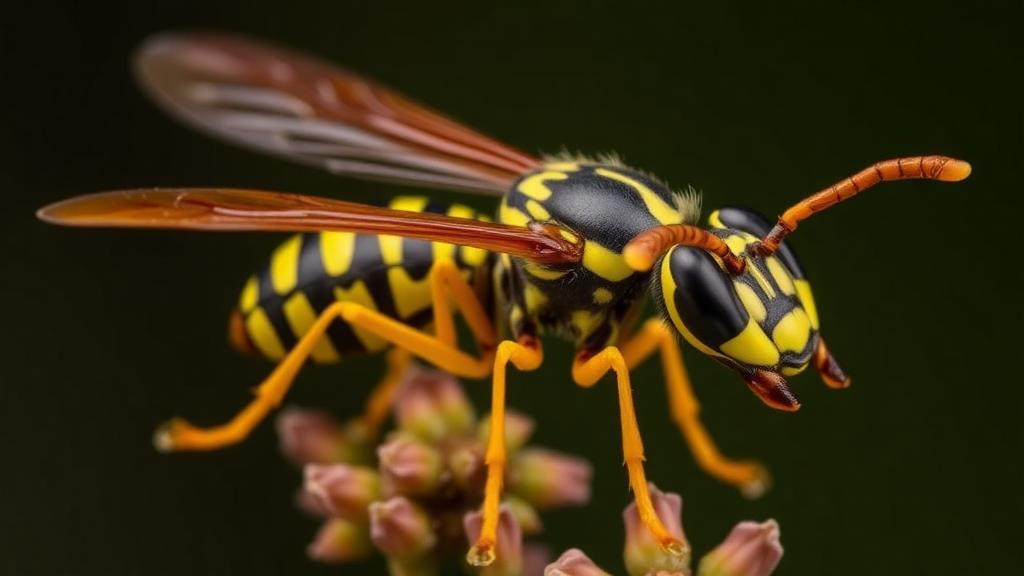
Deep in the reedbeds of southern Norway, a tiny parasitic wasp has been hiding in plain sight for decades, mislabelled and overlooked until its DNA gave it away. In a new review published in the Journal of Hymenoptera Research, a British taxonomist has combed through the European species of the braconid wasp genus Sarops, described a striking new species from Scandinavia, and used DNA barcodes to untangle a knot of classification problems that has puzzled specialists for more than eighty years. The new species, named Sarops audax – audax being Latin for bold, a nod to the divergent barcode that first flagged its existence – was caught in woodland along the river margin at Hestehavn on the river Nitelva near Lillestrøm, Norway, with a male specimen turning up much earlier in Nurmijärvi, Finland, in 1985.
The genus Sarops belongs to the braconid wasp subfamily Alysiinae, a group instantly recognisable to specialists by their exodont mandibles, which open outward rather than inward like those of most wasps. Within the Alysiinae, the tribe Dacnusini is characterised by the loss of a particular wing vein, r-m, and its members are almost all internal parasitoids of plant-feeding flies. Sarops itself sits within the Coelinius genus group, whose known members all attack Chloropidae, the grass flies, developing inside their hosts within plant stems. The group is taxonomically tangled: different authors on different continents have treated its components as full genera, subgenera, or synonyms, and the latest European checklist recognises five separate genera including Sarops, while the East Palaearctic treatment lumps them together under Coelinius.
Only two European species of Sarops were known before this study: S. rea, described by Nixon in 1942, and S. popovi, described by Tobias in 1962. Worldwide, the genus currently contains eleven described species, with additional species recorded from North America, the East Palaearctic, Malaysia and South Africa. The new review brings the European count to three and provides illustrated descriptions of both sexes for all three species, along with an identification key that separates them using features of the metasoma, the rear body segment of the wasp.
Sarops audax is a small wasp, with the female holotype measuring 3.4 millimetres in body length and 2.8 millimetres in fore wing length. It is predominantly black, with brown antennae, mandibles and legs, and a largely hyaline wing membrane. Its antennae carry 35 segments in the holotype and 33 in the female paratype, densely clothed in fine setae angled forward at roughly 25 degrees. The species is distinguished from its closest relative, S. rea, chiefly by the sculpturing of the metasomal tergites: in S. audax, the longitudinal sculpturing on the second tergite extends all the way to the tergite’s margin, and the third tergite bears a distinct triangular area of granular sculpturing that is absent in S. rea. The head of S. audax is also proportionally wider than that of S. rea, and its antennae are slightly thicker, with different ratios of segment lengths to widths.
S. popovi, the third European species, is easier to separate from both. Its metasoma is markedly longer relative to the mesosoma, running 1.8 to 2.0 times the mesosomal length compared with 1.5 to 1.6 in the other two species, and its first metasomal tergite is around 1.5 times as long as it is wide apically, against 1.0 to 1.1 in S. rea and S. audax. The mandible of S. popovi is narrower, with the longest tooth nearly half the length of the mandible, and the third metasomal tergite carries no sculpturing at all. Most specimens also show a more reddish-brown metasoma than their relatives.
To test whether these morphological differences reflect genuine evolutionary separations, the study drew on DNA sequences from the CO1 barcode locus, generated by the Centre for Biodiversity Genomics at the University of Guelph and hosted on the BOLD database. Three specimens of S. rea and five of S. popovi were sequenced, alongside the new species. The results were unambiguous: S. audax sits closest to S. rea but is separated by roughly 5 percent genetic divergence, a gap firmly supporting its status as a distinct species. S. popovi is more distantly related still, diverging by more than 9 percent from the other two, and its barcode index number, or BIN, shows greater internal variability, largely because European and North American specimens differ. Notably, the Old and New World specimens of S. popovi cluster apart in the analysis, suggesting the species is not a recent introduction to Canada and presumably does not attack the introduced Cryptonevra flies there.
The phylogenetic analysis also raised questions about the genus itself. In most trees constructed from the barcode data, S. popovi appears more closely associated with species of Polemochartus, another Dacnusini genus, than with the other Sarops species. The single mitochondrial marker used provides limited resolution, with low bootstrap values at the deeper nodes, so the author is careful not to overclaim. Whether Sarops is monophyletic, and how it relates to Polemochartus and the broader Coelinius genus group, will require additional molecular data, particularly from nuclear loci, which the author expects to become available in the coming years.
The biology of Sarops remains tantalisingly poorly known. The holotype of S. rea is labelled
Subject of Research: Taxonomic review of European Sarops parasitoid wasps with description of a new species
Article Title: A review of European species of Sarops ( Hymenoptera , Braconidae , Alysiinae , Dacnusini ) with the description of a new species
Article References: Godfray, H. C. J. (2026). A review of European species of Sarops (Hymenoptera, Braconidae, Alysiinae, Dacnusini) with the description of a new species. Journal of Hymenoptera Research, 99, 733-751. https://doi.org/10.3897/jhr.99.198145
Image Credits: AI Generated
Keywords: Sarops, Braconidae, Alysiinae, Dacnusini, new species, DNA barcoding, parasitoid wasp, Norway, Finland, Chloropidae, taxonomy, Polemochartus
Cite Scienmag News
Gavin Prescott. (October 16, 2026). Bold New Wasp Species Emerges From Scandinavian Marshes as Scientists Rewrite the Sarops Family Tree. Scienmag. https://scienmag.com/bold-new-wasp-species-emerges-from-scandinavian-marshes-as-scientists-rewrite-the-sarops-family-tree/
Gavin Prescott. "Bold New Wasp Species Emerges From Scandinavian Marshes as Scientists Rewrite the Sarops Family Tree." Scienmag, 16 October 2026, https://scienmag.com/bold-new-wasp-species-emerges-from-scandinavian-marshes-as-scientists-rewrite-the-sarops-family-tree/. Accessed 16 October 2026.
Gavin Prescott. "Bold New Wasp Species Emerges From Scandinavian Marshes as Scientists Rewrite the Sarops Family Tree." Scienmag. October 16, 2026. https://scienmag.com/bold-new-wasp-species-emerges-from-scandinavian-marshes-as-scientists-rewrite-the-sarops-family-tree/


