


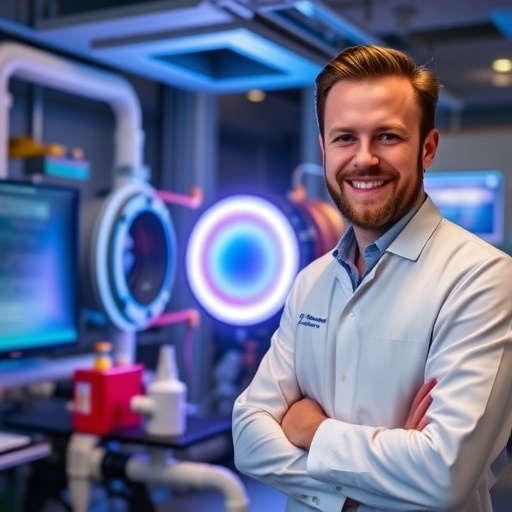
Dr. Yannik Zobus, a pioneering laser physicist at GSI/FAIR in Darmstadt, has embarked on a groundbreaking journey to transform the landscape of fusion energy research. As the newly appointed head of the LASE-FUSE (LAser Simulation for Enhanced FUSion Efficiency) Young Investigators Group since May 1, 2026, Zobus’s work is set to revolutionize the development of next-generation high-power laser systems integral to laser-driven inertial confinement fusion (ICF). Backed by a substantial funding of three million euros over five years from Germany’s Federal Ministry of Research, Technology, and Space (BMFTR), LASE-FUSE represents a critical stride in laser fusion technology with ambitions to accelerate fusion energy’s arrival as a viable power source.
Inertial confinement fusion relies on the precise compression and heating of minute fuel capsules by intense laser pulses to reach ignition conditions necessary for nuclear fusion. Achieving these extreme conditions requires laser systems of extraordinary power, precision, and complexity, posing formidable engineering challenges. The development of such intricate machinery demands an unprecedented level of simulation capability—one that can capture every physical nuance and interaction within the laser system’s architecture. LASE-FUSE addresses this need by developing a comprehensive modular simulation environment that functions as a sophisticated digital twin of fusion laser setups.
This innovative simulation framework aims to harmonize all relevant components of a fusion laser system, modeling processes from the initial laser generation through beam shaping, amplification stages, and energy transport right up to the instant before laser-target interaction. Historically, these elements have been simulated separately or in isolation, limiting the accuracy and scope of predictions. The LASE-FUSE platform’s holistic approach offers an integrated perspective, enabling researchers to optimize laser system designs virtually before hardware is constructed, thus streamlining development cycles and mitigating costly errors.
One of the hallmark features LASE-FUSE explores is the simulation of advanced laser pulse structures—both spatially and temporally modulated—which could dramatically enhance laser efficiency for fusion ignition. The initiative also pioneers the concept of temporally adaptive focusing, known as “focal zooming,” where the laser’s focal spot dynamically adapts during pulse delivery to maximize energy coupling with fusion targets. These novel laser engineering paradigms, previously difficult to model comprehensively, are central to pushing the performance boundaries of future fusion lasers.
To bridge simulation with experimental reality, LASE-FUSE develops realistic detector models that simulate the response of diagnostic instruments used in fusion experiments. This ensures that simulated data and laboratory measurements align closely, enhancing confidence in the simulation platform’s predictive capability. By unifying simulation with experimental feedback, LASE-FUSE fosters a virtuous cycle of iterative design improvements, propelling fusion laser innovation more rapidly than before.
Dr. Zobus highlights the transformative potential of this work: “Our vision with LASE-FUSE is to create a next-generation simulation toolbox that captures the full complexity of modern fusion laser systems. This capability will empower designers to make reliable, data-driven decisions early in the laser development process, ultimately accelerating the roadmap toward operational fusion power plants.” His leadership is instrumental in spearheading this digital transformation in laser fusion research.
LASE-FUSE is deeply embedded within GSI/FAIR’s esteemed Plasma Physics department under Professor Vincent Bagnoud, benefiting from a rich ecosystem of expertise and prior technological foundations. Notably, LASE-FUSE expands upon the OPOSSUM simulation platform, an open-source optics simulation system originally developed under the European THRILL project. This platform’s capacity for unified modeling of high-power laser systems forms the backbone of LASE-FUSE’s ambitious fusion-oriented applications, marking a significant step forward for open-access high-energy laser research tools.
The recognition of Dr. Zobus as a “fusion talent” follows a lineage of excellence at GSI/FAIR, paralleling previous awardees like Dr. Jonas Ohland, and underscores Germany’s commitment to fostering young scientific leaders in fusion science. Professor Thomas Nilsson, Scientific Director of GSI and FAIR, emphasizes the strategic importance of cultivating homegrown expertise: “Fusion research is pivotal for sustainable energy futures. By combining established scientific know-how with innovative young researchers like Dr. Zobus, GSI/FAIR aims to make pioneering contributions to fusion energy development.”
Collaboration is also a cornerstone of LASE-FUSE’s strategy. The project partners with academic institutions and industry leaders, including Marvel Fusion in Munich and Focused Energy in Darmstadt, to nurture an innovation-driven ecosystem around fusion laser technology. These alliances not only enhance technology development but also cultivate a fertile environment for training and preparing the next generation of fusion scientists and engineers tasked with taking fusion research from experimental stages to commercial reality.
Dr. Zobus’s scientific trajectory is firmly rooted in high-energy laser physics, having earned his PhD from the Technical University of Darmstadt in 2023. His doctoral research involved experimental and theoretical work at the PHELIX (Petawatt High-Energy Laser for Ion Experiments) facility of GSI/FAIR. The experience and insights gained at PHELIX, coupled with his subsequent postdoctoral research on the THRILL project, underpin his expertise and innovative vision, culminating in the conceptualization of LASE-FUSE.
The “Fusionstalente” program, championed by the German Federal Ministry of Research, Technology, and Space, underpins initiatives like LASE-FUSE by nurturing young investigators who demonstrate exceptional promise in fusion research. The program offers not only financial resources but also access to cutting-edge facilities and training, aiming to fortify Germany’s position at the forefront of fusion science. This effort aligns with the broader “Fusion 2040 – Research on the Way to the Fusion Power Plant” funding agenda, which envisions bringing practical fusion energy solutions closer to reality within the coming decades.
LASE-FUSE promises to be a watershed in the fusion laser community—providing a robust, scalable, and comprehensive computational tool that integrates simulation and experimental paradigms. As fusion energy continues to captivate the scientific world with its potential to provide virtually limitless, clean power, technologies like LASE-FUSE play an indispensable role in overcoming the formidable scientific and engineering barriers on the path to realizing functional fusion reactors. The initiative embodies the spirit of innovation and collaborative ambition that will define the next era of energy research worldwide.
News Publication Date: Not specified.
Web References: Not provided.
References: Not provided.
Keywords
Physics, Applied physics, Laser systems, Lasers, Energy resources, Fusion energy
Cite Scienmag News
Bethany Barker. (May 7, 2026). BMFTR Awards Multi-Million Funding for Fusion Research – Dr. Yannik Zobus of GSI/FAIR Leads New Young Investigators Group. Scienmag. https://scienmag.com/bmftr-awards-multi-million-funding-for-fusion-research-dr-yannik-zobus-of-gsi-fair-leads-new-young-investigators-group/
Bethany Barker. "BMFTR Awards Multi-Million Funding for Fusion Research – Dr. Yannik Zobus of GSI/FAIR Leads New Young Investigators Group." Scienmag, 7 May 2026, https://scienmag.com/bmftr-awards-multi-million-funding-for-fusion-research-dr-yannik-zobus-of-gsi-fair-leads-new-young-investigators-group/. Accessed 5 September 2026.
Bethany Barker. "BMFTR Awards Multi-Million Funding for Fusion Research – Dr. Yannik Zobus of GSI/FAIR Leads New Young Investigators Group." Scienmag. May 7, 2026. https://scienmag.com/bmftr-awards-multi-million-funding-for-fusion-research-dr-yannik-zobus-of-gsi-fair-leads-new-young-investigators-group/


