


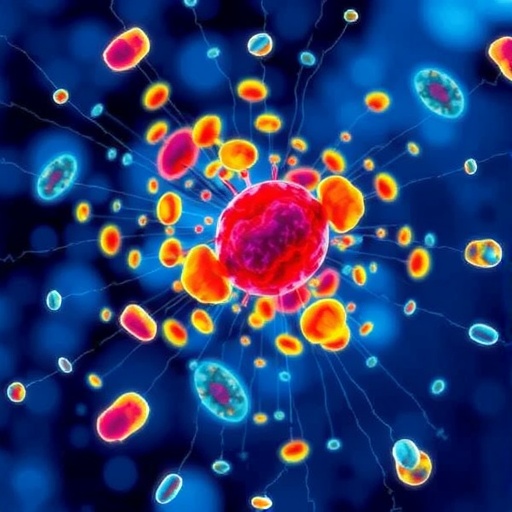
In a groundbreaking advancement poised to transform the landscape of cancer diagnostics and treatment, a team of researchers from Stanford Medicine and the Mayo Clinic has unveiled a novel, noninvasive blood test capable of mapping the complex ecosystem surrounding tumors. This innovative method elucidates intricate cellular interactions within the tumor microenvironment—an elusive but critical factor influencing patient outcomes and responses to therapy—that until now could only be glimpsed through invasive biopsy procedures.
Traditionally, oncologists have relied heavily on tissue biopsies to study tumors, capturing static snapshots of cancer cells alongside their immediate healthy neighbors. These biopsies provide vital genetic information, but the invasive nature and temporal limitations restrict frequent monitoring. Moreover, tumor microenvironments are dynamic, continually evolving during disease progression and in response to treatments. The inability to observe these changes in real-time has hindered precision medicine efforts, often leaving clinicians to guess how tumors might adapt or resist therapies.
The Stanford and Mayo Clinic teams tackled this challenge by integrating cutting-edge machine learning algorithms with detailed molecular profiling. Central to their approach are two computational tools—CytoSPACE and Spatial EcoTyper—which piece together spatial maps of cellular neighborhoods within tumors based on gene expression patterns. CytoSPACE, developed just last year, accurately assigns individual cells to their precise coordinates within tumor tissue, akin to plotting every resident on a detailed city map. Spatial EcoTyper complements this by characterizing cell types, states, and interactions, revealing distinct spatial ecotypes—cellular communities with unique genetic and functional signatures.
By applying these methods to over 100 tumor samples spanning ten diverse cancer types, the researchers identified nine conserved spatial ecotypes within tumors, regardless of cancer origin. These cellular neighborhoods varied in location and composition, some residing at interfaces between tumor and healthy tissue, others deep within malignant masses. Crucially, certain ecotypes correlated strongly with patients’ responses to immunotherapy, suggesting these spatial patterns could serve as biomarkers guiding personalized treatment choices.
A critical insight emerged when the team observed that individual immune cells like CD8 T cells displayed context-dependent gene expression profiles influenced by their surrounding cellular “neighbors.” This discovery parallels human social behavior—distinct conversations and interactions occurring in different social settings despite the presence of common participants. In the tumor microenvironment, these spatially dependent gene expression programs define the functional states of cells, potentially tipping the balance between tumor suppression and progression.
Recognizing the clinical constraints of repeated biopsies, the scientists sought a less invasive method to capture these spatial relationships. Their solution lies in analyzing methylation patterns—chemical modifications on DNA that reflect gene expression activities—in circulating cell-free DNA found in patients’ blood. Tumors and surrounding cells release fragments of their DNA into the bloodstream upon cell death, carrying methylation “signatures” indicative of their origins and current states. Leveraging artificial intelligence, the team developed Liquid EcoTyper, a tool capable of reconstructing the tumor microenvironment from these methylation signals, effectively translating blood samples into dynamic maps of spatial ecotypes.
Validation studies demonstrated strong concordance between spatial ecotype profiles derived from tumor biopsies and those inferred via Liquid EcoTyper from patient blood samples. This breakthrough paves the way for longitudinal monitoring of tumor ecosystems through simple blood draws, enabling clinicians to track the evolving interactions within the tumor microenvironment as patients undergo therapy. Such real-time insights could alert physicians to emerging resistance mechanisms or shifts in immune landscapes, prompting timely adjustments to treatment regimens.
Beyond its diagnostic potential, this research challenges the tumor-centric paradigm that has dominated cancer biology. By highlighting the pivotal roles played by surrounding healthy cells—including fibroblasts, immune modulators, and vascular elements—in shaping tumor behavior, the study underscores the importance of targeting the tumor microenvironment alongside malignant cells. This holistic perspective promises novel therapeutic avenues that disrupt the nurturing niches fostering cancer growth.
Mechanistically, cancer cells employ sophisticated strategies to co-opt their neighbors. They induce blood vessel formation (angiogenesis) to secure vital nutrients, reprogram immune cells to evade detection, and stimulate fibroblasts to generate collagen-rich scaffolds that shield tumors from immune attack. Each spatial ecotype represents a unique micro-ecosystem wherein these interactions unfold, orchestrating cancer progression and influencing therapeutic success. By mapping these ecotypes, Liquid EcoTyper offers a window into the molecular conversations driving malignancy.
The implications for immunotherapy are particularly profound. Immunotherapies, which unleash the immune system against cancer, often exhibit variable efficacy across patients with seemingly similar tumors. This variability may stem from differences in spatial ecotypes within tumors that modulate immune cell activation and infiltration. Liquid EcoTyper’s ability to noninvasively detect ecotype patterns associated with favorable immunotherapy responses heralds a new era of predictive and adaptive cancer care.
Looking ahead, the researchers envision integrating liquid biopsy-based spatial profiling into clinical workflows, furnishing oncologists with actionable intelligence throughout the treatment journey. Repeated assessments could refine individualized therapy plans, minimize unnecessary toxicities, and ultimately improve survival outcomes. Before widespread adoption, however, comprehensive clinical trials will be necessary to validate Liquid EcoTyper across broader patient populations and cancer subtypes.
The study represents a remarkable convergence of biomedical data science, genomics, and computational biology. It exemplifies how sophisticated algorithms can extract meaningful biological signals from high-dimensional data, transforming clinical diagnostics and deepening our understanding of tumor ecosystems. Fueled by collaborative efforts spanning prestigious institutions, the research underscores the growing importance of interdisciplinary approaches in tackling cancer’s complexity.
While significant challenges remain, such as standardizing assay protocols and ensuring robust interpretation in diverse clinical contexts, the demonstration of a blood test that noninvasively captures spatial ecotypes marks a paradigm shift in oncology. It opens avenues for exploring tumor ecology dynamically and noninvasively, moving beyond static snapshots toward continuous monitoring and precise intervention.
In essence, this innovative methodology reframes cancer not as a solitary invader but as a thriving community embedded within a complex cellular milieu. Understanding and disrupting these malignant neighborhoods may prove pivotal to defeating one of humanity’s deadliest foes. As the field moves forward, tools like Liquid EcoTyper promise to empower clinicians with unprecedented clarity into the tumor microenvironment’s spatial and functional architecture, heralding a future where cancer treatment is smarter, more adaptive, and profoundly personalized.
News Publication Date: 6-May-2026
Web References:
References:
- Newman, A., et al. (2026). Non-invasive profiling of the tumour microenvironment with spatial ecotypes. Nature. DOI: 10.1038/s41586-026-10452-4
Cite Scienmag News
Nathaniel Bowman. (May 6, 2026). Blood Test Maps Tumor Cell ‘Neighborhoods’ to Predict Immunotherapy Outcomes. Scienmag. https://scienmag.com/blood-test-maps-tumor-cell-neighborhoods-to-predict-immunotherapy-outcomes/
Nathaniel Bowman. "Blood Test Maps Tumor Cell ‘Neighborhoods’ to Predict Immunotherapy Outcomes." Scienmag, 6 May 2026, https://scienmag.com/blood-test-maps-tumor-cell-neighborhoods-to-predict-immunotherapy-outcomes/. Accessed 5 September 2026.
Nathaniel Bowman. "Blood Test Maps Tumor Cell ‘Neighborhoods’ to Predict Immunotherapy Outcomes." Scienmag. May 6, 2026. https://scienmag.com/blood-test-maps-tumor-cell-neighborhoods-to-predict-immunotherapy-outcomes/


