

Saturday, September 5, 2026
Science
No Result
View All Result
  • Login
  • HOME
  • SCIENCE NEWS
  • CONTACT US
  • HOME
  • SCIENCE NEWS
  • CONTACT US
No Result
View All Result
Scienmag
No Result
View All Result
Home Science News Medicine

Blood Test for Tuberculosis Could Cut Spread of Global Infectious Killer

July 28, 2026
in Medicine
Ophelia Keating
By Ophelia Keating Scienmag Editorial Profile - Health Services Research
Reading Time: 2 mins read
0
Blood Test for Tuberculosis Could Cut Spread of Global Infectious Killer

Blood Test for Tuberculosis Could Cut Spread of Global Infectious Killer

65
SHARES
587
VIEWS
Share on FacebookShare on Twitter
ADVERTISEMENT

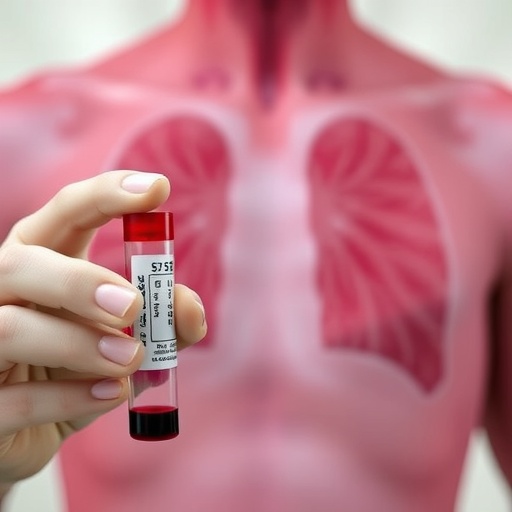
A study presented at ADLM 2026 in Anaheim, California reports that a blood test could identify active tuberculosis (TB) with high accuracy across a spectrum of exposure levels. TB remains a major global killer, and faster diagnosis is widely seen as a practical lever for reducing transmission. The findings, if validated in real-world workflows, may help clinicians act sooner—especially when standard sputum testing is not feasible.

Dr. Sheng-Wei Pan of Taipei Veterans General Hospital, lead author of the work, emphasized that “every week of delay” matters for both patient outcomes and public health. The World Health Organization estimates that roughly one-quarter of the global population is infected with Mycobacterium tuberculosis, and 5–10% may progress to active disease. Early detection followed by antibiotic treatment can be lifesaving and can reduce onward spread.

Traditionally, TB diagnosis relies on sputum samples, which require patients to produce mucus from the lungs and airways. That approach can fail in early infection or in cases with low bacterial burden, leaving clinicians without a reliable, non-sputum alternative. A blood-based method would broaden access to testing in settings where collection and lab turnaround are limiting factors.

The study centers on a bacterial marker: 6-kDa early secreted antigenic target (ESAT-6). While ESAT-6 has been studied previously, many sensors have struggled to distinguish active pulmonary TB from latent TB infection, prior exposure without infection, TB caused by other Mycobacterium species, lung cancer, or other lung disorders. The team addressed this challenge using a biosensor designed for highly sensitive quantification of circulating ESAT-6.

Researchers measured ESAT-6 levels in blood from 217 participants with confirmed active pulmonary TB or with non-TB conditions. The control group included lung disease from non-TB Mycobacterium species, lung cancer, latent TB, exposed but uninfected individuals, and healthy participants with no known TB contact. The marker clearly separated TB from non-TB participants.

Importantly, ESAT-6 concentrations showed a stepwise pattern: lowest in uninfected contacts, intermediate in latent TB, and highest in active TB. This relationship remained robust even after accounting for variables such as age, sex, and diabetes. Because ESAT-6 originates directly from the bacteria rather than from the host immune response, the signal may better reflect disease activity.

Compared with two commonly used blood-based markers, ESAT-6 demonstrated improved discrimination among clinical TB groups. Still, the researchers note that their study design used known disease status from the outset, so prospective testing is needed to establish predictive performance over time.

While sputum cultures remain essential for confirmation and drug-resistance profiling, ESAT-6 could provide a fast, practical triage tool when sputum diagnostics are delayed or limited. The team is planning a prospective study to evaluate whether the test can guide clinical decision-making in real-world settings.

Subject of Research: Quantitative blood ESAT-6 for non-sputum identification of pulmonary tuberculosis
Article Title: Quantitative assessment of circulating blood ESAT-6 for non-sputum identification of pulmonary tuberculosis (Abstract A-097)
News Publication Date: July 28, 2026
Web References: https://posters.myadlm.org/adlm/2026/adlm-2026/4215994/sheng-wei.pan.quantitative.assessment.of.circulating.blood.esat-6.for.html?f=listing%3D0%2Abrowseby%3D8%2Asortby%3D1%2Asearch%3Dtuberculosis
References: World Health Organization estimates cited in the article; ADLM 2026 presentation details provided in the source text
Image Credits: Not provided

Article Title: Blood Test for Tuberculosis Could Cut Spread of Global Infectious Killer

Article References: Original research article

Image Credits: AI Generated

DOI: Not provided

Keywords: tuberculosis, ESAT-6, biosensor, blood test, pulmonary TB, non-sputum diagnosis, diagnostic accuracy, latent TB, infection exposure

Cite Scienmag News

Ophelia Keating. (July 28, 2026). Blood Test for Tuberculosis Could Cut Spread of Global Infectious Killer. Scienmag. https://scienmag.com/blood-test-for-tuberculosis-could-cut-spread-of-global-infectious-killer/

Ophelia Keating. "Blood Test for Tuberculosis Could Cut Spread of Global Infectious Killer." Scienmag, 28 July 2026, https://scienmag.com/blood-test-for-tuberculosis-could-cut-spread-of-global-infectious-killer/. Accessed 5 September 2026.

Ophelia Keating. "Blood Test for Tuberculosis Could Cut Spread of Global Infectious Killer." Scienmag. July 28, 2026. https://scienmag.com/blood-test-for-tuberculosis-could-cut-spread-of-global-infectious-killer/


Tags: blood-based infectious disease testingearly TB detectionglobal TB health strategiesmolecular markers for TBMycobacterium tuberculosis detectionnon-sputum TB testingTB diagnostic methodsTB infection spectrumTB public health impactTB rapid diagnosisTB transmission reductionTuberculosis blood test
Share26Tweet16
Previous Post

New Assyrian King List Insights Reveal Three Newly Identified Kings

Next Post

Xi’an Jiaotong Achieves Low-Cost Roll-to-Roll 3D Nanobowl Light-Trapping Films

Related Posts

Machine learning predicts survival and chemotherapy benefit in gastric cancer
Medicine

Machine learning predicts survival and chemotherapy benefit in gastric cancer

September 5, 2026
Adolescent vaccine attitudes revealed through co-produced thematic analysis study
Medicine

Adolescent vaccine attitudes revealed through co-produced thematic analysis study

September 5, 2026
AI models predict blood clot risk in septic ICU patients
Medicine

AI models predict blood clot risk in septic ICU patients

September 5, 2026
Nationwide study tracks infection, vaccination and excess deaths in older adults during COVID-19
Medicine

Nationwide study tracks infection, vaccination and excess deaths in older adults during COVID-19

September 5, 2026
Rehabilitation principles for critically ill patients with obesity outlined
Medicine

Rehabilitation principles for critically ill patients with obesity outlined

September 5, 2026
Deep brain stimulation eases severe tinnitus over two years of follow-up
Medicine

Deep brain stimulation eases severe tinnitus over two years of follow-up

September 5, 2026
Next Post
Xi’an Jiaotong Achieves Low-Cost Roll-to-Roll 3D Nanobowl Light-Trapping Films

Xi’an Jiaotong Achieves Low-Cost Roll-to-Roll 3D Nanobowl Light-Trapping Films

  • Mothers who receive childcare support from maternal grandparents show more optimized

    Mothers who receive childcare support from maternal grandparents show more parental warmth, finds NTU Singapore study

    27656 shares
    Share 11059 Tweet 6912
  • University of Seville Breaks 120-Year-Old Mystery, Revises a Key Einstein Concept

    1061 shares
    Share 424 Tweet 265
  • Bee body mass, pathogens and local climate influence heat tolerance

    682 shares
    Share 273 Tweet 171
  • Researchers record first-ever images and data of a shark experiencing a boat strike

    546 shares
    Share 218 Tweet 137
  • Groundbreaking Clinical Trial Reveals Lubiprostone Enhances Kidney Function

    531 shares
    Share 212 Tweet 133
Science

Embark on a thrilling journey of discovery with Scienmag.com—your ultimate source for cutting-edge breakthroughs. Immerse yourself in a world where curiosity knows no limits and tomorrow’s possibilities become today’s reality!

RECENT NEWS

  • Wild Koala Gut Microbiomes Unaffected by Integron Presence
  • Machine learning predicts survival and chemotherapy benefit in gastric cancer
  • Adolescent vaccine attitudes revealed through co-produced thematic analysis study
  • AI models predict blood clot risk in septic ICU patients

Categories

  • Agriculture
  • Anthropology
  • Archaeology
  • Athmospheric
  • Biology
  • Biotechnology
  • Blog
  • Bussines
  • Cancer
  • Chemistry
  • Climate
  • Earth Science
  • Editorial Policy
  • Marine
  • Mathematics
  • Medicine
  • Pediatry
  • Policy
  • Psychology & Psychiatry
  • Science Education
  • Social Science
  • Space
  • Technology and Engineering

Subscribe to Blog via Email

Enter your email address to subscribe to this blog and receive notifications of new posts by email.

Join 5,151 other subscribers

© 2025 Scienmag - Science Magazine

Welcome Back!

Login to your account below

Forgotten Password?

Retrieve your password

Please enter your username or email address to reset your password.

Log In
No Result
View All Result
  • HOME
  • SCIENCE NEWS
  • CONTACT US

© 2025 Scienmag - Science Magazine

Discover more from Science

Subscribe now to keep reading and get access to the full archive.

Continue reading