

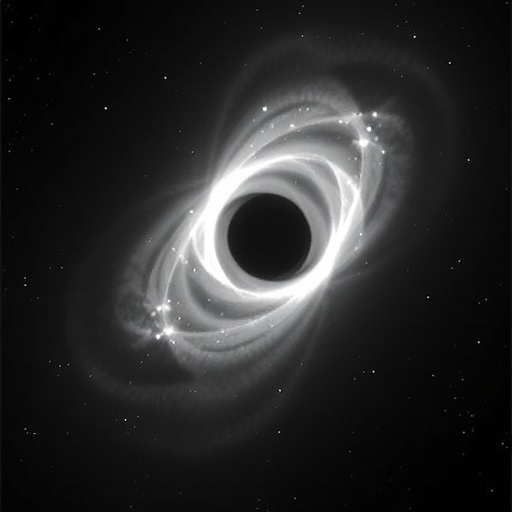
Black holes, enigmatic cosmic objects surrounded by extreme gravitational fields, continue to challenge astronomers’ understanding of high-energy astrophysical processes. One of the most fascinating phenomena arising from black hole accretion—the process by which matter spirals inward under gravity—are powerful outflows that can dramatically affect their surroundings. These outflows manifest primarily in two distinct forms: disk winds and relativistic jets. Recent groundbreaking observations have unveiled a compelling and previously elusive interplay between these two outflow mechanisms, shedding light on how energy and matter escape from the vicinity of black holes in X-ray binary systems.
In accreting black holes found in X-ray binaries, matter from a companion star forms an accretion disk as it spirals inward. The intense gravitational pull heats this disk to millions of degrees, causing it to emit copious amounts of X-rays. Embedded within or near this disk are two types of outflows: disk winds, composed of hot, ionized gas that escapes slowly and broadly from the disk, and relativistic jets, which are narrow, highly collimated streams of particles ejected at speeds approaching that of light. Despite extensive study over recent decades, the complex relationship and physical conditions that dictate whether a black hole launches winds, jets, or both simultaneously have remained shrouded in mystery.
The recent study led by Zhang, Jiang, Carotenuto, and collaborators marks a paradigmatic step forward by capitalizing on coordinated observations from NASA’s NICER X-ray observatory and South Africa’s MeerKAT radio telescope. These instruments targeted the recurrent black hole X-ray binary 4U 1630–472 during three distinct outbursts, capturing the detailed evolution of both wind and jet components. The team’s analysis revealed a striking anti-correlation: throughout each event, only one form of outflow—either a disk wind or a jet—was detected at any given time. This mutual exclusivity challenges prior frameworks that treated wind and jet production as potentially coexisting phenomena in black hole systems.
What makes this discovery even more compelling is that it holds true across epochs when the accretion luminosity remains within levels typical of a standard thin accretion disk. This contrasts with earlier studies that often linked jets to low/hard accretion states and winds to high/soft states, with transitions in outflow types thought to hinge largely on spectral state changes. Here, however, both winds and jets emerge within overlapping luminosity regimes, implying the accretion flow’s internal structure or energy distribution dynamically governs the switch between outflow modalities, rather than luminosity alone.
The key lies in how the accretion power is partitioned between the cooler, optically thick geometrically thin disk and its hotter, tenuous corona. The corona—comprised of high-energy electrons situated above and below the disk—plays a pivotal role in mediating outflows. When more accretion energy is channeled into the disk, radiation pressure likely drives powerful disk winds. Conversely, a robust corona may magnetically launch collimated jets along the black hole’s spin axe. This delicate competition between disk and corona energetics effectively toggles the dominant outflow, dictating whether the system vents energy broadly or narrowly.
The NICER instrument’s rich spectral resolution was instrumental in tracing wind signatures, such as blue-shifted absorption lines, which signify gas being pushed away from the inner disk at hundreds to thousands of kilometers per second. Simultaneously, MeerKAT’s unparalleled radio sensitivity enabled precise measurements of faint jet emission, revealing compact, relativistic particle acceleration during phases devoid of detectable wind absorption features. Combining these multiwavelength diagnostics allowed the researchers to construct a detailed chronology of outflow behavior, unprecedented in its clarity.
Moreover, the study underscores the time-dependent nature of these outflows. As the accretion flow evolves during an outburst, a phase favoring wind dominance can abruptly transition to one where jets emerge strongly, and vice versa. This dynamic interplay hints at underlying magnetohydrodynamic instabilities or changes in magnetic field topology that reshape the inner accretion environment. By linking wind and jet activity to geometrical and physical changes in the disk-corona system, the research offers fundamental constraints for theoretical models attempting to unify outflow production mechanisms.
This observed dichotomy also has profound implications for how black hole X-ray binaries feedback energy into their surrounding interstellar medium. Winds, being less collimated but mass-loaded, tend to distribute energy isotropically and can significantly influence disk chemistry and star formation over large volumes. Jets, on the other hand, pierce through the environment with focused kinetic power, driving shocks and inflating radio lobes. Understanding which outflow mode prevails under given conditions is therefore critical to unraveling the co-evolution of black holes and their host galaxies.
Perhaps equally exciting is the potential relevance of these findings beyond stellar-mass black holes. Supermassive black holes at the centers of galaxies also launch jets and winds, and the insights gained from 4U 1630–472 could illuminate accretion-outflow physics across vastly different mass scales. The concept that outflow modes are mutually exclusive and controlled by the accretion energy distribution may be a universal principle, crucial for interpreting active galactic nuclei variability and feedback phenomena.
As next-generation facilities come online, such as the enhanced X-ray ATHENA observatory and Square Kilometre Array (SKA) for radio astronomy, astronomers will be poised to systematically characterize outflow behavior in numerous X-ray binaries, refining and testing the mutual exclusivity paradigm. Long-term monitoring with high spectral and timing resolution will also probe the rapid transitions between wind and jet states, potentially revealing the magneto-rotational instabilities or reconnection events hypothesized to drive these changes.
In essence, the discovery reported by Zhang and colleagues decisively advances our grasp of black hole accretion physics by spotlighting a clear competition between disk winds and jets rather than coexistence. This offers a unifying framework where the dominance of one outflow mode over the other hinges on the intricate balance of energy dissipation in the accretion flow’s disk and corona. It compels theorists to rethink how angular momentum transport, magnetic field structure, and radiation pressure interplay to orchestrate the magnetic acceleration processes powering these cosmic jets and winds.
The mutual exclusivity of outflows also invites novel approaches to interpreting X-ray binary spectral states, emphasizing the multifaceted role of corona dynamics beyond standard disk-blackbody and power-law emission components. Such insights pave the way for holistic accretion models capturing the simultaneous generation of radiation, particles, and winds that shape the observable universe around these extreme black hole systems. Zhang et al.’s landmark observations thus not only unravel a fundamental accretion physics puzzle but reinvigorate the study of how black holes mold their cosmic neighborhoods through multifarious feedback channels.
Subject of Research: Black hole accretion outflows, X-ray binaries, disk winds, relativistic jets
Article Title: Evidence of mutually exclusive outflow forms from a black hole X-ray binary
Article References:
Zhang, Z., Jiang, J., Carotenuto, F. et al. Evidence of mutually exclusive outflow forms from a black hole X-ray binary.
Nat Astron (2026). https://doi.org/10.1038/s41550-025-02753-x
Image Credits: AI Generated
DOI: https://doi.org/10.1038/s41550-025-02753-x


