


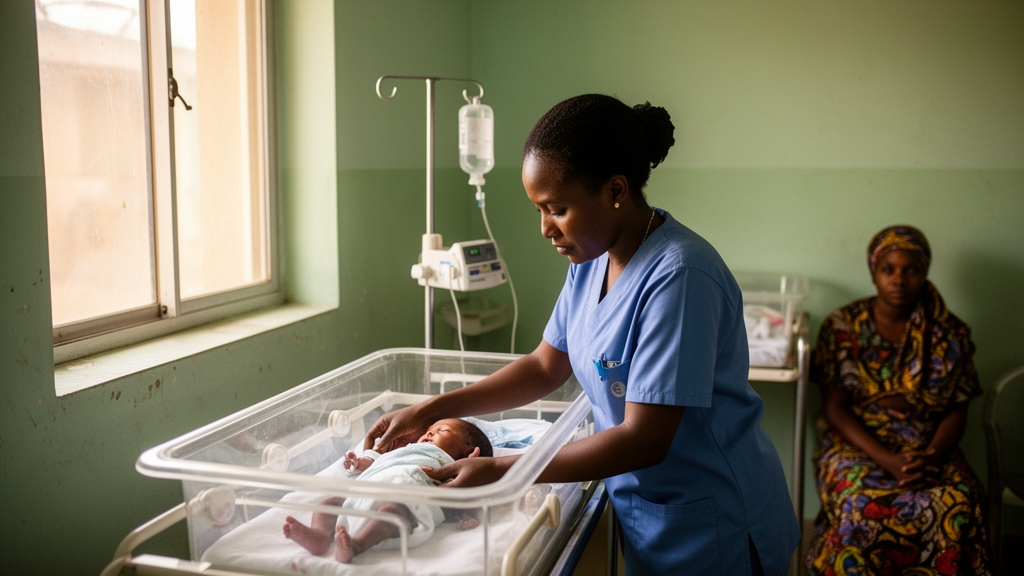
Each year, millions of families around the world face the devastating loss of a baby within the first four weeks of life. In 2022 alone, an estimated 2.3 million newborns died globally, which works out to roughly 6,500 deaths every single day. The overwhelming majority of these deaths, about 98 percent, occur in low- and middle-income countries, where access to skilled obstetric and neonatal care can be limited and health systems are often stretched to their limits. A new study from northern Ethiopia now offers a detailed picture of which factors are most strongly linked to these deaths in one of the regions where the burden is heaviest, and the findings point to several preventable causes that clinicians and policymakers can act upon.
The research, published in BMC Pediatrics, was conducted by Haftu Berhe Beyene of Lemlem Carl Hospital in Maichew and Selomon Weldemariam Gebrehiwet of Mekelle University. The two investigators set out to identify the determinants of neonatal mortality among babies admitted to the neonatal intensive care units of public general hospitals in the southern zone of Tigray, Ethiopia. Their work is grounded in a sobering epidemiological reality: while mortality among children under five has been falling worldwide, the rate of decline in neonatal mortality has been noticeably slower. Because the neonatal period is the most vulnerable window of human life, understanding precisely which clinical and obstetric factors drive deaths in this period is considered paramount for designing effective interventions.
Methodologically, the study took the form of an institution-based unmatched case-control design, a classic epidemiological approach in which infants who died (the cases) are compared with infants who survived (the controls) in order to isolate the characteristics associated with death. Rather than enrolling new patients, the researchers conducted a retrospective review of medical records, drawing on the charts of neonates admitted to the neonatal intensive care units of general hospitals in the southern zone of Tigray between 2017 and 2020. Using a systematic random sampling technique, they retrieved a total of 495 neonatal charts, comprising 165 cases and 330 controls, a two-to-one ratio of controls to cases that gives the analysis greater statistical power. The chart retrieval rate was an impressive 97 percent, which strengthens confidence that the sample was representative of the hospital population rather than skewed by missing records.
Once the data were assembled, the team entered them into EpiData Version 4.6 software and exported them to SPSS Windows Version 22 for statistical analysis. To test which factors were independently associated with mortality, the researchers employed multiple logistic regression, a technique that allows investigators to estimate the effect of each variable while controlling for the influence of all the others. They set the threshold for statistical significance at a P-value below 0.05, with results reported as adjusted odds ratios and 95 percent confidence intervals. This approach is standard in case-control research, and the use of adjusted odds ratios matters because crude associations can be misleading when potential risk factors overlap, as they frequently do in obstetric and neonatal care.
The results were striking. Five factors emerged as statistically significant predictors of neonatal death. Instrumental delivery, meaning delivery assisted by instruments such as forceps or vacuum, nearly tripled the odds of death, with an adjusted odds ratio of 2.96 and a 95 percent confidence interval of 1.56 to 5.64. Cesarean delivery was also associated with increased odds of mortality, with an adjusted odds ratio of 1.29 and a confidence interval of 1.29 to 3.41, reaching statistical significance at a P-value of 0.033. Birth asphyxia, the condition in which a baby is deprived of oxygen around the time of birth, proved to be one of the most powerful predictors, raising the odds of death nearly fivefold, with an adjusted odds ratio of 4.93 and a confidence interval of 2.40 to 10.14.
Infection proved to be the single strongest predictor in the study. Neonates who had infections faced more than five times the odds of death compared with those who did not, with an adjusted odds ratio of 5.08 and a 95 percent confidence interval of 2.95 to 8.76. This finding resonates with a large body of global evidence identifying neonatal sepsis and other infections as leading causes of newborn death in sub-Saharan Africa, where infection prevention practices, laboratory capacity, and timely access to antibiotics can all be constrained. The fifth significant factor was meconium aspiration syndrome, a serious respiratory condition that occurs when a newborn inhales a mixture of meconium and amniotic fluid into the lungs before, during, or shortly after delivery. Babies with this syndrome had nearly double the odds of death, with an adjusted odds ratio of 1.98 and a confidence interval of 1.22 to 3.23.
Taken together, these findings sketch a coherent clinical narrative. The significant predictors cluster around the circumstances of birth and the first days of life: how the baby was delivered, whether the baby suffered oxygen deprivation, whether infection took hold, and whether the airways were compromised by meconium. In other words, the study suggests that a substantial share of neonatal mortality in these hospitals is tied to events that happen during labor, delivery, and immediate newborn care, rather than to factors that are entirely outside the reach of the health system. That interpretation carries real weight for health planners, because events surrounding birth are precisely the points at which targeted interventions, from skilled birth attendance to prompt resuscitation and early treatment of infection, are known to save lives.
The authors conclude that mode of delivery, birth asphyxia, neonatal infections, and meconium aspiration syndrome were independently significant factors for neonatal mortality in their setting. Crucially, they argue that several of these factors may be amenable to improvement through strengthened intrapartum, postpartum, and neonatal care services. Their recommendations are specific: attention should be given to basic emergency obstetric and newborn care, neonatal intensive care unit services should be reinforced, and capacity building for health care providers should be prioritized. Each of these recommendations maps directly onto the risk factors identified in the analysis. Better management of labor and delivery could reduce the need for instrumental deliveries and improve outcomes when operative delivery is necessary. Newborn resuscitation training and equipment could blunt the impact of birth asphyxia. Vigilant infection prevention and early antibiotic treatment could address the strongest predictor of all, while improved airway management at birth could reduce deaths from meconium aspiration.
The study also carries broader significance in the context of global health targets. Neonatal mortality is widely regarded as a crucial indicator of neonatal health status and features prominently in international development frameworks, including the Sustainable Development Goals, which call for ending preventable deaths of newborns and children. The fact that almost all neonatal deaths occur in low- and middle-income countries means that context-specific evidence, such as this study from Tigray, is essential for translating global goals into local action. Generic strategies drawn from high-income settings may not fit the epidemiology of a regional hospital system in northern Ethiopia, where the mix of risk factors and the capacity of health services differ substantially. Studies like this one provide the granular, locally grounded data that health authorities need to decide where to invest scarce resources.
The research was supported by Mekelle University, which funded the data collection activities under grant reference CRPO/CHS/SM/09/20, although the funding did not cover publication costs and the university had no role in the study design, analysis, interpretation, or the decision where to publish. Ethical clearance was obtained from the Institutional Review Board of Mekelle University’s College of Health Sciences, with additional written permission from the Tigray Regional Health Bureau, and because the study relied on secondary data from medical records, confidentiality and anonymity were carefully maintained throughout. As the global health community continues to grapple with the slower pace of progress on newborn survival, this study from the general hospitals of southern Tigray delivers a clear message: the battle against neonatal mortality will be won or lost in the delivery room and the neonatal unit, and strengthening those frontline services is the most direct path to keeping more newborns alive.
Subject of Research: Determinants of neonatal mortality in public general hospitals in southern Tigray, Ethiopia
Article Title: Predictors of neonatal mortality among neonates admitted to public general hospitals in southern zone of Tigray, Ethiopia, 2021: unmatched case-control study
Article References: Beyene, H. B., & Gebrehiwet, S. W. (2026). Predictors of neonatal mortality among neonates admitted to public general hospitals in southern zone of Tigray, Ethiopia, 2021: unmatched case-control study. BMC Pediatrics. https://doi.org/10.1186/s12887-026-07731-4
Image Credits: AI Generated
DOI: 10.1186/s12887-026-07731-4
Keywords: neonatal mortality, birth asphyxia, neonatal sepsis, meconium aspiration syndrome, case-control study, Ethiopia, Tigray, neonatal intensive care, obstetric care, cesarean delivery, instrumental delivery, global health
Cite Scienmag News
Harold Sullivan. (October 9, 2026). Birth Complications Drive Neonatal Deaths in Ethiopian Hospitals, Study Finds. Scienmag. https://scienmag.com/birth-complications-drive-neonatal-deaths-in-ethiopian-hospitals-study-finds/
Harold Sullivan. "Birth Complications Drive Neonatal Deaths in Ethiopian Hospitals, Study Finds." Scienmag, 9 October 2026, https://scienmag.com/birth-complications-drive-neonatal-deaths-in-ethiopian-hospitals-study-finds/. Accessed 9 October 2026.
Harold Sullivan. "Birth Complications Drive Neonatal Deaths in Ethiopian Hospitals, Study Finds." Scienmag. October 9, 2026. https://scienmag.com/birth-complications-drive-neonatal-deaths-in-ethiopian-hospitals-study-finds/


