


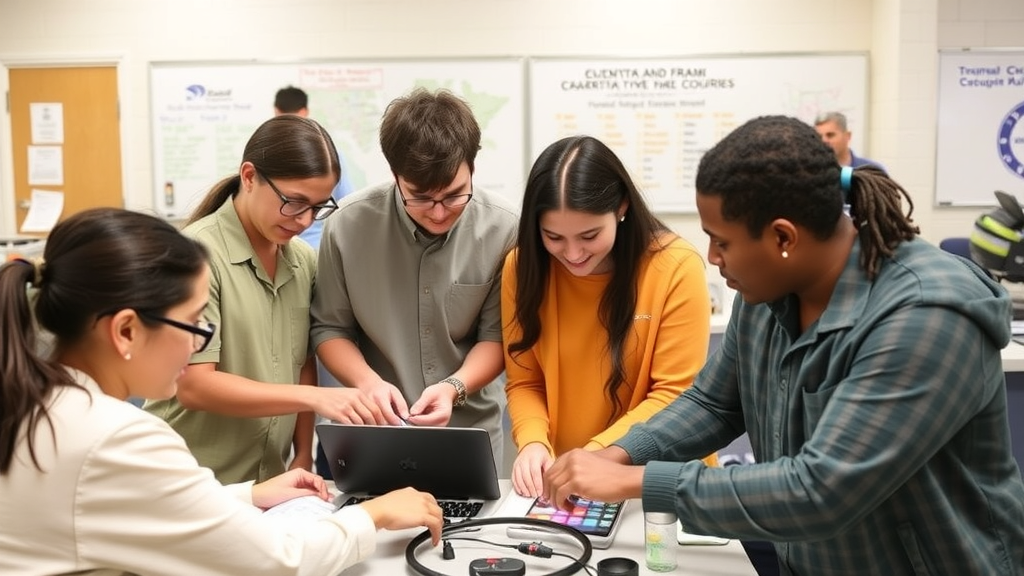
A junior-level bioinstrumentation course at Widener University has been rebuilt around a simple but powerful idea: engineering students learn circuits, sensors, and biosignals better when they have to explain them to children. A new study published in Biomedical Engineering Education describes how a required course for third-year biomedical engineering students was redesigned to weave service-learning directly into the technical core of the curriculum, rather than postponing real-world engagement to senior capstone projects or optional clinical immersions. The result, according to the author, is a framework that preserves rigorous engineering content while simultaneously building communication skills, civic identity, and professional confidence at an earlier stage of undergraduate education.
The challenge the framework addresses is well documented in biomedical engineering education. Core technical courses have long relied on didactic lectures, leaving students to absorb physiological measurement theory, amplifier design, and signal processing without frequent opportunities to apply those concepts in authentic contexts. Experiential learning, when it exists, is typically deferred to the final year, and capstone or clinical immersion experiences are not universally required. That delay can weaken student engagement, slow the formation of professional identity, and leave graduates underprepared for the communication demands of engineering practice. Prior surveys of biomedical engineering classrooms have identified persistent barriers to engagement, and large-scale studies of STEM teaching in North American universities have shown that lecture-dominated instruction remains the norm across many disciplines.
The redesigned course, developed by Ria Mazumder of the Department of Biomedical Engineering and the Center for Teaching and Learning at Widener University, integrates three interconnected interventions into a single scaffolded sequence. The first is a set of Arduino-based hands-on laboratories in which students work directly with physiological sensors, biosignal acquisition hardware, and microcontroller-controlled systems. Rather than treating the microcontroller platform as a toy demonstration, the course uses it as a genuine engineering tool: students build circuits that detect and record biological signals, program the acquisition pipeline, and interpret the resulting data with the same rigor expected of professional instrumentation work.
The second intervention, designated Phase 1, consists of community-engaged STEM workshops. Students take the concepts they have just mastered in the laboratory and translate them into accessible, hands-on demonstrations suitable for a non-technical youth audience. This translation step is not an afterthought but a deliberate pedagogical mechanism. Educational research on learning by teaching has shown that preparing to explain material to others produces measurable gains in the explainer’s own understanding, and the course exploits that effect by requiring students to distill amplifier theory, sensor physics, and signal processing into activities that children can grasp and enjoy.
The third intervention, Phase 2, escalates the challenge into team-based bioinstrumentation design projects implemented in partnership with a local Boys and Girls Club serving underrepresented youth. Student teams design, build, and refine instrumentation prototypes, then deliver them as interactive experiences for the club’s members. The partnership gives the engineering students an authentic client community with real constraints, while giving the young participants early exposure to engineering role models and hands-on science, a pairing the author argues supports both technical learning and civic development on both sides of the relationship.
Assessment of the redesigned course relied on descriptive data, including student surveys and written reflections. The results indicate strong engagement and perceived gains across technical, communication, and professional competencies mapped to the outcomes required by ABET, the accreditation body for engineering programs. Students reported that the service-learning structure helped them connect abstract theory to practice, sharpened their ability to communicate with non-technical audiences, and strengthened their sense of civic identity. These themes recurred across the reflection data, suggesting that the benefits were not confined to a handful of unusually motivated participants but represented a broad pattern in the cohort’s experience.
The theoretical grounding of the framework draws on several established strands of educational scholarship. Kolb’s experiential learning cycle positions concrete experience as the engine of learning and development, and the course operationalizes that cycle by moving students from laboratory experience to community application to structured reflection. Lave and Wenger’s model of situated learning frames expertise as legitimate participation in a community of practice, which the Boys and Girls Club partnership supplies in concrete form. The service-learning literature itself, including foundational work by Bringle and Hatcher and later distinctions between traditional and critical service-learning by Mitchell, informs the design’s emphasis on reciprocal community benefit rather than one-way outreach.
What distinguishes the framework from earlier service-learning efforts in engineering is its placement and its scaffolding. Service projects have historically been concentrated in capstone design courses, where they compete with the logistical pressures of a final-year project, or offered as standalone electives that reach only a subset of students. By embedding service-learning in a required junior-level core course, the model guarantees that every student encounters community-engaged engineering before the final year. The three-phase scaffold, moving from guided laboratories to workshops to open-ended design, gives students a graduated pathway into that experience, lowering the barrier that often discourages instructors from adding experiential components to technically dense courses.
The practical implications extend beyond Widener University. The author describes the framework as scalable and transferable, and the ingredients are deliberately modest: a low-cost microcontroller platform, a structured laboratory sequence, and a community partner willing to host student-led activities. The work was supported by external funding from a PECO Grant and a PEEP Grant awarded twice, along with internal Faculty Development and Course Mini-Grant support, suggesting that the resource requirements are within reach of many institutions. For programs seeking to satisfy ABET’s professional and societal competency outcomes without diluting technical content, the study offers a concrete template rather than an abstract aspiration.
The broader significance lies in what the model says about when professional formation should begin. If identity as an engineer, communicator, and civic participant crystallizes through repeated authentic practice, then deferring those experiences to the senior year forfeits years of development. The Widener experiment suggests that a core bioinstrumentation course, often considered one of the most technically demanding stops in the biomedical engineering curriculum, can simultaneously serve as a site of community engagement without sacrificing rigor. As biomedical engineering programs continue to grapple with engagement challenges and evolving accreditation expectations, the study offers evidence that the classroom and the community need not be competing priorities, but can be mutually reinforcing components of a single, well-scaffolded educational design.
Subject of Research: Integration of service-learning into a junior-level biomedical engineering bioinstrumentation course
Article Title: Embedding Service-Learning in a Core Junior-Level Bioinstrumentation Course: A Practical Framework for Integrating Technical Rigor with Professional and Societal Competencies
Article References: Embedding Service-Learning in a Core Junior-Level Bioinstrumentation Course: A Practical Framework for Integrating Technical Rigor with Professional and Societal Competencies. (n.d.). https://doi.org/10.1007/s43683-026-00250-9
Image Credits: AI Generated
DOI: 10.1007/s43683-026-00250-9
Keywords: service-learning, bioinstrumentation, biomedical engineering education, experiential learning, Arduino, community-engaged learning, ABET outcomes, STEM education, professional skills development, Widener University, Boys and Girls Club, curriculum design
Cite Scienmag News
Denise Maddox. (September 20, 2026). Bioinstrumentation Course Turns Engineering Students Into Community Teachers. Scienmag. https://scienmag.com/bioinstrumentation-course-turns-engineering-students-into-community-teachers/
Denise Maddox. "Bioinstrumentation Course Turns Engineering Students Into Community Teachers." Scienmag, 20 September 2026, https://scienmag.com/bioinstrumentation-course-turns-engineering-students-into-community-teachers/. Accessed 5 October 2026.
Denise Maddox. "Bioinstrumentation Course Turns Engineering Students Into Community Teachers." Scienmag. September 20, 2026. https://scienmag.com/bioinstrumentation-course-turns-engineering-students-into-community-teachers/


