

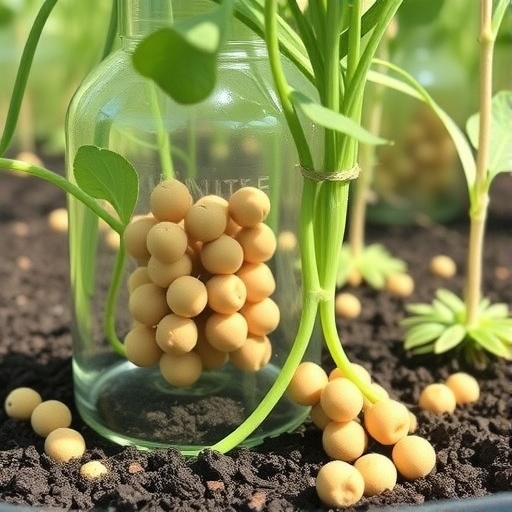
In the realm of modern agriculture, sustainable practices are essential for addressing the growing concerns over food security and environmental preservation. Among the innovative approaches gaining traction, the integration of beneficial microorganisms, particularly biofilm-forming agents, has emerged as a pivotal focus. A groundbreaking study spearheaded by Kashyap et al. unveils the development of a remarkable biofilm inoculant composed of the fungi Trichoderma and the bacteria Bacillus. This novel concoction holds the promise of significantly enhancing plant growth while simultaneously mitigating the impacts of devastating soil-borne pathogens like Sclerotium and Fusarium, especially in chickpea cultivation.
Biofilms represent complex communities of microorganisms that exhibit enhanced resilience compared to their planktonic counterparts. This study dives deep into the mechanisms underlying the formation of these biofilms, emphasizing their role in establishing a protective barrier for plants against harmful pathogens. The symbiotic relationship between the mycelium of Trichoderma and the bacterium Bacillus creates a multifaceted defense system, allowing for effective colonization of plant roots and prevention of pathogen invasion. The dual-action approach not only promotes plant growth but also contributes to soil health, creating a sustainable agricultural framework.
Chickpeas, a staple in many diets worldwide, face considerable threats from pathogenic fungi that can decimate yields and compromise food security. Sclerotium and Fusarium species, notorious for their destructive attributes, pose significant challenges to chickpea farmers. The research conducted by Kashyap and colleagues addresses this urgent issue by demonstrating how the Trichoderma-Bacillus biofilm inoculant can significantly reduce the incidence of these pathogens. This finding is not only a technical achievement but also a beacon of hope for farmers struggling with crop losses year after year.
One of the critical components of this study involves the meticulous process of developing the biofilm inoculant. The researchers utilized advanced techniques to optimize the growth conditions for both Trichoderma and Bacillus, ensuring their compatibility and functionality within the biofilm context. Enhanced biofilm formation was achieved through a variety of growth mediums and environmental conditions, showcasing the meticulous experimental design that underscores the reliability of the findings. The researchers also investigated the genetic mechanisms that enable these microorganisms to thrive in concert, painstakingly documenting the biochemical pathways involved.
Field trials are critical in establishing the efficacy of any agricultural innovation. In this regard, the research team undertook extensive field assessments, applying the biofilm inoculant to chickpea crops. The results were striking; not only did the treated plants exhibit robust growth, but they also demonstrated remarkable resistance to the targeted pathogens. These field trials serve as a compelling testament to the potential of this biofilm mixture to revolutionize chickpea farming, offering farmers an eco-friendly alternative to synthetic chemicals often employed to combat pests.
In evaluating the biofilm’s role in enhancing plant health, researchers noted a substantial uptick in the plants’ physiological parameters. The benefits observed included increased root biomass, enhanced nutrient uptake, and improved overall plant vigor. Such advantages highlight the crucial role microorganisms play in facilitating the sustainable growth of crops. Furthermore, the study delves into the synergistic effects of Trichoderma and Bacillus, emphasizing how their joint presence leads to superior outcomes compared to applying either microorganism alone. This key discovery could pave the way towards new standards in biofertilizers and pest management strategies.
Sustainability is at the forefront of global agricultural research, and the contributions made by Kashyap and his team align seamlessly with this goal. Not only does their work propose a natural solution to pest control, but it also reduces reliance on harmful chemical inputs that can adversely affect soil health and biodiversity. The implications extend beyond chickpea cultivation; the principles derived from this research could be adapted for various crops and farming systems, enhancing resilience across the agricultural landscape.
Moreover, the economic ramifications of implementing such biofilm technologies cannot be overstated. By reducing dependency on chemical pesticides and fertilizers, farmers could significantly lower their operational costs while promoting healthier ecosystems. The competitive advantage offered by this innovative approach may encourage widespread adoption, ultimately leading to a more sustainable agricultural industry. A transition towards bio-based agriculture could mitigate environmental degradation while still meeting the food demands of a growing global population.
Looking forward, the study posits that further research is necessary to explore the broader applications of the Trichoderma-Bacillus biofilm inoculant. There is a pressing need to identify additional strains and variants that may enhance the effectiveness of biofilm formulations. Understanding the dynamics of various microorganisms in agricultural settings will be critical in tailoring solutions specific to different crops and cultivation practices. Collaborative efforts among researchers, agronomists, and farmers will be instrumental in implementing and scaling these innovative solutions.
As these technologies gain traction in agronomy, the study by Kashyap et al. could serve as a template for future research endeavors. Establishing robust methodologies for the development of biofilm inoculants could open new avenues for scientific investigation, leading to further innovations in sustainable agricultural practices. The pathway to harnessing the full potential of plant-associated microorganisms continues to be a thrilling field of study, promising an era of agriculture that is as productive as it is sustainable.
The journey of turning research into practice is never straightforward, yet the excitement surrounding the applications of biofilm technology is palpable. With continued advancements and a better understanding of plant-microbe interactions, the agricultural community stands on the brink of a paradigm shift. Solutions that once felt like distant possibilities are now within reach, ready to support a new generation of sustainable farming practices.
As this pivotal research unfolds, its impact may prove profound. The world watches closely as the agricultural sector seeks innovative solutions to pressing challenges, including pest resistance, soil health, and food security. With studies like that of Kashyap et al. paving the way, the integration of biofilm technology into our agricultural systems might just be the watershed moment we’ve been waiting for.
In conclusion, the work presented by the team serves as a powerful reminder of the untapped potential lying within the microbial world. As they forge ahead with their research, the implications for both plants and farmers remain significant and promising. This biofilm inoculant stands poised to redefine agricultural practices, ushering in a new era where sustainability and productivity go hand in hand.
Subject of Research: Development of a Trichoderma-Bacillus biofilm inoculant for plant growth and pathogen biocontrol.
Article Title: Development of a Trichoderma–Bacillus biofilm inoculant for plant growth promotion and biocontrol of Sclerotium and Fusarium in chickpea.
Article References:
Kashyap, A.S., Kannojia, P., Manzar, N. et al. Development of a Trichoderma–Bacillus biofilm inoculant for plant growth promotion and biocontrol of Sclerotium and Fusarium in chickpea. Discov Sustain (2026). https://doi.org/10.1007/s43621-025-02356-6
Image Credits: AI Generated
DOI: 10.1007/s43621-025-02356-6
Keywords: Trichoderma, Bacillus, biofilm, chickpea, plant growth promotion, biocontrol, sustainable agriculture, Sclerotium, Fusarium.


