


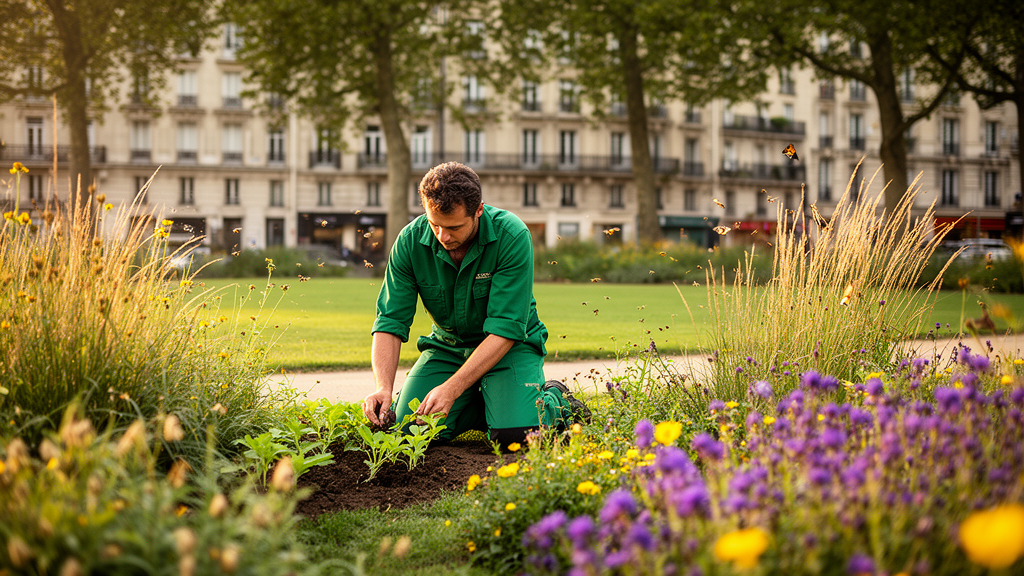
A sweeping survey of European municipalities has found that biodiversity is no longer an afterthought in urban green space planning — it is now a central motivation for the people who design and manage the parks, lawns and green corridors of Europe’s cities. Researchers questioned 574 municipalities across 18 European countries and discovered that 85 percent of them consider biodiversity a key motivation in how they plan and manage public green spaces. The findings, published in the journal Nature Cities, offer one of the first broad, expert-based pictures of how Europe’s city administrations view the ecological condition of their own urban nature, and what they are doing to make it better.
The scale of the survey is notable. Responses came from countries as diverse as Germany, France, Denmark, Slovenia, Latvia and Luxembourg, with 612 individual responses collected between April 2023 and May 2024. Each questionnaire targeted the individual responsible for fundamental decisions about public green space in their municipality — from small towns of a few hundred residents to metropolises like Berlin, Paris and Vienna. The survey was translated into national languages to avoid misunderstandings, and participation was voluntary. The geographic spread spanned northern, southern, eastern and western Europe, although the authors acknowledge that voluntary participation left some gaps in representation.
The headline numbers are striking. Beyond the 85 percent of municipalities naming biodiversity as a key motivation, 82 percent reported providing training on biodiversity-friendly management to city administrators and staff. Three quarters said they take active steps to increase public acceptance of biodiversity-promoting management — a recognition that ecologically valuable practices, such as leaving leaf litter or letting vegetation grow wilder, can look untidy to residents accustomed to manicured lawns. Slightly more than half, 54 percent, involve their populations directly in green space planning and design, potentially seeding bottom-up initiatives for urban nature.
Yet biodiversity is far from the only goal. When respondents rated the importance of 13 goals for green space planning and management, the four highest-ranked were all related to the well-being of urban citizens. Promoting biodiversity ranked fifth, rated rather or very important by 83 percent of respondents. Twelve of the 13 goals were rated important by more than half of respondents; the lone exception was creating opportunities for urban gardening — the growing of fruits and vegetables in cities — which only 38 percent considered rather or very important, while 34 percent rated it as rather not or not at all important. The authors see in these results a clear demand for multifunctional green space, but also a risk of conflict between goals such as visual appearance, recreation and ecological value.
The survey also probed how municipalities perceive the ecological state of their own urban nature. Over half — 57 percent — rated the current state as good or very good, while only 11 percent considered it poor or very poor. A large majority, 68 percent, perceived improvement over the past decade, although about one in five — 19 percent — reported deterioration, which the researchers suggest could reflect ongoing losses in the quantity or quality of green space driven by urban development and increasing impervious cover. These are expert-based perceptions rather than detailed ecological measurements, but they offer a coarse and, until now, largely unavailable assessment of where European urban nature stands.
Statistical analysis revealed intriguing links between municipal characteristics and biodiversity priorities. The likelihood that biodiversity was considered a basic motivation increased significantly with the proportion of impervious, sealed surface in a municipality, and with a higher national quality-of-life index. The authors suggest a rationale: highly sealed municipalities often have limited green space, and expanding it through de-sealing is difficult, so improving the ecological quality of what already exists may be the most feasible strategy. The association with quality of life may reflect a shift toward post-materialist values, in which administrations can look beyond basic human needs and embrace the idea of multispecies coexistence in cities.
Other patterns followed similar fault lines. Training opportunities were more likely in municipalities with higher impervious cover, more northern locations and higher national quality-of-life indices. Citizen involvement in planning increased with both quality of life and population size, while actions to boost public acceptance rose with impervious cover and larger populations. The authors point to structural inequalities: wealthier, larger municipalities may have the financial and institutional resources for participatory processes and benefit from denser networks of universities, while those in countries with lower quality-of-life indices may be occupied with pressing challenges like housing, healthcare and transport, limiting their capacity to engage with biodiversity initiatives even when benefits are recognized.
Geography also colored perceptions. Municipalities further east were more likely to rate the current state of their urban nature as ecologically valuable, while those further south rated it less favorably — possibly because summer-dry southern cities, battered by heatwaves and water shortages, have green spaces that appear less lush and attractive. Perceived improvement over the past decade was higher in countries with lower quality-of-life indices. The authors stress that such regional and cultural differences matter for policy: frameworks aiming to support biodiversity-promoting management must be locally adaptable rather than uniform, a point reinforced by the finding that sealed, densely built municipalities are already those most committed to ecological improvement.
The study arrives at a politically significant moment. Current European Union indicators under the Nature Restoration Regulation focus primarily on the quantity of urban green space, whereas this survey offers insight into its ecological quality — the diversity of species and habitats that green space actually supports. The authors see encouraging momentum, suggesting that the positive trends they document might strengthen as European policy frameworks place growing emphasis on urban ecosystems, and they hope their results will inform targeted communication and locally adjustable strategies for municipalities.
Important caveats remain. Responses were collected from a single representative per municipality, which may not capture the full range of perspectives within local administrations, though the large number of municipalities mitigates this. Impervious cover was calculated from built-up surface within administrative unit boundaries that can include farmland or forest beyond the city center, potentially diluting the measure for some municipalities. The ecological assessments are expert judgments, not systematic habitat surveys, and more detailed evaluations of urban habitats will be needed to prioritize restoration. Still, the core message is clear: Europe’s municipalities overwhelmingly view biodiversity as a goal worth pursuing alongside — not instead of — the needs of their citizens, and balancing the two will define the next chapter of urban green space governance.
Subject of Research: A European survey of municipal green space planning and biodiversity priorities
Article Title: Biodiversity is a key motivation for European urban green space planning and management
Article References: De Vrieze, E., Krouthén, A. S., Baeten, L., Deák, B., Valkó, O., Moesch, S. S., Barot, S., Drejerska, N., Fischer, L. K., Garcia Antúnez, O., Gernow, L., Gonçalves, P., Grilo, F., Kamenečki, M., Krstonošić, D., Lampinen, J., Lata, J.-C., Mudrák, O., Neuenkamp, L., … Klaus, V. H. (2026). Biodiversity is a key motivation for European urban green space planning and management. Nature Cities. https://doi.org/10.1038/s44284-026-00537-6
Image Credits: AI Generated
DOI: 10.1038/s44284-026-00537-6
Keywords: urban biodiversity, green space management, municipalities, Europe, survey, urban ecology, Nature Cities, impervious cover, public acceptance, quality of life, urban planning, ecological restoration
Cite Scienmag News
Margaret Porter. (October 23, 2026). Biodiversity emerges as a leading driver of urban green space management across Europe. Scienmag. https://scienmag.com/biodiversity-emerges-as-a-leading-driver-of-urban-green-space-management-across-europe/
Margaret Porter. "Biodiversity emerges as a leading driver of urban green space management across Europe." Scienmag, 23 October 2026, https://scienmag.com/biodiversity-emerges-as-a-leading-driver-of-urban-green-space-management-across-europe/. Accessed 23 October 2026.
Margaret Porter. "Biodiversity emerges as a leading driver of urban green space management across Europe." Scienmag. October 23, 2026. https://scienmag.com/biodiversity-emerges-as-a-leading-driver-of-urban-green-space-management-across-europe/


