

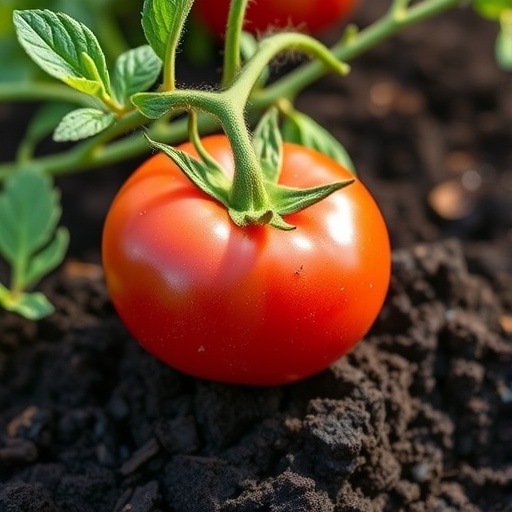
In the ongoing quest to sustainably enhance agricultural productivity, a groundbreaking study has emerged showcasing the remarkable power of integrating biochar with phosphate-solubilizing bacteria. This innovative synergy has demonstrated unprecedented improvements in phosphorus bioavailability, root system development, and fruit production in greenhouse cherry tomato cultivation, illuminating new pathways for nutrient-efficient, eco-friendly farming practices.
Phosphorus, a crucial macronutrient for plant metabolic processes such as energy transfer, photosynthesis, and nucleic acid synthesis, often remains immobilized in soil matrices, thereby limiting its accessibility to crops. Such phosphorus fixation drives the excessive application of chemical fertilizers, engendering economic burdens for farmers alongside severe environmental repercussions, including eutrophication. Addressing this biochemical bottleneck, the research team engineered a biochar-based microbial consortium harnessing the abilities of Bacillus species known for phosphate solubilization.
Biochar, a carbon-rich material derived from the pyrolysis of biomass, serves a dual function in this system: it improves soil physical properties like porosity and water retention while acting as a protective carrier substrate that enhances bacterial survival and activity in the rhizosphere. By loading biochar with phosphate-solubilizing Bacillus strains, the study crafted a composite amendment that effectively mobilizes occluded phosphorus pools, transforming unavailable forms into plant-accessible orthophosphate ions.
Quantitative soil assays revealed that application of this biochar-Bacillus consortium led to a remarkable 170 percent increase in microbial biomass phosphorus within the rhizosphere, underscoring an intensified microbial phosphorus turnover. Concomitantly, alkaline phosphatase activity – a pivotal enzymatic driver in organic phosphorus mineralization – was significantly elevated, signifying enhanced enzymatic hydrolysis of complex organic phosphorus compounds. These biochemical modulations collectively elevated soil phosphorus solubility and accessibility beyond levels attainable by biochar or microbial inoculants alone.
The benefits imparted by this soil amendment translated strongly into plant physiological and morphological improvements. Detailed root imaging analyses illustrated pronounced enhancements in root length, surface area, and branching architecture compared to control plants. Such architectural modifications are critical determinants of soil exploration capacity and nutrient absorption efficiency, directly correlating with improved plant vigor.
Remarkably, these enhancements extended beyond vegetative growth. The study documented substantial shifts in inflorescence architecture, where the treated tomato plants exhibited increased ratios of fruit-bearing branches. Though the average weight per fruit showed a marginal decrease, this was offset by a significant rise in total fruit number, culminating in an impressive net yield increase exceeding 23 percent relative to conventional fertilization regimes.
Microscopic and molecular examinations of the soil microbiome exposed a reshaping of microbial community dynamics within treated soils. The biochar matrix preferentially supported populations of Bacillus and other plant growth-promoting rhizobacteria, allowing them to dominate and displace less beneficial or neutral microbial taxa. This selective microbial proliferation fosters enhanced nutrient cycling efficiency and exerts a positive feedback loop augmenting plant nutrient acquisition and growth.
This study not only elucidates key mechanistic insights underpinning biochar-microbe synergisms but also addresses a critical global challenge: the sustainable management of phosphorus, an element imperative for global food security yet constrained by finite natural reserves. Conventional phosphorus fertilization is both economically and ecologically untenable over the long term, emphasizing the import of strategies that unlock inherent soil phosphorus pools.
The practical implications of this research are particularly significant for intensive greenhouse systems, where nutrient imbalances and soil degradation are prevalent due to high cultivation densities and rapid nutrient turnover. Employing biochar-Bacillus consortia offers a scalable and environment-friendly alternative to augment soil fertility, reduce synthetic fertilizer dependence, and mitigate the environmental footprint of crop production.
By integrating biochar technology with microbial biotechnology, this study paves the way for nature-based agricultural solutions that harmonize productivity with ecosystem health. It exemplifies how harnessing microbial functions through tailored soil amendments can fundamentally shift nutrient dynamics and plant developmental trajectories, producing more resilient and resource-efficient cropping systems.
As global populations escalate and arable land per capita diminishes, such innovations will be instrumental in ensuring sustainable intensification of agriculture. Enhancing nutrient use efficiency while maintaining or elevating yields is paramount for food security, making this biochar-Bacillus synergy a promising frontier in agronomic research and application.
In conclusion, this study substantiates the multifaceted benefits of combining biochar with phosphate-solubilizing Bacillus strains to create an effective consortium that not only alleviates phosphorus limitation but also optimizes plant growth architecture and productivity. As we advance toward resilient agricultural paradigms, embracing such microbial-assisted biochar technologies heralds a transformative approach aligned with environmental stewardship and agronomic advancement.
Subject of Research:
Phosphorus bioavailability enhancement and its effects on root architecture and inflorescence development in greenhouse-grown cherry tomatoes using biochar–Bacillus microbial consortia.
Article Title:
Synergistic biochar‑Bacillus consortium enhances phosphorus availability, root architecture, and inflorescence development in greenhouse cherry tomato.
News Publication Date:
1-Mar-2026
Web References:
http://dx.doi.org/10.1007/s42773-026-00586-z
References:
Liu, S., Shi, Y., Zhang, A. et al. Synergistic biochar‑Bacillus consortium enhances phosphorus availability, root architecture, and inflorescence development in greenhouse cherry tomato. Biochar 8, 66 (2026).
Image Credits:
Sainan Liu, Yongjia Shi, Aijia Zhang, Yuwei Huang, Dianyun Cao & Yu Lan
Keywords
Biochar, Bacillus, phosphorus availability, phosphate solubilization, root architecture, inflorescence development, greenhouse tomatoes, soil microbiome, microbial consortia, sustainable agriculture, nutrient cycling, crop yield enhancement


