


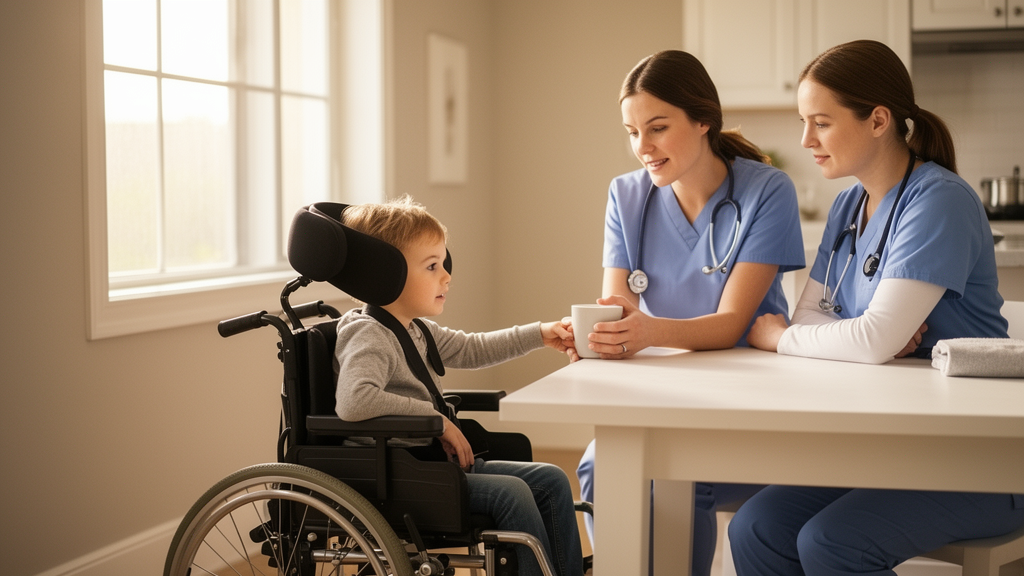
When a child survives a stroke, a car crash, a brain tumor, or encephalitis, the medical system mobilizes with impressive speed. Emergency teams stabilize the injury, specialists prevent secondary damage, and rehabilitation therapists begin the painstaking work of rebuilding motor, cognitive, and socio-emotional function. Then, at some point, the formal treatment ends. The child goes home. And for a surprising number of families, that is exactly when the hardest part begins.
A new Perspective article published in Frontiers in Rehabilitation Sciences argues that this moment of discharge is where pediatric medicine has been getting it wrong for decades. Led by Christiaan Gmelig Meyling of the Netwerk Kind & NAH research hub and the UMC Utrecht Brain Center, together with colleagues spanning rehabilitation medicine, pediatric psychiatry, oncology, and parental advisory boards, the paper proposes that care for childhood acquired brain injury should abandon its phase-based, healthcare-centered model entirely. In its place, the authors call for a developmental, trans-sectoral system of support that follows children across healthcare, education, youth services, and community life for as long as their developing brains demand it.
The scale of the problem is anything but niche. Acquired brain injury, or ABI, refers to any non-congenital brain injury occurring after birth, encompassing both traumatic etiologies like traffic accidents and falls and non-traumatic ones such as stroke, brain tumors, encephalitis, and hypoxic injury. Pediatric ABI is a major cause of death and long-term disability among children worldwide. Reported global incidence of pediatric traumatic brain injury varies enormously by country, generally falling between 47 and 280 per 100,000 children. In the Netherlands alone, extrapolation of hospital-based data suggests roughly 19,000 children and young people aged 0 to 24 receive a diagnosis of traumatic or non-traumatic brain injury every year.
What makes pediatric ABI fundamentally different from adult brain injury is that it strikes a brain still under construction. The injury disrupts ongoing developmental trajectories across physical, cognitive, behavioral, emotional, and social domains, which means difficulties may not reflect the immediate effects of the injury at all. Instead, they can emerge or become noticeable years later, as developmental, educational, and social demands increase. Researchers describe this phenomenon as growing into deficit: a child with apparently subtle impairments at age six may hit a wall at fourteen, when abstract reasoning, social navigation, and academic pressure ramp up. Difficulties frequently surface during transitions, such as changing schools, entering adolescence, or even when everyday support systems shift, like a new teacher or sports coach who does not know the child’s history.
The conventional care pathway follows three interconnected phases. The acute phase focuses on diagnostics, medical stabilization, and prevention of secondary neurological damage. The subacute rehabilitation phase delivers multidisciplinary therapy for children with moderate to severe impairments. The chronic phase shifts toward optimizing participation in daily life. But there is a critical blind spot: children with initially mild impairments are often discharged home without structured follow-up, placing them at risk for delayed identification of emerging problems. Severity indicators used in acute care, such as the Glasgow Coma Scale and duration of post-traumatic amnesia, are useful for early medical decisions but have limited value for predicting long-term functioning. Children with apparently mild injuries may develop persistent difficulties, while others with severe injuries adapt relatively well in supportive environments. Outcomes, the authors stress, are not determined by injury characteristics alone but by the dynamic interaction between neurological impairment, developmental processes, child factors, and the family and environmental context.
To capture this complexity, the team introduces the term pediatric ABI with complex consequences, abbreviated ABI+. Crucially, this is not proposed as a new diagnostic category. It is a descriptive term identifying a vulnerable population: children and youth with persistent or emerging difficulties across multiple domains of functioning after brain injury, spanning physical and cognitive functions, daily functioning and participation, contextual factors, and risk and safety. A central feature is that complexity emerges through the dynamic interaction between the child and everyday contexts. Neurobehavioral difficulties are often the most prominent long-term consequences, and they may resemble symptoms of attention-deficit hyperactivity disorder, oppositional defiant disorder, anxiety, depression, or autism spectrum disorder, complicating clinical interpretation and care allocation. Children and families often bounce between neurological, rehabilitation, and mental health services without a shared understanding or language for what happened to them.
The structural mismatch between developmental trajectories and the organization of care becomes glaring during the transition from rehabilitation to daily life. Rehabilitation services, mental health care, educational systems, and social support are typically organized in separate sectors with distinct professional frameworks and funding structures. Collaboration across sectors often depends on individual professionals rather than embedded coordination structures. After formal rehabilitation ends, access to specialized ABI expertise becomes limited, while responsibility for identifying emerging difficulties shifts to schools, general practitioners, youth care providers, and community professionals who may struggle to link behavioral or learning difficulties to a brain injury that occurred years earlier. The knowledge gained during rehabilitation does not automatically translate into classrooms, sports fields, or family life. Within this fragmented landscape, each professional observes only part of the child’s functioning, and no single service has sufficient overview of the developmental trajectory. Families frequently become the de facto coordinators of care, navigating multiple systems on top of an already overwhelming situation. Without adequate coordination, evolving difficulties can accumulate into physical challenges, mental health problems, school failure, family stress, and reduced social participation.
The Dutch response to this systemic failure offers a transferable blueprint. The Dutch Pediatric ABI Network, known as Netwerk Kind & NAH, was established with a systemic, trans-sectoral approach that refuses to concentrate expertise within specialized institutions. Instead, it operates through a layered model. At the local level, six regional expertise centers provide family-centered guidance, bridging the transition from clinical rehabilitation to everyday life. Case managers conduct an initial inventory of the child’s and family’s concerns, help clarify the nature of emerging problems, and know how to navigate the care landscape to connect families to appropriate expertise across sectors. They also serve as accessible points of contact for schools and community services, translating specialized knowledge into practical strategies and identifying emerging developmental challenges early. At the national level, two diagnostic expertise centers integrate expertise from rehabilitation medicine, psychiatry, neurology, neuropsychology, and psychosocial disciplines, providing comprehensive multidisciplinary functional assessment and treatment advice for children with complex neurobehavioral challenges. Regional case managers can consult these centers directly, ensuring consistency across levels.
The network also functions as a research and knowledge hub, bringing together three complementary forms of knowledge: professional expertise, lived-experience knowledge, and research-based knowledge. Its role is to support knowledge development, gather questions and needs from practice and families, translate knowledge into usable tools, and disseminate insights across the network. Innovations from research can be implemented in everyday care and educational settings, while challenges encountered in daily life directly inform research priorities and policy agendas. A structural parent and lived-experience advisory group ensures that families contribute to defining what constitutes good care, operationalizing the principle of nothing about us without us. The development has been supported by the Dutch national program for Knowledge Networks for Specific Target Groups, funded by the Ministry of Health, Welfare and Sport and coordinated by ZonMw, with start-up funding from the Dutch Healthcare Authority supporting pediatric ABI case managers. Continued funding is contingent upon ongoing development of expertise, collaboration, and demonstrable impact.
The authors are candid about the lessons and limitations of their pioneering effort. Trans-sectoral collaboration requires both commitment and structure: the network grew initially through voluntary collaboration and professional commitment, but sustainable collaboration cannot rely solely on personal relationships, so formalized care pathways, consultation structures, and shared working procedures become increasingly important as the network matures. Family involvement must be structurally embedded, not tokenistic. Major challenges remain, including sustainable funding across multiple legislative and financial systems, the absence of standardized criteria for defining the ABI+ population, incomplete nationwide coverage and equitable access, and the need for sustainable data infrastructures. The low prevalence and high heterogeneity of pediatric ABI+ make it difficult for individual institutions to generate robust evidence on long-term outcomes, so structured longitudinal data collection across the network is essential, requiring agreement on shared outcomes, data governance, privacy safeguards, and long-term investment. The authors envision pediatric ABI networks as learning systems in which clinical practice, research, implementation, policy, and lived experience continuously inform each other. The Dutch Government has already recognized the ABI+ term as identifying a population at risk for long-term community support needs. Whether this model delivers its intended impact remains to be formally evaluated, with future assessment planned across process indicators like regional coverage and waiting times, and outcome indicators reflecting what matters over time for children and families, including goal attainment, family centeredness, caregiver burden, well-being, participation, school functioning, and continuity of support. If the approach proves out, it could reshape how medicine thinks about childhood brain injury everywhere: not as an episode to be treated, but as a developmental course to be accompanied.
Subject of Research: Neuroscience
Article Title: Beyond rehabilitation: toward developmental and trans-sectoral systems of support for complex acquired brain injury in children
Article References: Gmelig Meyling, C., Bakker, S., Reinders, M., Voorman, J., Oude Ophuis, B., Blenk, G., van der Lei, H., Ketelaar, M., Donkervoort, M., & Gorter, J. W. (2026). Beyond rehabilitation: toward developmental and trans-sectoral systems of support for complex acquired brain injury in children. Frontiers in Rehabilitation Sciences, 7, Article 1936032. https://doi.org/10.3389/fresc.2026.1936032
Image Credits: AI Generated
DOI: 10.3389/fresc.2026.1936032
Keywords: acquired brain injury, pediatric rehabilitation, ABI+, trans-sectoral care, integrated care networks, child development, Netwerk Kind & NAH, growing into deficit, family-centered care, learning health systems, Beyond, rehabilitation
Cite Scienmag News
Cassandra Pierce. (October 17, 2026). Beyond rehabilitation: rethinking lifelong support for children with complex acquired brain injury. Scienmag. https://scienmag.com/beyond-rehabilitation-rethinking-lifelong-support-for-children-with-complex-acquired-brain-injury/
Cassandra Pierce. "Beyond rehabilitation: rethinking lifelong support for children with complex acquired brain injury." Scienmag, 17 October 2026, https://scienmag.com/beyond-rehabilitation-rethinking-lifelong-support-for-children-with-complex-acquired-brain-injury/. Accessed 17 October 2026.
Cassandra Pierce. "Beyond rehabilitation: rethinking lifelong support for children with complex acquired brain injury." Scienmag. October 17, 2026. https://scienmag.com/beyond-rehabilitation-rethinking-lifelong-support-for-children-with-complex-acquired-brain-injury/


