


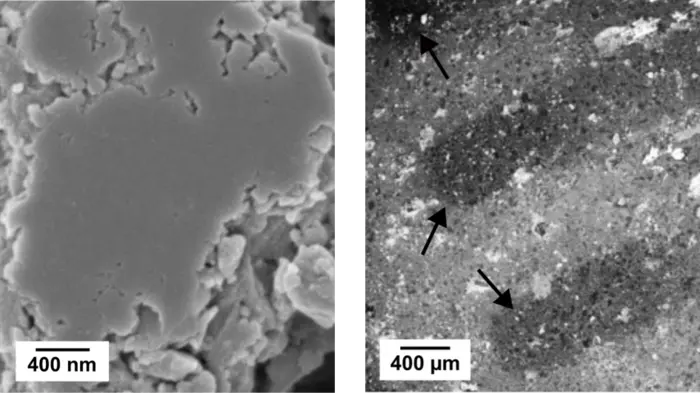
Solid-state batteries have several advantages: they can store more energy and are safer than batteries with liquid electrolytes. However, they do not last as long and their capacity decreases with each charge cycle. But it doesn’t have to stay that way: Researchers are already on the trail of the causes. In the journal ACS Energy Letters, a team from HZB and Justus-Liebig-Universität, Giessen, presents a new method for precisely monitoring electrochemical reactions during the operation of a solid-state battery using photoelectron spectroscopy at BESSY II. The results help to improve battery materials and design.

Credit: 10.1021/acsenergylett.4c01072
Solid-state batteries have several advantages: they can store more energy and are safer than batteries with liquid electrolytes. However, they do not last as long and their capacity decreases with each charge cycle. But it doesn’t have to stay that way: Researchers are already on the trail of the causes. In the journal ACS Energy Letters, a team from HZB and Justus-Liebig-Universität, Giessen, presents a new method for precisely monitoring electrochemical reactions during the operation of a solid-state battery using photoelectron spectroscopy at BESSY II. The results help to improve battery materials and design.
Solid-state batteries use a solid ion conductor between the battery electrodes instead of a liquid electrolyte, which allows lithium to be transported during charging and discharging. This has advantages including increased safety during operation and generally higher capacity. However, the lifetime of solid-state batteries is still very limited. This is because decomposition products and interphases form at the interfaces between the electrolyte and the electrode, which hinders the transport of the lithium ions and leads to consumption of active lithium so that the capacity of the batteries decreases with each charge cycle.
What happens during operation?
Now a team led by HZB researchers Dr. Elmar Kataev and Prof. Marcus Bär has developed a new approach to analyse the electrochemical reactions at the interface between solid electrolyte and electrode with high temporal resolution. Kataev explains the research question: “Under what conditions and at what voltage do such reactions occur, and how does the chemical composition of these intermediate phases evolve during cell operation?”
Best candidate LiPSCl examined
For the study, they analysed samples of the solid electrolyte Li6PS5Cl, a material that is considered the best candidate for solid-state batteries as it possesses high ionic conductivity. They worked closely with the team of battery expert Professor Jürgen Janek from the Justus Liebig University Giessen (JLU Giessen). An extremely thin layer of nickel (30 atomic layers or 6 nanometres) served as the working electrode. A film of lithium was pressed onto the other side of the Li6PS5Cl pellet to act as a counter electrode.
Hard X-ray photoelectron spectroscopy HAXPES
In order to analyse the interfacial reactions and the formation of an interlayer (SEI) in real time and as a function of the applied voltage, Kataev used the method of hard X-ray photoelectron spectroscopy (HAXPES) exploiting the analytical capabilities of the Energy Materials In-situ Laboratory Berlin (EMIL) at BESSY II: X-rays hit the sample, exciting the atoms there and the reaction products can be identified from the photoelectrons emitted as a function of the applied cell voltage and time. The results showed that the decomposition reactions were only partially reversible.
Outlook: Examination of different battery materials
“We demonstrate that it is possible to use an ultra-thin current collector to study the electrochemical reactions at the buried interfaces using surface characterisation methods,” says Kataev. The HZB team has already received inquiries from research groups in Germany and abroad that are also interested in this characterization approach. As a next step, the HZB team wants to extend this approach and also investigate batteries with composite polymer electrolytes and a variety of anode and cathode materials.
Journal
ACS Energy Letters
Method of Research
Experimental study
Subject of Research
Not applicable
Article Title
Operando Photoelectron Spectroscopy Analysis of Li6PS5Cl Electrochemical Decomposition Reactions in Solid-State Batteries
Article Publication Date
27-Jun-2024
COI Statement
none
Cite Scienmag News
Bethany Barker. (July 10, 2024). BESSY II shows how solid-state batteries degrade. Scienmag. https://scienmag.com/bessy-ii-shows-how-solid-state-batteries-degrade/
Bethany Barker. "BESSY II shows how solid-state batteries degrade." Scienmag, 10 July 2024, https://scienmag.com/bessy-ii-shows-how-solid-state-batteries-degrade/. Accessed 4 September 2026.
Bethany Barker. "BESSY II shows how solid-state batteries degrade." Scienmag. July 10, 2024. https://scienmag.com/bessy-ii-shows-how-solid-state-batteries-degrade/

