

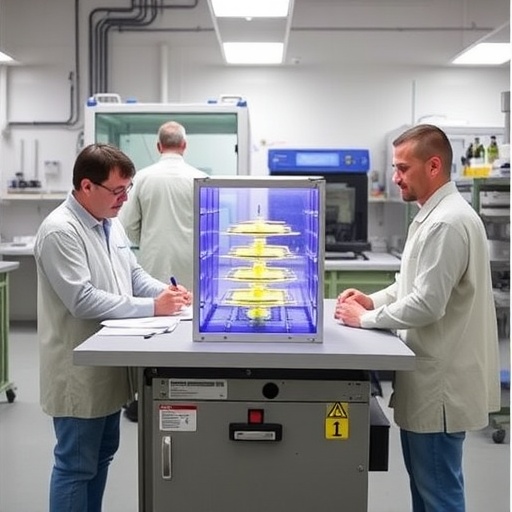
In a landmark development for sustainable energy storage, the Federal Institute for Materials Research and Testing (BAM), the Helmholtz Zentrum Berlin (HZB), and Humboldt-Universität zu Berlin (HU) have officially launched the Berlin Battery Lab (BBL). This cutting-edge research platform is designed to pioneer the development and rigorous testing of resource-efficient battery technologies, with an explicit focus on sodium-based systems. By converging the expertise and infrastructure of three premier institutions, the BBL establishes a comprehensive hub where new battery materials are conceptualized, innovative cell chemistries are explored, and full prototypes are manufactured. This strategically integrated platform is also accessible to external scientific and industrial collaborators, accelerating the transition of laboratory breakthroughs into real-world applications.
Berlin has rapidly emerged as a powerhouse in battery research, underpinned by a growing emphasis on sustainable alternatives to conventional lithium-ion technology. Sodium-ion and lithium-sulfur batteries represent promising frontiers due to their potential for greater material abundance and reduced environmental impact. The Berlin Battery Lab’s mission is to act as a catalyst for these advancements by harnessing the complementary strengths of its founding partners, each contributing distinctive expertise and resources to the initiative.
The BAM brings an internationally recognized legacy in battery safety and materials innovation, crucial for ensuring the reliability and scalability of emerging battery technologies. Humboldt-Universität zu Berlin is noted for its academic leadership in sodium-ion battery research, providing fundamental insights into electrochemical mechanisms and material behavior. Meanwhile, Helmholtz Zentrum Berlin contributes deep expertise in lithium-sulfur battery science and operates BESSY II, one of the world’s most advanced synchrotron radiation sources, enabling state-of-the-art characterization of electrochemical processes at the atomic and molecular level.
What sets the Berlin Battery Lab apart is its unique integration of fundamental research, materials engineering, cell design, and stringent safety evaluation within a single facility. This seamless collaboration fosters a comprehensive innovation pipeline that bridges the notorious “valley of death” between laboratory discovery and commercial viability. By providing startups and technology-driven companies with access to its advanced infrastructure, the BBL envisions catalyzing the development of locally produced, sustainable battery technologies that meet industrial standards and market demands.
Dr. Ina Czyborra, Berlin’s Senator for Science, Health, and Care, emphasized the lab’s strategic significance during its inauguration. She highlighted how the BBL exemplifies Berlin’s capability to align top-tier research initiatives with technological imperatives, reinforcing Germany’s autonomy in critical raw materials and enhancing the resilience of key supply chains. The Berlin Senate supports this vision with a substantial allocation of €2.4 million from the European Regional Development Fund between 2026 and 2028, reinforcing the lab’s role in the High-Tech Agenda and national innovation ecosystem.
Professor Dr. Ulrich Panne, President of BAM, underscored the urgency of translating emerging battery technologies into practice. He noted that despite Germany’s prolific innovation in this field, a key bottleneck has been the slow commercial adoption of new battery chemistries. The Berlin Battery Lab addresses this gap by uniting research, development, and cell manufacturing with an embedded focus on safety and regulatory compliance, ultimately facilitating more rapid and reliable technology transfer.
Echoing this sentiment, Professor Dr. Julia von Blumenthal, President of Humboldt-Universität zu Berlin, framed batteries as essential drivers of a sustainable energy future. She stressed that the lab consolidates the combined expertise of three leading institutions in Berlin, creating an integrated research ecosystem that spans the entire innovation chain. This alliance not only accelerates scientific progress but also strengthens partnerships with industry, driving the development of tangible, market-ready solutions.
Professor Dr. Bernd Rech, Scientific Director of HZB, discussed the lab’s forward-looking technical infrastructure, including the establishment of a new pouch-cell laboratory dedicated to sodium-ion battery research. He also highlighted the critical role of BESSY II’s advanced characterization capabilities in enabling detailed investigation of battery chemical processes through cutting-edge X-ray techniques, an essential element to understanding and optimizing performance and longevity.
A significant highlight of the inauguration was the recognition of Professor Dr. Philipp Adelhelm, a scientific director of the Berlin Battery Lab, with the Wilhelm-Ostwald Fellowship awarded by BAM. This prestigious fellowship acknowledges Adelhelm’s substantial contributions to the physical chemistry of batteries, particularly sodium-ion systems. It also symbolizes the intensified scientific collaboration between Humboldt-Universität and BAM, fostering interdisciplinary exchange within the BBL and promoting cross-institutional innovation.
The lab’s operational philosophy embodies a holistic approach to battery research that integrates theoretical modeling, synthesis of novel materials, electrochemical testing, and safety assessments with prototyping capabilities. This multifaceted framework is essential for addressing the complex challenges posed by next-generation battery systems, which require optimization of energy density, cycle life, charge rates, and sustainable raw materials sourcing.
Moreover, the Berlin Battery Lab positions itself as a beacon for Europe’s strategic ambition to reduce dependence on geopolitically sensitive materials such as lithium and cobalt. By advancing sodium-based batteries—which utilize abundantly available raw materials—the BBL contributes to reshaping global battery value chains toward greater sustainability and supply security.
In conclusion, the Berlin Battery Lab represents a bold and visionary collaborative initiative that consolidates Berlin’s position at the forefront of battery science and technology. Through its interdisciplinary, resource-rich environment and commitment to partnership with industry, the BBL is poised to drive transformative innovations in sustainable energy storage. This will not only accelerate the deployment of next-generation batteries but also stimulate the economic and technological resilience of Germany and broader Europe in an increasingly competitive global landscape.
Subject of Research:
Resource-efficient battery technologies with a focus on sodium-ion and lithium-sulfur battery systems.
Article Title:
Berlin Battery Lab Unveiled: A New Era for Sustainable, Sodium-Based Energy Storage
News Publication Date:
Not specified.
Web References:
https://mediasvc.eurekalert.org/Api/v1/Multimedia/44ed5611-7095-4bf7-adc3-2c5219691dfe/Rendition/low-res/Content/Public
Image Credits:
BAM
Keywords
Electrochemistry, Sodium-ion batteries, Lithium-sulfur batteries, Battery safety, Energy storage, Materials research, Battery prototypes, Sustainable technologies, BESSY II, Synchrotron radiation, Energy materials, Technology transfer, Battery innovation, Supply chain resilience


