


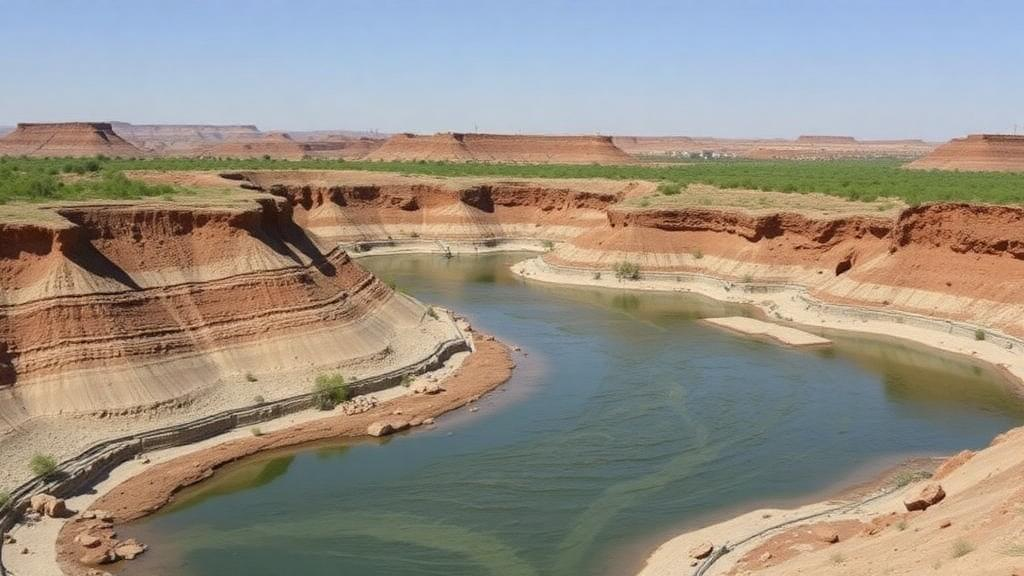
Beneath the sun-scorched Boshruyeh Plain in Iran’s South Khorasan Province, an invisible economy is already thriving. Farmers buy and sell groundwater every season, but none of it happens through official channels, meters, or contracts. Instead, a sprawling informal water market has emerged organically in one of the most severely over-exploited aquifers in the country, driven by desperate necessity rather than policy design. A new study published in the journal Environmental Management has now taken one of the most rigorous looks yet at whether this shadow economy could ever be formalized, and the answer is a sobering one: the region is not ready, and the reasons why reveal a fundamental disconnect between the experts who design water policy and the farmers who must live under it.
The research, led by Moein Tosan of the University of Tehran together with colleagues at the University of Birjand, Sultan Qaboos University, the University of Memphis, and the University of Technology Sydney, examined the pre-implementation hurdles to establishing a formal groundwater trading system in the Boshruyeh Plain. Rather than relying on a single line of evidence, the team constructed an integrated empirical design that combined three distinct data streams: quantitized narratives gathered from local farmers, structured survey metrics collected from 109 stakeholders including state officials and academic experts, and hydrogeological baselines quantifying the degree of aquifer overdraft. This triangulation matters, because water markets fail not only for hydraulic reasons but for institutional and social ones, and any honest assessment must capture all three dimensions simultaneously.
The hydrogeological picture alone explains why the stakes are so high. The study documented dramatic fluctuations in water availability across the plain, with the region experiencing water deficiencies of up to 40 percent in dry periods against surpluses of roughly 30 percent in wetter years. This volatility is precisely the condition that economic theory says a well-functioning water market should remedy: in scarcity years, trading would allow water to flow toward the highest-value uses, while surplus years would let sellers bank income and buyers accumulate reserves. Yet the same volatility also fuels the informal market, because when official allocation mechanisms cannot respond flexibly to swings in supply, farmers improvise their own exchange systems outside the law.
When the researchers turned to the institutional dimension, the findings were unambiguous. Statistical analysis of the expert survey data showed that the level of infrastructural preparedness in the region was inadequate for supporting a transparent formal water market. The questionnaire items probed whether the physical measurement and monitoring infrastructure, including meters and telemetry needed to verify who is pumping what and when, could sustain a market in which water rights are bought and sold with confidence. The verdict was negative. Without reliable measurement, there can be no enforceable entitlements; without enforceable entitlements, there can be no trust between buyers and sellers; and without trust, no formal market can displace the informal arrangements that already exist.
Perhaps the most striking result of the study is what the researchers describe as a policy disconnect between experts and farmers, an institutional blind spot with direct implications for how reform efforts should be prioritized. Spearman rank correlation analysis, a statistical technique for measuring the strength and direction of monotonic relationships between variables, provided empirical evidence of theory in action within each group. But when the responses of the two groups were compared, they diverged sharply on what actually stands in the way of formal water trading. Experts, drawn from the ranks of state officials and academics, considered social acceptability and monitoring capacity to be the decisive dependencies. Farmers, by contrast, identified technical and legal hurdles as the critical barriers. In other words, the people who govern the system and the people who are governed by it are not even looking at the same problem.
This divergence is more than a survey curiosity. If policymakers invest primarily in monitoring technology and public outreach while farmers are paralyzed by unclear legal status of their water rights and incompatible technical conditions on the ground, the reform will stall regardless of how sophisticated the metering network becomes. Conversely, if legal frameworks are drafted without addressing the social acceptability that experts emphasize, the resulting market may exist on paper only. The study’s central lesson is that both dimensions must be addressed in parallel, and that diagnosing which barriers matter to whom is a prerequisite for designing interventions that actually close the gap rather than widen it.
The researchers also applied K-means clustering, an unsupervised machine learning algorithm that partitions observations into groups by minimizing within-cluster variance, to the expert survey responses. The analysis revealed three distinct expert archetypes within the governing body, which the authors labeled Pessimists, Optimists, and Proponents. This heterogeneity is itself a policy-relevant finding. It means that the very institutions charged with implementing groundwater markets do not share a coherent internal view of whether such markets are feasible, desirable, or safe. A divided governing body risks sending contradictory signals to stakeholders, undermining the credibility that any market reform requires, and the study suggests that this internal variability of the governing apparatus is as much an obstacle as any physical shortage of water.
From these findings, the authors distill a clear prescription: a successful transition to formal groundwater trading requires the integration of two essential infrastructures. The first is robust monitoring systems, which serve as a prerequisite for trust-building, because participants must believe that extraction is measured accurately and violations are detected reliably. The second is flexible legislative systems, which are essential for systematically harmonizing the diverse interests of stakeholders, because rigid fixed-allocation water laws cannot accommodate the seasonal and interannual variability that characterizes arid-zone hydrology. The balance between institutional coherence and market efficiency, the study concludes, is what determines whether sustainable groundwater management is achievable at all.
The implications extend far beyond one Iranian plain. Groundwater depletion is a defining crisis of the twenty-first century, particularly across the arid belt stretching from North Africa through the Middle East and Central Asia, where aquifers supply agriculture and cities but are being drained faster than rainfall can replenish them. Market-based allocation has delivered documented benefits in places like California, Australia, and Chile, yet the Boshruyeh Plain study demonstrates that the technology of trading is the easy part. The hard part is the institutional scaffolding: legal clarity, measurement infrastructure, and consensus among stakeholders who currently disagree about what the problem even is. The authors argue that establishing both technological and legal trust is a non-negotiable prerequisite for the transition from informal to formal water markets, a conclusion of general relevance to other arid hydrogeological systems worldwide.
What makes this research resonate is its refusal to treat water markets as a purely technical fix. The informal market in Boshruyeh is not a failure of the farmers; it is a rational response to scarcity in the absence of functioning institutions. Any reform that ignores the lived reality of those farmers, or the internal divisions of the agencies that govern them, will simply push the shadow economy deeper underground. The study offers instead a template for readiness assessment, one that measures hydrogeological stress, institutional capacity, and stakeholder perceptions together before a single water right is ever traded. For the millions of people dependent on shrinking aquifers across the world’s drylands, that template may prove as valuable as any amount of new water.
Subject of Research: Groundwater market readiness and institutional barriers to formal water trading in an over-exploited Iranian aquifer
Article Title: Assessing Groundwater Market Readiness: Institutional Gaps and Stakeholder Divides in Iran
Article References: Tosan, M., Shamshirgaran, R., Nikoo, M. R., Nazari, R., Karimi, M., & Gandomi, A. H. (2026). Assessing Groundwater Market Readiness: Institutional Gaps and Stakeholder Divides in Iran. Environmental Management, 76(9), Article 296. https://doi.org/10.1007/s00267-026-02589-9
Image Credits: AI Generated
DOI: 10.1007/s00267-026-02589-9
Keywords: groundwater, water markets, Iran, aquifer depletion, water policy, institutional analysis, stakeholder engagement, arid regions, Boshruyeh Plain, informal water trading, hydrogeology, Environmental Management
Cite Scienmag News
Sloane Callahan. (October 3, 2026). Before Water Can Trade, Trust Must Flow: Iran’s Aquifer Crisis Exposes Institutional Gaps. Scienmag. https://scienmag.com/before-water-can-trade-trust-must-flow-irans-aquifer-crisis-exposes-institutional-gaps/
Sloane Callahan. "Before Water Can Trade, Trust Must Flow: Iran’s Aquifer Crisis Exposes Institutional Gaps." Scienmag, 3 October 2026, https://scienmag.com/before-water-can-trade-trust-must-flow-irans-aquifer-crisis-exposes-institutional-gaps/. Accessed 4 October 2026.
Sloane Callahan. "Before Water Can Trade, Trust Must Flow: Iran’s Aquifer Crisis Exposes Institutional Gaps." Scienmag. October 3, 2026. https://scienmag.com/before-water-can-trade-trust-must-flow-irans-aquifer-crisis-exposes-institutional-gaps/


