

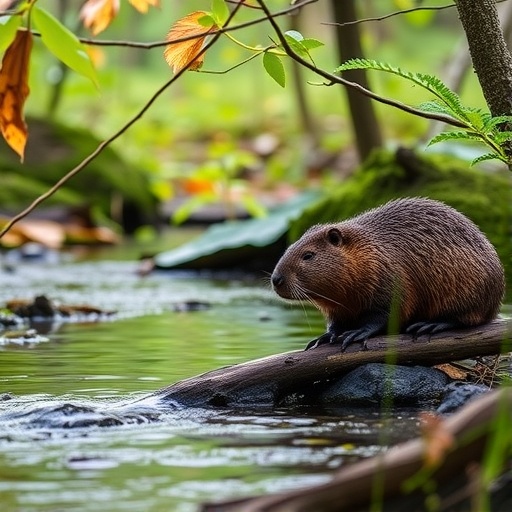
In a compelling new study poised to reshape our understanding of freshwater ecosystems and their role in the global carbon cycle, researchers have identified beavers as unlikely but powerful agents of carbon sequestration. Traditionally known for their engineering feats that reshape landscapes, beavers are now being recognized for their ability to convert stream corridors into persistent carbon sinks. This discovery not only highlights an ecological service provided by these industrious mammals but also opens fresh pathways for climate change mitigation strategies rooted in ecosystem management.
The research, conducted in diverse stream networks in North America, meticulously quantified carbon storage changes linked to beaver dam construction and the subsequent transformation of stream corridors into complex wetland environments. Through an array of field measurements, sediment core analyses, and carbon flux monitoring, scientists demonstrated that beaver-modified stream environments exhibit elevated carbon retention compared to unaltered streams. This persistent carbon storage is largely facilitated by the damming activity that alters hydrology, sediment deposition, and organic matter accumulation.
One of the pivotal mechanisms identified involves the creation of a mosaic of slow-flowing water bodies—ponds and wetlands—that promote the deposition of organic-rich sediments. These beaver ponds enhance anaerobic conditions, which slow the decomposition of organic carbon, allowing substantial quantities to be buried in sediment layers. Over time, this buried organic matter becomes a long-term carbon repository, effectively sequestering CO2 that would otherwise be released into the atmosphere, thus contributing to climate regulation.
Notably, the study underscores the longevity of these carbon sinks. Unlike seasonal or ephemeral carbon pools typical of many ecosystems, beaver-constructed wetlands maintain their carbon storage capacity for decades, maintaining a stable carbon pool. This durability arises from the sustained hydrologic and geomorphologic conditions shaped by beaver activity, which periodically refresh and preserve sediment layers, reinforcing their role as carbon burial sites.
Beyond the biogeochemical impacts, the research highlights the broader ecological benefits of beaver activity. The transformation from free-flowing streams into complex wetland networks not only enhances biodiversity by creating varied aquatic habitats but also ameliorates water quality by trapping sediments and nutrients. These ecological co-benefits amplify the importance of beavers as key ecosystem engineers, providing multi-faceted services that extend far beyond carbon sequestration.
The implications of this discovery extend deeply into conservation and climate policy. Incorporating beaver activity into landscape management offers a natural, cost-effective method to bolster carbon sequestration efforts. Encouraging beaver populations through protected habitats and reintroduction programs may serve as a complementary strategy to conventional carbon capture technologies, leveraging ecosystem processes already optimized over evolutionary time scales.
Furthermore, the spatial scale of beaver impacts is significant. Large stream corridors and river networks, especially those in temperate zones, present vast opportunities for beaver-mediated carbon storage. These ecosystems, once fragmented or degraded by human activities, could potentially be restored to their carbon-sequestering potential via targeted beaver habitat recovery, linking ecological restoration with climate change mitigation in a novel and synergistic manner.
Importantly, the researchers also addressed potential concerns regarding methane emissions, a potent greenhouse gas often associated with wetland ecosystems. Their comprehensive greenhouse gas flux measurements indicate that while beaver ponds do release methane, the overall greenhouse gas balance remains strongly negative due to the dominant carbon storage effects. This nuanced understanding dispels apprehensions about wetland-induced methane emissions undermining carbon sequestration benefits and strengthens the case for beaver-facilitated ecosystem management.
This study also advances our theoretical comprehension of landscape carbon dynamics by integrating animal-driven geomorphic processes into carbon budget models. Recognizing ecosystem engineers such as beavers as active agents influencing carbon flux challenges traditional views that have largely centered on abiotic factors and vegetation changes. This integration promises more accurate, holistic predictive models essential for managing natural carbon sinks under dynamic environmental conditions.
Hotspots of beaver activity serve as natural “carbon laboratories,” demonstrating how biological agents can modify environmental states and feedback into global cycles. The potential to upscale these findings globally, especially to other regions where similar species or processes prevail, offers exciting avenues for international research collaborations and environmental policy innovations.
Moreover, the study’s multi-disciplinary approach, combining hydrology, geomorphology, microbial ecology, and landscape genetics, exemplifies the power of integrative science in unraveling complex ecological phenomena. This methodological framework sets a precedent for future research aiming to untangle the intertwined effects of biotic and abiotic factors on ecosystem functions critical to planetary health.
Public engagement emerges as a vital component following this revelation. Educating communities on the ecological value of beavers can foster co-existence and generate grassroots conservation momentum. Additionally, leveraging this positive narrative around beavers could shift perceptions from viewing them as nuisances to recognizing them as indispensable contributors to environmental sustainability.
In conclusion, this landmark study not only amplifies the ecological importance of beavers beyond their well-documented landscape engineering but positions them as key players in the fight against climate change. By converting stream corridors into robust, long-lasting carbon sinks, beavers exemplify nature’s inherent capacity to regulate Earth’s atmosphere. Incorporating such biotic interventions into climate action frameworks could transform conservation paradigms and propel innovative, nature-based solutions to the forefront of global environmental strategy.
Subject of Research: Beavers’ role in carbon sequestration within stream corridors and their impact on ecosystem carbon cycling.
Article Title: Beavers can convert stream corridors to persistent carbon sinks.
Article References:
Hallberg, L., Larsen, A., Ceperley, N. et al. Beavers can convert stream corridors to persistent carbon sinks. Commun Earth Environ 7, 227 (2026). https://doi.org/10.1038/s43247-026-03283-8
Image Credits: AI Generated


