


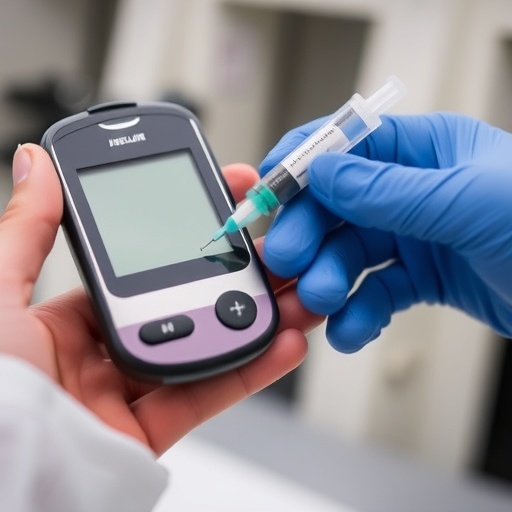
In a groundbreaking advancement set to transform diabetes management, researchers have unveiled a sophisticated Bayesian decision support system designed to automate insulin dosing for adults suffering from type 1 diabetes who use multiple daily injections. This revolutionary technology, detailed in a recent randomized controlled trial published in Nature Communications, promises enhanced precision in insulin therapy, potentially alleviating the daily burden of disease management for millions worldwide.
Type 1 diabetes requires continuous vigilance as patients meticulously balance their insulin intake to match blood glucose levels. Improper dosing can lead to severe consequences, including hypoglycemia or long-term complications due to hyperglycemia. Traditional methods depend heavily on patient experience and meticulous manual calculations, often resulting in considerable variability in glucose control. This new approach integrates Bayesian probabilistic models with real-time patient data to predict optimal insulin dosages, shifting the paradigm from reactive to proactive disease management.
Bayesian decision theory, recognized for its ability to quantify uncertainty and update predictions as new data emerges, forms the backbone of this system. By continuously analyzing variables such as current and historical glucose readings, carbohydrate intake, physical activity, and insulin sensitivity, the model dynamically adjusts insulin dose recommendations. This nuanced calculation accounts for physiological variability unique to each patient, an advancement beyond static dosing algorithms typical of many existing insulin pumps and continuous glucose monitoring devices.
The trial enrolled adult patients with type 1 diabetes undergoing treatment via multiple daily injections, a demographic historically underserved by automated insulin delivery technologies primarily focused on pump users. Over the study period, participants utilized the decision support system integrated into their everyday routine, receiving tailored insulin dose guidance. Outcomes highlighted the system’s ability to maintain tighter glycemic control, evidenced by significant reductions in HbA1c levels and fewer hypoglycemic events compared to standard care protocols.
What sets this system apart is its transparent, interpretable framework. Unlike opaque machine learning ‘black boxes,’ the Bayesian approach allows clinicians and patients to understand the rationale behind each dosing decision. This interpretability fosters trust and facilitates shared decision-making, an essential component in chronic disease management. Furthermore, it enables clinicians to intervene or recalibrate parameters if necessary, ensuring safety is never compromised.
The study also showcased impressive adaptability to real-world challenges. Accounting for meal onsets, exercise bouts, stress levels, and even illness-related variations, the model demonstrates robustness to the multifaceted nature of glycemic control obstacles. Importantly, this flexibility comes without requiring extensive daily manual inputs from patients, thereby reducing cognitive load and improving adherence, factors critical to long-term diabetes management success.
Another notable outcome was the system’s scalability potential. Because it operates on widely available devices without necessitating complex hardware, it could seamlessly integrate into current diabetes care frameworks globally, including resource-constrained settings. Adoption of such technology could democratize access to precision insulin therapy, dramatically improving quality of life and health outcomes across diverse populations.
From a technical perspective, the model continuously updates its posterior distributions as new data arrives, refining its insulin dosing predictions. This Bayesian updating mechanism contrasts starkly with static dosing charts or rule-based systems, providing a living, learning algorithm tailored in real time. The mathematical rigor underpinning this system ensures statistically optimal decisions under uncertainty, a leap forward from heuristic-based insulin calculations.
The implications of this advancement extend beyond individual patient care. By standardizing and automating insulin dosing decisions, healthcare systems can reduce variability in treatment quality, decrease hospitalization rates from diabetes-related complications, and lower associated costs. Additionally, accumulated anonymized data from system users could fuel further research, enabling refinement of disease models and potential identification of novel therapeutic targets.
Patient testimonials from the trial accentuated newfound confidence and reduced anxiety around insulin administration. Many reported feeling more in control and less overwhelmed navigating everyday glucose management, a testament to the system’s user-centric design. As diabetes prevalence escalates globally, innovations that empower patients and alleviate chronic stress are paramount.
While the Bayesian system marks a significant leap forward, researchers acknowledge the necessity for continued validation across broader demographics, including pediatric populations and those with comorbidities. Future iterations could integrate additional physiological markers, such as continuous ketone monitoring or stress hormone levels, to further enhance predictive capabilities.
Moreover, as artificial intelligence and machine learning continue to evolve, hybrid models combining Bayesian frameworks with deep learning techniques may emerge, harnessing strengths from both approaches for even greater accuracy and personalization.
In conclusion, this pioneering Bayesian decision support system represents a new frontier in automated insulin therapy for type 1 diabetes. By marrying rigorous statistical modeling with user-focused design, it offers hope for safer, smarter, and more seamless disease management. As the technology moves toward commercial availability, it promises to revolutionize how patients and clinicians approach insulin dosing, transforming lives through science.
Cite Scienmag News
Ophelia Keating. (September 30, 2025). Bayesian AI Optimizes Insulin Doses in Type 1 Diabetes. Scienmag. https://scienmag.com/bayesian-ai-optimizes-insulin-doses-in-type-1-diabetes/
Ophelia Keating. "Bayesian AI Optimizes Insulin Doses in Type 1 Diabetes." Scienmag, 30 September 2025, https://scienmag.com/bayesian-ai-optimizes-insulin-doses-in-type-1-diabetes/. Accessed 4 September 2026.
Ophelia Keating. "Bayesian AI Optimizes Insulin Doses in Type 1 Diabetes." Scienmag. September 30, 2025. https://scienmag.com/bayesian-ai-optimizes-insulin-doses-in-type-1-diabetes/


