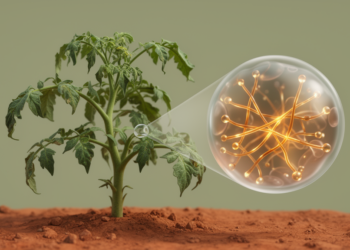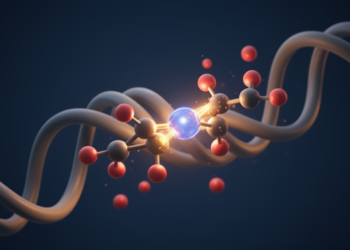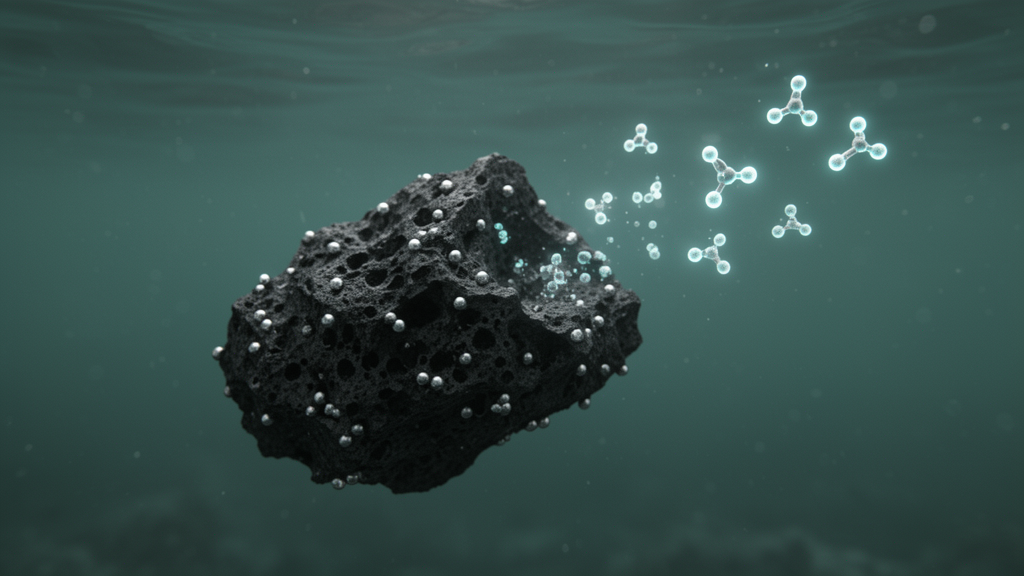
A bamboo-derived biochar studded with iron nanoparticles removed 98 percent of the fifth-generation cephalosporin antibiotic ceftaroline from water within 60 minutes, according to a study published in Applied Biological Chemistry. The material, labeled BBC-Fe10, combined two mechanisms in a single particle: the porous carbon surface first concentrated the antibiotic molecules, and then embedded iron nanoparticles catalyzed a Fenton-like oxidation that broke them down. After five reuse cycles the composite still retained 82 percent of its activity, with cumulative iron leaching staying below 1.5 percent of the loaded metal.
The researchers built the composite in two stages. Dried bamboo chips were oven-dried at 105 °C, ground and sieved, then pyrolyzed in a tube furnace under a nitrogen flow. A baseline biochar, BBC-A500, was produced by heating to 500 °C at 10 °C per minute and holding for one to two hours. A second, chemically activated version was made by impregnating the biomass with potassium hydroxide at weight ratios of 1:1 to 3:1 and pyrolyzing at 700 °C, a temperature chosen because KOH activation requires more than 650 °C for effective pore development. A control sample, BBC-A700, was pyrolyzed at 700 °C without activation to separate the effects of temperature from those of the chemical treatment. Biochar yields ranged from 10 to 25 percent of the starting dry bamboo.
Iron was then loaded onto the activated biochar by wet chemistry. Ferric chloride hexahydrate, 4.84 grams per 10 grams of biochar, was dissolved and dripped slowly onto the biochar suspension so that Fe³⁺ ions adsorbed onto the carbon surface. Freshly prepared sodium borohydride, added dropwise in an ice bath under nitrogen, reduced the iron to black deposits of metallic iron and iron oxides. The solid was centrifuged, washed repeatedly with deionized water and ethanol, and dried under vacuum at 80 °C for 12 hours. The final material carried roughly 10 weight percent iron.
A battery of characterization techniques confirmed the structure. Scanning and transmission electron microscopy showed fine iron particles distributed through the biochar matrix, with a mean particle size of 8.5 ± 3.2 nanometers. X-ray diffraction revealed broadened reflections from nanocrystalline magnetite and maghemite, together with weak, broadened peaks of metallic α-iron; crystallite sizes calculated with the Scherrer equation were 7.8 ± 2.1 nanometers for the oxide phases and 6.2 ± 1.8 nanometers for metallic iron, matching the microscopy. X-ray photoelectron spectroscopy quantified the surface iron species as 28.5 percent Fe⁰, 34.2 percent Fe²⁺ and 37.3 percent Fe³⁺, giving an Fe²⁺/Fe³⁺ ratio of 0.92. That mixed-valence surface is the catalytic engine of the material, because the Fe(II)/Fe(III) redox cycling drives Fenton-like reactions.
The carbon framework itself changed in predictable ways when the metal arrived. BET analysis showed the specific surface area falling from 220 to 150 square meters per gram after iron loading, with pore volume also decreasing, signs that nanoparticles partially occupied and occluded existing pores. Average pore diameter increased slightly, consistent with structural reorganization during deposition. The unactivated 700 °C control sat between the two extremes, with a surface area of 185 square meters per gram and a pore volume of 0.28 cubic centimeters per gram, confirming that the composite’s properties arise from the combination of activation and iron incorporation. Zeta potential measurements shifted from −23.1 millivolts for the untreated biochar to −11.0 millivolts for the iron-loaded composite at neutral pH, reflecting positively charged iron-bearing sites coexisting with the negatively charged carbon framework. Infrared spectroscopy recorded a new iron–oxygen band near 570 to 600 wavenumbers, evidence that the metal was anchored to oxygenated surface groups.
Adsorption tests came first in the batch experiments, which were run in triplicate at 25 ± 1 °C with 10 milligrams per liter ceftaroline solutions and 1.0 gram per liter catalyst. Uptake was rapid, with most sorption occurring in the first 30 to 60 minutes and quasi-equilibrium reached within one to two hours. The kinetics fit a pseudo-second-order model far better than a pseudo-first-order model, with coefficients of determination of 0.997 versus 0.86, and the fitted equilibrium capacity of about 8.9 milligrams per gram matched the measured 8.85 milligrams per gram. That pattern points to chemisorption, with chemical bonding between ceftaroline and the oxygen-containing functional groups and iron sites, rather than simple passive diffusion. The equilibrium data followed a Langmuir isotherm with R² of 0.995, against 0.92 for the Freundlich model, indicating monolayer adsorption on sites of relatively uniform energy. The fitted maximum capacity was approximately 125 milligrams per gram, and the Langmuir separation factor of 0.18 confirmed favorable adsorption.
Oxidation then took over. When hydrogen peroxide was added to the composite, the apparent first-order rate constant reached 0.092 per minute, and the parent antibiotic was almost completely gone within an hour. Mineralization lagged behind, however: total organic removal reached only about 60 to 65 percent after 240 minutes, indicating that intermediate oxidation products, including small carboxylic acids, persisted. Control experiments clarified where the credit belonged. Biochar alone adsorbed the compound but showed negligible oxidative elimination; unsupported iron nanoparticles were active but less effective because of aggregation and poor dispersion; oxidants alone degraded the antibiotic much more slowly. The composite’s advantage came from synergy, with adsorption concentrating the target molecules near dispersed iron sites that simultaneously activated the oxidant.
Operating conditions mattered. Degradation rates rose with hydrogen peroxide concentration up to an optimum near 10 millimolar, then fell at higher doses as excess peroxide scavenged the very radicals it had generated. pH had a strong influence: the highest rates in the hydrogen peroxide system occurred under acidic to slightly acidic conditions, pH 3 to 5, as expected for Fenton chemistry, while rates dropped above pH 7 as radical formation declined and iron precipitated or deactivated at the surface. Peroxymonosulfate proved more tolerant of neutral pH, and persulfate activation worked over a wider pH range. Radical-scavenger experiments and electron paramagnetic resonance spectroscopy with the spin trap DMPO identified the reactive species directly. Methanol, which quenches both free and surface-bound hydroxyl radicals, inhibited 86 percent of degradation, while tert-butanol, which reaches only free radicals in the bulk solution, inhibited 57 percent. The 29 percentage-point difference implicates surface-bound hydroxyl radicals generated within the pore network, where iron sites sit close to adsorbed molecules. Superoxide and singlet oxygen played minor roles, with 12 percent and 8 percent inhibition respectively, and both DMPO-OH and DMPO-SO₄ adducts were clearly observed in the spectra, with hyperfine splitting constants of 14.9 gauss consistent with literature values.
Liquid chromatography–mass spectrometry tracked the chemical fate of the antibiotic. The parent ceftaroline peak disappeared and several lower-molecular-weight peaks appeared at shorter retention times, signaling water-soluble transformation products. Preliminary identification suggested a hydroxylated product, a dealkylated product and a fragment with a broken ring structure, consistent with stepwise oxidative cleavage and hydroxyl addition. Total organic carbon measurements supported partial conversion to inorganic carbon alongside the formation of smaller, more stable organic compounds such as carboxylic acids.
Durability testing addressed the practical question of whether such a catalyst survives real use. Over five consecutive cycles, removal declined gradually from 98 percent to about 82 percent. Post-use examination by electron microscopy, diffraction and BET showed slight nanoparticle aggregation, a modest surface-area loss from 150 to 132 square meters per gram, and stronger iron oxide diffraction peaks, all signs of mild surface oxidation. Iron loss was small: a single run with 0.1 gram of the 9.6 weight percent iron catalyst in 100 milliliters released 0.018 milligrams of dissolved iron, or 0.19 percent, and cumulative leaching over five cycles stayed below 1.5 percent. A simple regeneration, an ethanol wash followed by weak thermal treatment under nitrogen at 200 °C for one hour, restored about 90 percent of the activity, indicating that most deactivation, from adsorbed organics and partial oxidation, is reversible. The authors note that full-scale application would still require managing released iron and a regeneration plan. Because bamboo is a renewable, commercially available feedstock and the synthesis uses standard reagents and equipment, the researchers argue the approach is a plausible route for treating pharmaceutical effluents, where conventional treatment plants often fail to eliminate persistent advanced-generation antibiotics that otherwise accumulate and fuel antimicrobial resistance.
Subject of Research: Development of an iron nanoparticle-loaded bamboo biochar composite that removes the antibiotic ceftaroline from pharmaceutical wastewater by combined adsorption and Fenton-like oxidation.
Article Title: Development of bamboo biochar–iron nano bio- composite for efficient removal of ceftaroline from pharmaceutical wastewater through adsorption and Fenton-like oxidation
Article References: Siddharth, S., kudapa, V., Sivasundar, V., Veeranjaneyulu, I., Gebrehiwot, K. H., sri, M. N. S., Peyyala, A., & Rajulapati, A. (2026). Development of bamboo biochar–iron nano bio- composite for efficient removal of ceftaroline from pharmaceutical wastewater through adsorption and Fenton-like oxidation. Applied Biological Chemistry, 69(1), Article 77. https://doi.org/10.1186/s13765-026-01144-8
Image Credits: AI Generated
DOI: 10.1186/s13765-026-01144-8
Keywords: bamboo biochar, iron nanoparticles, ceftaroline, pharmaceutical wastewater, Fenton-like oxidation, adsorption, hydroxyl radicals, antibiotic degradation, water treatment, nanocomposite, catalyst reusability, antimicrobial resistance
Cite Scienmag News
Bethany Barker. (October 28, 2026). Bamboo Biochar Loaded with Iron Nanoparticles Strips Antibiotic from Wastewater. Scienmag. https://scienmag.com/bamboo-biochar-loaded-with-iron-nanoparticles-strips-antibiotic-from-wastewater/
Bethany Barker. "Bamboo Biochar Loaded with Iron Nanoparticles Strips Antibiotic from Wastewater." Scienmag, 28 October 2026, https://scienmag.com/bamboo-biochar-loaded-with-iron-nanoparticles-strips-antibiotic-from-wastewater/. Accessed 28 October 2026.
Bethany Barker. "Bamboo Biochar Loaded with Iron Nanoparticles Strips Antibiotic from Wastewater." Scienmag. October 28, 2026. https://scienmag.com/bamboo-biochar-loaded-with-iron-nanoparticles-strips-antibiotic-from-wastewater/