


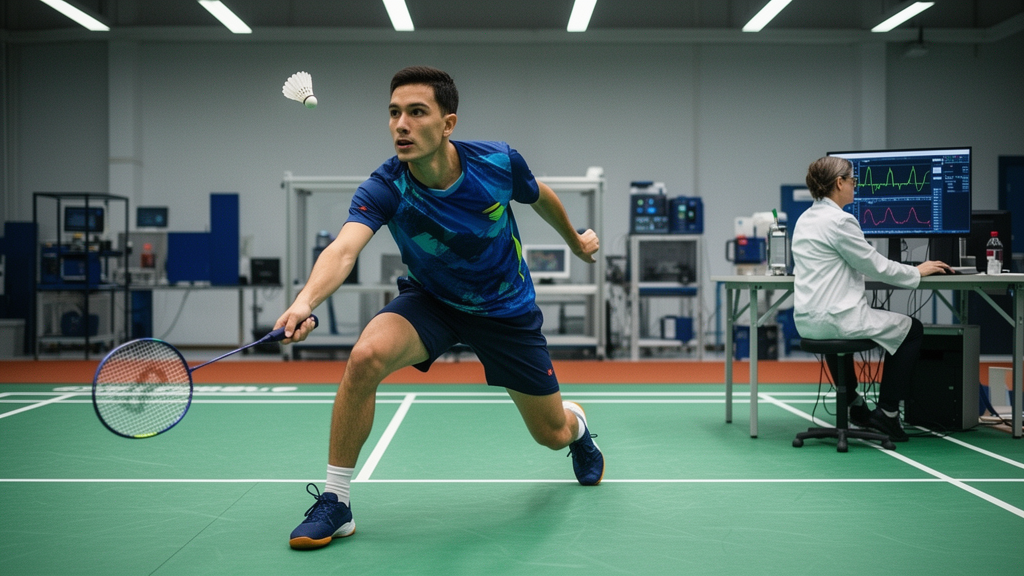
Elite badminton players must track a shuttlecock that can travel at blistering speeds, adjust their position in fractions of a second, and switch between attack and defense without warning. It is tempting to conclude that such demands forge a broadly superior mind, sharpening every executive function from inhibition to working memory. A new cross-sectional study from Chengdu Sport University and East China Normal University, published in Frontiers in Psychology, put that intuition to a careful test, and the answer is more nuanced than the popular narrative suggests: the cognitive advantages associated with badminton expertise are real but strikingly task-specific, not a blanket upgrade of the executive system.
The research team recruited 96 university students aged 18 to 24 and divided them into three naturally occurring groups. Thirty-three were high-level players holding Chinese national first- or second-class athlete designations, training at least four times a week for at least 90 minutes per session, with badminton careers spanning 4 to 15 years. Thirty-one were recreational players with at least one year of experience and regular practice but no professional training or athlete rank. The remaining 32 participants had no badminton experience at all, and recruitment deliberately excluded people involved in other open-skill sports. All three groups shared sport-related educational backgrounds, which makes the comparison a test of badminton-specific expertise rather than a simple athlete-versus-sedentary contrast.
Each participant completed a battery of tasks in a fixed order on identical equipment: a word-color matching judgment derived from the Stroop paradigm, a task-switching paradigm requiring judgments of color or shape under changing rules, a 1-back working-memory task with a punishing 500-millisecond response deadline, and Raven’s Standard Progressive Matrices as a measure of fluid intelligence. The researchers statistically adjusted all comparisons for sex, age, and Raven score, because fluid intelligence overlaps with executive functions and age-related cognitive changes extend well into adulthood. The 1-back deadline was chosen deliberately to mirror the rapid information-processing demands of badminton itself.
The clearest result emerged from the word-color matching task. In a multivariate analysis of covariance, the overall group effect was highly significant, and follow-up models with robust standard errors showed that high-level players responded roughly 90 to 127 milliseconds faster than both comparison groups in both the congruent and incongruent conditions, without any measurable loss of accuracy. Hierarchical regression underscored the scale of the effect: after sex, age, and fluid intelligence explained only a few percent of variance in reaction time, adding group membership raised explained variance by roughly 24 percentage points in each condition. Bayesian model comparisons were overwhelming, with Bayes factors exceeding 8,000 and 18,000 in favor of models including group membership for congruent and incongruent reaction times respectively.
Yet the researchers are careful about what this speed advantage means. In their implementation, congruent trials required a left-hand response on a quarter of trials while incongruent trials demanded a right-hand response on three-quarters, so condition, response hand, and response frequency were confounded. The incongruent-minus-congruent reaction-time difference, often treated as a proxy for inhibitory control, therefore cannot be interpreted as an isolated conflict effect, and the Bayesian evidence on that contrast was inconclusive. What the data do support is faster performance shared across both conditions, likely reflecting operations such as stimulus identification, rule matching, response selection, and execution that are common to every trial.
The task-switching paradigm told a different story. Despite numerically shorter reaction times among high-level players, the overall group effect was far from significant, and component analyses of switch trials, repeat trials, and the switch cost itself showed no reliable differences. Bayesian comparisons for switch and repeat reaction times were equivocal, and the switch-cost analysis actually favored a model containing only the covariates. The authors note that their task required switching between explicitly instructed abstract rules, whereas badminton demands continuous adaptation to an evolving game situation, a distinction that may explain why this laboratory measure failed to separate the groups even though other studies have reported flexibility advantages for open-skill athletes.
The 1-back task produced perhaps the most intriguing pattern. Under the 500-millisecond deadline, timeout rates were 40.45 percent in the high-level group, 36.92 percent among recreational players, and 48.21 percent among non-badminton participants. Both badminton groups showed lower adjusted timeout rates than the non-badminton group under both match and mismatch conditions, with no clear difference between the two badminton groups. Crucially, when the analysis separated timeouts from accuracy among answered trials, accuracy among the trials people actually completed was statistically indistinguishable across groups, hovering around 90 to 91 percent, and correct-response reaction times did not differ either. The advantage, in other words, lay in responding in time, not in judging more accurately or faster once a response was made.
This decomposition matters for interpretation. Because all-trial accuracy counts timeouts as errors, the raw accuracy differences between badminton and non-badminton groups partly reflect the ability to meet the deadline, and the authors found that this evidence was sensitive to model specification, with sensitivity analyses hovering at the edge of significance. They therefore describe the finding as performance on a deadline-constrained 1-back task rather than a demonstration of superior memory updating. It is a distinction that echoes a broader lesson from the sports-cognition literature: what looks like a domain-general cognitive advantage can dissolve into a specific speed-of-responding benefit once the task is dissected properly.
The study’s design choices strengthen its conclusions while also marking its limits. By comparing three performance levels within a single sport, the researchers avoided the cross-sport heterogeneity that muddies many athlete-cognition studies, and by adjusting for fluid intelligence they controlled a major confound. But the cross-sectional design cannot establish whether badminton training produced these differences or whether people with faster processing speed gravitate toward and persist in the sport. Performance level and accumulated training years are tightly intertwined, other sporting backgrounds were not recorded in detail, task order was not counterbalanced, and keyboard timing was not validated against an external reference. General response speed or familiarity with speeded computer tasks could contribute to the word-color finding, since no independent simple reaction-time baseline was included.
The takeaway is a corrective to a seductive headline. Badminton expertise, in this sample, was associated with faster word-color matching and more timely responding under a tight deadline, but not with better task switching, not with higher accuracy on answered memory trials, and not with a uniform advantage across the classic executive components of inhibition, shifting, and updating. Multi-task assessment, the authors argue, reveals different facets of performance rather than a single cognitive ranking by competitive level. For coaches, scientists, and anyone hoping that a racquet sport will comprehensively rewire the brain, the message is that the cognitive footprint of expertise is selective, measurable only when the right tasks and the right comparisons are used, and far narrower than the myth of the all-around superior athlete mind.
Subject of Research: Executive-function performance differences across badminton skill levels assessed with multiple cognitive tasks
Article Title: Do high-level badminton players show broad executive-function advantages? Evidence from a multi-task assessment
Article References: Sun, S., & Zhang, Z. (2026). Do high-level badminton players show broad executive-function advantages? Evidence from a multi-task assessment. Frontiers in Psychology, 17, 1960617. https://doi.org/10.3389/fpsyg.2026.1960617
Image Credits: AI Generated
DOI: 10.3389/fpsyg.2026.1960617
Keywords: badminton, executive function, reaction time, task switching, working memory, Stroop task, 1-back task, sport psychology, open-skill sport, cognitive performance, cross-sectional study, athletes
Cite Scienmag News
Glenn Wilkins. (October 27, 2026). Badminton Experts Show Task-Specific Cognitive Edge, Not Broad Executive Advantage. Scienmag. https://scienmag.com/badminton-experts-show-task-specific-cognitive-edge-not-broad-executive-advantage/
Glenn Wilkins. "Badminton Experts Show Task-Specific Cognitive Edge, Not Broad Executive Advantage." Scienmag, 27 October 2026, https://scienmag.com/badminton-experts-show-task-specific-cognitive-edge-not-broad-executive-advantage/. Accessed 27 October 2026.
Glenn Wilkins. "Badminton Experts Show Task-Specific Cognitive Edge, Not Broad Executive Advantage." Scienmag. October 27, 2026. https://scienmag.com/badminton-experts-show-task-specific-cognitive-edge-not-broad-executive-advantage/


