

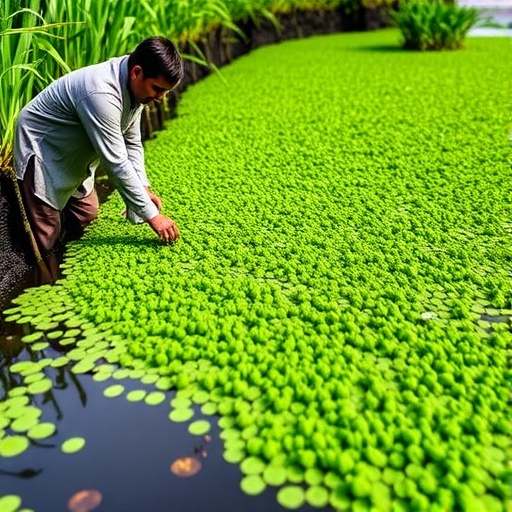
In recent years, the intensifying strains of climate change have compelled scientists and agronomists to explore innovative strategies for enhancing sustainability within agricultural systems. One such promising avenue is the investigation of Azolla—a small freshwater fern—as a multi-faceted tool for carbon capture, biofertilization, and improving rice productivity. This research highlights Azolla’s potential to adapt to our changing climate while ensuring the viability of lowland farming practices.
Azolla is known for its remarkable ability to fix atmospheric nitrogen, which contributes significantly to soil fertility. The fern forms a symbiotic relationship with cyanobacteria, specifically Anabaena, which plays a pivotal role in converting nitrogen gas into a usable form for plants. This symbiotic mechanism not only enriches the soil but also minimizes the need for chemical fertilizers, reducing input costs and environmental impacts related to fertilizer use. Such an aspect is incredibly valuable in regions heavily impacted by climate change.
Through their comprehensive study, Candra et al. investigate how the incorporation of Azolla in farming practices can directly influence the growth cycles of rice, a staple food for a large part of the world’s population. Given rice’s significant dependence on nitrogen for optimal growth, Azolla’s ability to provide a sustainable source of this essential nutrient establishes it as a vital asset in the effort to enhance agricultural productivity under stress conditions that climate change brings.
Furthermore, the research emphasizes the role of Azolla in carbon sequestration—a process of long-term storage of carbon dioxide or other forms of carbon to mitigate or defer global warming and its effects. As the globe faces increasing levels of carbon emissions, cultivating Azolla not only aids farmers in improving their soil’s fertility but also presents a pathway to absorbing atmospheric carbon, assisting in climate regulation efforts. This capacity to sequester carbon while simultaneously rejuvenating the soil offers a win-win situation for sustainable agriculture.
Another dimension explored in this study is the biofertilizer application of Azolla. The integration of biofertilizers into agronomic practices can significantly bolster soil health and fertility over time. With the application of Azolla as a biofertilizer, the immediate benefits of heightened soil nutrient content and improved moisture retention manifest. These attributes are critical as water scarcity and nutrient depletion become increasingly pressing issues in agriculture, especially under climate-related stresses.
The findings from Candra and colleagues affirm that the use of Azolla not only enhances rice productivity but does so in an environmentally sustainable manner. The research presents data indicating that rice fields incorporating Azolla record higher yields compared to those relying solely on conventional agricultural practices. This outcome reinforces the concept of agroecology, where nature and agricultural practices work in harmony—a concept that is urgently needed in our contemporary agricultural discussions.
Additionally, the adaptability of Azolla to varying climatic conditions makes it an ideal candidate for many regions that are traditionally regarded as marginal for rice cultivation. Research indicates that the fern thrives in a range of temperatures and can even withstand occasional droughts, providing an insurance policy for farmers facing unpredictable weather patterns. This adaptability means that farmers can maintain consistent productivity levels, even amidst external challenges brought about by climate change.
However, like any agricultural practice, the successful integration of Azolla into lowland farming systems necessitates proper management strategies. Soil conditions, water availability, and local ecological dynamics play crucial roles in determining the effectiveness of Azolla as a tool for carbon capture and productivity enhancement. The study suggests ongoing education and support for farmers to implement Azolla cultivation effectively, ensuring they are aware of best practices and potential pitfalls.
The research also delves into the socio-economic implications of adopting Azolla as a sustainable farming practice. When farmers adopt integrated crop management practices that include Azolla, they can potentially reduce their reliance on expensive chemical fertilizers. This shift not only cuts costs but also aligns with broader goals of increasing food security by making farming more economically viable in the face of increasing climate uncertainties.
Moreover, the potential for Azolla to create a circular economy within agricultural ecosystems cannot be overlooked. By providing a regenerative means to enrich soils and capture carbon, Azolla can stimulate not only agricultural productivity but also contribute positively to local and global sustainability goals. The utilization of Azolla aligns well with sustainable development objectives that emphasize reducing environmental footprints while promoting responsible resource utilization.
In light of these findings, the research urges policymakers to consider integrating Azolla cultivation into broader agricultural and environmental strategies aimed at combating climate change. Investment in training programs for farmers, along with research support to optimize Azolla applications, could yield substantial benefits for both farmers and the local environment. As we strive towards more resilient food systems, Azolla presents a novel opportunity to support sustainable practices that harmonize with nature.
The research conducted by Candra et al. serves as a potent reminder that innovative and nature-based solutions are essential in the ongoing battle against climate challenges. As Azolla continues to showcase its multifaceted benefits, it may well emerge as a cornerstone in sustainable agricultural practices. Through collaborative efforts in research, policy, and grassroots application, the journey towards sustainable lowland farming systems can indeed be navigated with resilience and foresight.
This groundbreaking study lays a foundation for future explorations and emphasizes the importance of integrating nature-based solutions within our agricultural framework to not only mitigate climate change but also ensure food security and economic stability for future generations. With continued research and adoption of Azolla, we may be on the brink of revolutionizing how we approach agriculture in a rapidly changing world.
Subject of Research: Azolla’s Role in Carbon Capture, Biofertilization, and Rice Productivity Enhancement
Article Title: Assessment of Azolla for carbon capture, biofertilizer application, and rice productivity enhancement in sustainable lowland farming systems under climate change adaptation.
Article References:
Candra, B., Ambarita, D.D.M., Utami, D.S. et al. Assessment of Azolla for carbon capture, biofertilizer application, and rice productivity enhancement in sustainable lowland farming systems under climate change adaptation.
Discov Sustain 6, 1398 (2025). https://doi.org/10.1007/s43621-025-02210-9
Image Credits: AI Generated
DOI: https://doi.org/10.1007/s43621-025-02210-9
Keywords: Azolla, Carbon Capture, Biofertilizer, Rice Productivity, Sustainable Farming, Climate Change Adaptation


