


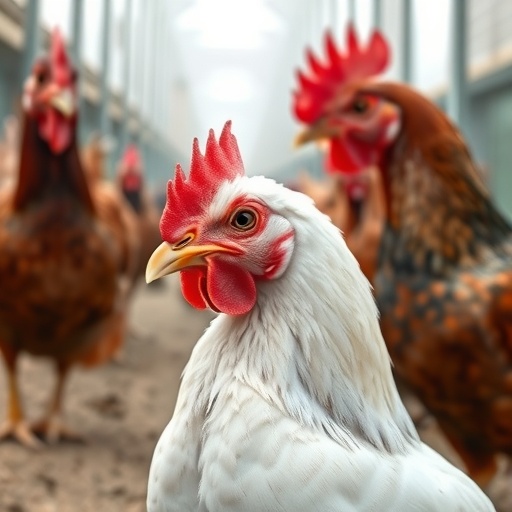
Avian influenza viruses are continuing to circulate widely in the environments where humans and poultry intersect in China, even as the country’s aggressive vaccination and culling strategy has suppressed the most dangerous H5 and H7 lineages in recent years. That is the central finding of a new surveillance study published in Virology Journal, in which researchers from the Chinese National Influenza Center and provincial disease control agencies tracked avian influenza viruses across live poultry markets, slaughterhouses, and farms in three Chinese cities over a two-year period, while simultaneously screening hundreds of hospitalized pneumonia patients for signs of zoonotic spillover. The results paint a picture of persistent, low-level viral circulation at the human-animal interface—dominated by the H9 subtype and punctuated by the continued presence of clade 2.3.4.4b H5 viruses, the same lineage that has swept across continents and caused unprecedented losses in wild birds and poultry worldwide.
The study, led by Xiaoxu Zeng, YuWei Weng, Sheng Ye, and Yifei Nie as co-first authors, with Dayan Wang of the Chinese National Influenza Center as corresponding author, was designed as a “multi-section” surveillance effort. Rather than sampling a single type of location or a single population, the team collected environmental specimens from three distinct categories of poultry-exposure settings—live poultry markets where birds are sold and slaughtered on site, commercial slaughterhouses, and poultry farms and backyard flocks—alongside respiratory specimens from patients hospitalized with pneumonia of unknown etiology, or PUE, a surveillance category used to catch severe respiratory infections whose cause is unclear at admission. The fieldwork ran from December 2021 to December 2023, spanning two full years and capturing both autumn-winter peaks and summer troughs of viral activity.
The laboratory backbone of the study was real-time reverse transcription polymerase chain reaction, or rRT-PCR, a technique that converts viral RNA into DNA and then amplifies and detects it using fluorescent probes. The researchers tested all 8,335 environmental samples for influenza A virus, the broad group that includes all avian influenza subtypes, and then ran subtype-specific assays targeting the H5, H7, H9, and H10 hemagglutinin subtypes. The hemagglutinin protein, the “H” in subtype names such as H5N1 or H9N2, is the viral surface molecule that determines which receptors the virus can bind and, largely, which species it can infect. Among human respiratory specimens, the team screened 840 samples from hospitalized PUE patients.
The headline number from the environmental sampling is striking: 32.2 percent of the 8,335 samples tested positive for influenza A virus. In other words, nearly one in three swabs taken from places where people routinely come into contact with poultry, poultry products, or poultry waste carried detectable avian influenza genetic material. The subtype breakdown was dominated by H9, which was detected in 20.1 percent of all samples—a reminder that this low-pathogenic subtype, which causes mild or asymptomatic disease in birds, is endemic in Chinese poultry production systems. H5, the subtype that includes both highly pathogenic and low-pathogenic variants, accounted for 7.1 percent of samples. H10 appeared only sporadically at 0.2 percent, and H7—the subtype behind severe human H7N9 outbreaks in China between 2013 and 2017—was not detected at all, a result consistent with the effectiveness of China’s poultry vaccination campaigns against that lineage.
Seasonality emerged as a clear pattern. Positive rates for both H5 and H9 were higher during autumn and winter months, mirroring the well-documented winter seasonality of respiratory influenza viruses and possibly reflecting cooler temperatures that prolong viral survival in the environment, along with increased poultry production and trade around winter holidays. Comparing the two study years, the median monthly positive rates for H5 and H9 were lower in 2023 than in 2022, although the researchers note that this downward trend did not reach statistical significance—a distinction that matters, because a non-significant decline could reflect sampling variability rather than a true reduction in viral circulation.
Geography within the poultry supply chain also mattered. H5 and H9 positive rates were generally higher in live poultry markets and slaughterhouses than in farms and backyard flocks. This gradient makes biological and operational sense: markets and slaughterhouses concentrate birds from many sources, creating opportunities for viral amplification and environmental contamination, while farms represent the upstream end of the chain where birds have had fewer opportunities for cross-contamination. The finding reinforces a recurring theme in influenza surveillance—live poultry markets are the critical bottleneck where avian viruses accumulate and where human exposure risk is highest.
The researchers went beyond simple positive rates by comparing specific environmental sample categories within these settings—cutting boards, drinking water, blood sewage, and other surfaces and fluids commonly sampled in poultry environments. Here the results diverged by subtype. H5 showed no statistically significant difference across sample categories (P = 0.06), but H9 did (P = 0.03), with significantly higher median positive rates found on cutting boards and in blood sewage than in drinking water. This detail has practical implications: cutting boards, where raw poultry is chopped at markets and in food preparation, and blood sewage, the contaminated liquid waste generated during slaughter, represent the environmental niches where H9 viruses persist most reliably. The finding suggests that hygiene interventions targeting these specific fomites and waste streams—disinfection of cutting surfaces, proper treatment of slaughter waste—could disproportionately reduce environmental viral load.
To understand the genetic identity and evolutionary relationships of the circulating viruses, the team sequenced the hemagglutinin genes of H5, H9, and H10 viruses detected in the environment and performed phylogenetic analysis, the computational reconstruction of evolutionary family trees from genetic sequence data. All of the viruses belonged to the Eurasian lineage, one of the two great evolutionary branches of avian influenza (the other being the North American lineage), reflecting the movement of viruses among birds across Eurasia. Critically, the H5 viruses clustered in clade 2.3.4.4b, the globally dominant H5 clade responsible for the ongoing panzootic that has devastated wild bird populations and spread to mammalian species on multiple continents. Its continued detection in Chinese poultry environments confirms that this lineage remains entrenched at the human-animal interface in the region, despite vaccination efforts.
Perhaps the most sobering finding came from the phylogenetic comparison between environmental and human viruses. Several H9 viruses recovered from environmental samples were found to be closely related to representative human H9N2 viruses—meaning the viruses circulating in market environments were genetically near neighbors of viruses known to have infected people. H9N2 is considered one of the most important zoonotic influenza lineages because it possesses receptor-binding and other genetic features compatible with human infection, and it serves as an internal gene donor in reassortment events, the process by which co-infecting influenza viruses exchange genome segments to generate novel combinations. Human infections with H9N2 are typically mild and often go undetected, which means the true spillover burden is likely underestimated—a concern amplified by the genetic proximity documented in this study.
Against this backdrop of persistent environmental contamination, the human surveillance results were, in a sense, reassuring. Of the 840 respiratory specimens from hospitalized patients with pneumonia of unknown etiology, 86 tested positive for seasonal influenza viruses—the ordinary human influenza A and B strains that cause annual epidemics. However, none of the 840 specimens tested positive for H5, H7, H9, or H10. No zoonotic spillover events were captured among severe pneumonia cases during the study period, suggesting that whatever low-level human infections with these subtypes may be occurring, they did not translate into hospitalizations with severe pneumonia in these three cities during the surveillance window.
The authors emphasize that their findings should be read as a call for continued vigilance rather than comfort. Multiple avian influenza subtypes continued to circulate in poultry-exposure environments throughout the study, with H5 clade 2.3.4.4b—an H5 lineage with demonstrated pandemic potential—still present, and H9 viruses genetically linked to known human infections persisting at high rates in the very settings where human exposure is most intense. The research team advocates for sustained, multi-site “One Health” surveillance—an integrated approach that monitors human, animal, and environmental health as a connected system—covering both poultry-exposure environments and human populations. Such surveillance, they argue, is essential to track the ongoing evolution and reassortment of avian influenza viruses and to detect zoonotic spillover events early, before they have the chance to seed larger outbreaks.
The study was approved by the Ethics Committee of the National Institute for Viral Disease Control and Prevention, with informed consent obtained from all participants, and was funded in part by China’s National Science and Technology Major Project for the Prevention and Control of Emerging and Major Infectious Diseases, along with China CDC–US CDC collaboration programs and provincial health research grants. As avian influenza viruses continue their global expansion—driven by clade 2.3.4.4b H5 viruses spreading through migratory birds and poultry trade—the study offers both a methodological template and a warning: the environment where humans and poultry meet remains heavily seeded with influenza viruses, and only continuous monitoring at that interface can reveal whether the next subtype to jump the species barrier is already quietly gathering the genetic tools to do so.
Cite Scienmag News
William Thompson. (September 8, 2026). Avian influenza surveillance in poultry environments and pneumonia patients across three Chinese cities. Scienmag. https://scienmag.com/avian-influenza-surveillance-in-poultry-environments-and-pneumonia-patients-across-three-chinese-cities/
William Thompson. "Avian influenza surveillance in poultry environments and pneumonia patients across three Chinese cities." Scienmag, 8 September 2026, https://scienmag.com/avian-influenza-surveillance-in-poultry-environments-and-pneumonia-patients-across-three-chinese-cities/. Accessed 8 September 2026.
William Thompson. "Avian influenza surveillance in poultry environments and pneumonia patients across three Chinese cities." Scienmag. September 8, 2026. https://scienmag.com/avian-influenza-surveillance-in-poultry-environments-and-pneumonia-patients-across-three-chinese-cities/


