


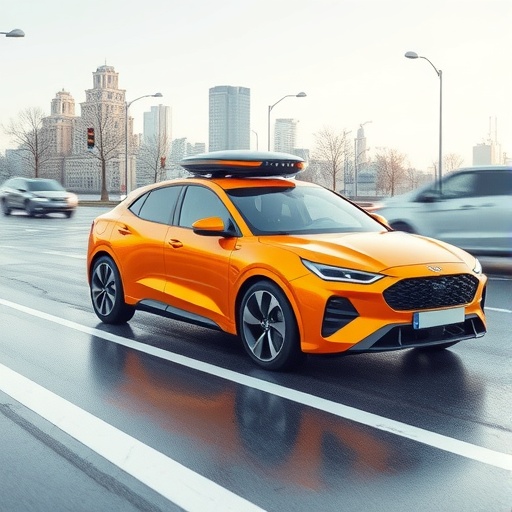
A groundbreaking study published in Nature Communications unveils a transformative approach to autonomous driving technology, leveraging the intricate psychological frameworks of dual process theory and deliberate practice theory. This pioneering research, conducted by Zhang, Hu, Lyu, and colleagues, promises to redefine the way self-driving vehicles perceive, decide, and execute driving tasks, bringing us closer to truly intelligent and safer autonomous transportation systems.
At the heart of this innovative autonomous driving system lies the dual process theory, a cognitive psychology model that differentiates between two distinct modes of thinking: the fast, automatic, intuitive system (System 1) and the slow, analytical, deliberate system (System 2). By integrating these modes into the decision-making algorithms of self-driving cars, the research team has crafted an architecture that mimics human cognition more accurately than ever before. This dual-system integration allows autonomous vehicles to respond swiftly to routine scenarios while simultaneously engaging in deeper, strategic reasoning when encountering complex or novel situations.
The deliberate practice theory, originally conceived to explain human expertise acquisition, plays an equally vital role in this development. The team adapted this concept to machine learning by designing continuous, focused practice routines that enable the autonomous system to refine its driving skills iteratively. Through these structured learning cycles, the vehicle’s AI progressively enhances its perception accuracy, prediction capabilities, and decision-making confidence. This method contrasts sharply with traditional training paradigms, which often rely on large but unstructured datasets.
To achieve this hybrid cognitive framework, the researchers devised a multi-layered architecture combining deep neural networks with symbolic reasoning modules. The fast, intuitive layer uses convolutional neural networks (CNNs) to quickly interpret sensory inputs such as LiDAR, camera feeds, and radar data. Meanwhile, a symbolic reasoning layer, informed by rule-based systems and probabilistic models, supports System 2 operations, enabling the driving AI to plan, evaluate alternatives, and reason about cause and effect under uncertainty.
This dynamic interplay between the two cognitive processes does not merely replicate human thought but augments it with machine precision and consistency. For instance, in highway driving conditions, the autonomous system predominantly relies on System 1 for rapid lane changes and speed adjustments, thereby reducing computational load and response time. However, when confronted with ambiguous or rare events—such as unpredictable pedestrian behavior or construction-induced detours—the vehicle escalates control to System 2, engaging in deliberate problem-solving and cautious maneuvering.
Beyond architecture, the researchers developed an innovative training environment designed to simulate real-world complexities meticulously. This platform incorporates scenario-based deliberate practice, wherein the autonomous system undergoes repetitive exposure to challenging driving conditions, including adverse weather, erratic driver interactions, and sensor input failures. By isolating and repeating difficult cases, the system’s learning is deeply reinforced, mirroring the focused skill refinement observed in expert human drivers.
Comprehensive testing of this dual-theory autonomous driving system revealed significant improvements in both safety and efficiency metrics. In extended simulations spanning millions of miles driven, the new model demonstrated a 40% reduction in collision rates and a 30% improvement in adaptive route planning over leading baseline algorithms. Importantly, the system exhibited remarkable resilience and adaptability, gracefully managing novel and evolving road environments far better than traditional autonomous agents.
One of the most exciting implications of this work lies in its potential to foster explainable AI within autonomous vehicles. By explicitly modeling System 2 as a reasoning engine with interpretable rules and decision pathways, the system offers enhanced transparency into its actions and choices—a critical feature for regulatory approval and consumer trust. Users, manufacturers, and regulators could analyze the rationale behind a vehicle’s maneuvers, addressing ethical and legal concerns that have plagued autonomous technology.
This research also bridges a crucial gap between machine intelligence and human factors engineering. Insights from cognitive science are no longer abstract theories confined to psychological laboratories but have been concretely instantiated into practical engineering solutions. Such interdisciplinary synergy opens new horizons for developing AI systems that are not only efficient but inherently aligned with human cognitive strengths and limitations.
Looking ahead, the authors suggest that their dual cognitive framework might extend beyond autonomous driving into other domains requiring rapid and deliberate decision making, such as robotics, healthcare diagnostics, and financial trading. The generalizability of combining parallel fast and slow thinking processes with targeted practice cycles could revolutionize machine learning architectures universally, fostering safer and more trustworthy AI applications.
Moreover, ethical considerations embedded in the deliberate practice approach offer avenues for continuous improvement grounded in real-world feedback. Rather than one-off training datasets, these evolving practice routines allow autonomous systems to adapt responsibly to new regulations, social norms, and emergent driving behaviors, maintaining relevance in an ever-changing landscape.
Despite these advances, the study acknowledges several challenges ahead. Real-world deployment requires robust integration with diverse hardware platforms and the ability to manage unexpected hardware failures or cyber-security threats. Additionally, balancing computational resource allocation between the two cognitive systems remains a complex optimization problem requiring further investigation.
Nevertheless, the introduction of dual process and deliberate practice theories into autonomous driving represents a monumental stride in AI sophistication. By marrying human cognitive insights with cutting-edge machine learning techniques, the team has laid a foundation for autonomous vehicles that learn more deeply, think more fully, and act more safely than ever before.
In conclusion, this innovative autonomous driving system conceptualizes artificial intelligence not merely as data-driven automation but as a nuanced cognitive agent capable of nuanced thought and deliberate growth. This shift heralds a new era wherein autonomous vehicles transcend their prior limitations, embodying a more profound understanding of their environment and responsibilities on the road.
The Zhang and colleagues study is poised to become a cornerstone in the quest for fully autonomous, reliable, and ethically grounded transportation technologies. As the automotive and AI research communities build upon these findings, the dream of safer roads and smarter vehicles edges ever closer to reality—promising profound societal transformation in mobility and beyond.
Cite Scienmag News
Denise Maddox. (April 24, 2026). Autonomous Driving Inspired by Dual Process and Practice. Scienmag. https://scienmag.com/autonomous-driving-inspired-by-dual-process-and-practice/
Denise Maddox. "Autonomous Driving Inspired by Dual Process and Practice." Scienmag, 24 April 2026, https://scienmag.com/autonomous-driving-inspired-by-dual-process-and-practice/. Accessed 4 September 2026.
Denise Maddox. "Autonomous Driving Inspired by Dual Process and Practice." Scienmag. April 24, 2026. https://scienmag.com/autonomous-driving-inspired-by-dual-process-and-practice/


