

Friday, October 23, 2026
Science
No Result
View All Result
  • Login
  • HOME
  • SCIENCE NEWS
  • CONTACT US
  • HOME
  • SCIENCE NEWS
  • CONTACT US
No Result
View All Result
Scienmag
No Result
View All Result
Home Science News Medicine

Autonomous AI eye exam closes diabetic retinopathy screening gap in minority youth

October 23, 2026
in Medicine
Ophelia Keating
By Ophelia Keating Scienmag Editorial Profile - Health Services Research
Reading Time: 2 mins read
0
Autonomous AI eye exam closes diabetic retinopathy screening gap in minority youth

Autonomous AI eye exam closes diabetic retinopathy screening gap in minority youth

65
SHARES
587
VIEWS
Share on FacebookShare on Twitter
ADVERTISEMENT

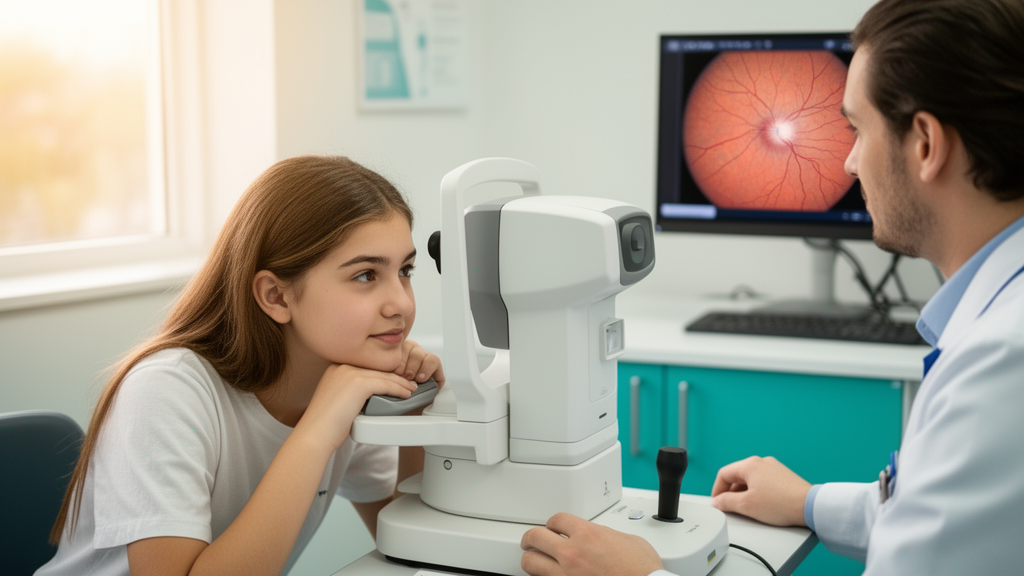
Autonomous artificial intelligence-based diabetic eye exams nearly eliminated a persistent screening gap when delivered directly at pediatric diabetes care visits, according to a prospective study of 397 young people with diabetes published in Nature Communications. Before the intervention, White youth were substantially more likely than non-White youth to have ever completed a diabetic eye exam, with 79.8% of the White cohort reporting prior screening compared with 61.8% of the non-White cohort, a statistically significant difference. After the point-of-care AI exam was offered, completion rose to 99.5% among White participants and 98% among non-White participants, achieving the study's primary endpoint of equivalence in screening completion between the two groups.

The findings address a twofold disadvantage documented in the study's framing: minority and underserved youth with diabetes are less likely to undergo diabetic retinopathy screening, yet more likely to have the condition. The ACCESS2 study hypothesized that autonomous AI-based diabetic eye exams could mitigate these screening disparities, and tested that hypothesis by embedding the exam directly into routine diabetes care visits rather than relying on a separate referral pathway. The study was registered as NCT05463289.

Participants were young people with type 1 diabetes, who made up 72% of the cohort, and type 2 diabetes, who accounted for 28%. All enrolled participants underwent the autonomous AI diabetic eye exam along with optical coherence tomography imaging during their diabetes care visits. Diagnostic performance was assessed against a prognostic standard using standard grading as the comparison.

For detecting more than mild diabetic retinopathy, the AI achieved a sensitivity of 100%, with a 95% confidence interval ranging from 67.6% to 100%, meaning no cases in this cohort were missed. Specificity was 76%, with a 95% confidence interval of 71.4% to 79.9%, indicating that roughly a quarter of eyes without the condition were flagged as positive. The equivalence in screening completion was demonstrated against a prespecified criterion rather than assumed.

The primary outcome compared completion rates between White and non-White youth after the AI intervention, and the near-identical rates of 99.5% and 98% satisfied it. This contrasts sharply with the baseline disparity in prior screening history that the researchers documented before any exposure to the AI exam. Even so, the authors describe the findings as suggesting the potential to reduce disparities in diabetic retinopathy screening, rather than proving a sustained reduction in retinopathy outcomes over time, and the results come from the specific study population and setting reported.

Subject of Research: Autonomous AI diabetic retinopathy screening to reduce disparities in youth with diabetes

Article Title: ACCESS2 study: the potential for autonomous AI to mitigate disparities in diabetic retinopathy screening in youth

Article References: Wolf, R. M., Channa, R., Liu, T. Y. A., Brown, E. A., Bromberger, L., Parimi, N., Zehra, A., Patel, D., Pan, B., Kim, Y. C., Shehadeh, A., Lehmann, H. P., & Abramoff, M. D. (2026). ACCESS2 study: the potential for autonomous AI to mitigate disparities in diabetic retinopathy screening in youth. Nature Communications. https://doi.org/10.1038/s41467-026-78842-w

Image Credits: AI Generated

DOI: 10.1038/s41467-026-78842-w

Keywords: autonomous AI, diabetic retinopathy, screening disparities, youth, type 1 diabetes, type 2 diabetes, point-of-care diagnostics, optical coherence tomography, health equity, ACCESS2 study, Nature Communications, prospective study

Cite Scienmag News

Ophelia Keating. (October 23, 2026). Autonomous AI eye exam closes diabetic retinopathy screening gap in minority youth. Scienmag. https://scienmag.com/autonomous-ai-eye-exam-closes-diabetic-retinopathy-screening-gap-in-minority-youth/


Ophelia Keating. "Autonomous AI eye exam closes diabetic retinopathy screening gap in minority youth." Scienmag, 23 October 2026, https://scienmag.com/autonomous-ai-eye-exam-closes-diabetic-retinopathy-screening-gap-in-minority-youth/. Accessed 23 October 2026.

Ophelia Keating. "Autonomous AI eye exam closes diabetic retinopathy screening gap in minority youth." Scienmag. October 23, 2026. https://scienmag.com/autonomous-ai-eye-exam-closes-diabetic-retinopathy-screening-gap-in-minority-youth/

Tags: ACCESS2 studyaddressing racial disparities in diabetic eye healthAI technology in routine diabetes careAI-based point-of-care eye examsautonomous AIAutonomous AI diabetic eye examsdiabetic retinopathydiabetic retinopathy screening disparitieshealth equityhealthcare equity in diabetic retinopathyintegrated AI screening in pediatric clinicsminority health interventionminority youth diabetes screeningNature Communications.optical coherence tomographypediatric diabetes eye screeningpoint-of-care diagnosticsprospective studyreducing healthcare disparities through AIscreening disparitiestype 1 diabetesType 2 diabetesyouthyouth diabetes management innovations
Share26Tweet16
Previous Post

TMS Biomarker Reveals Altered GABA Receptor Sensitivity in Heavy Drinkers

Next Post

Fracture Roughness and Reservoir Heterogeneity Reshape Shale Gas Production Forecasts

Related Posts

Year-Long Monitoring Maps VOC Variation Near Former Philadelphia Refinery
Medicine

Year-Long Monitoring Maps VOC Variation Near Former Philadelphia Refinery

October 23, 2026
France 2017 Death Certificate Redesign Doubled Medicolegal Investigations and Sharpened Mortality Data
Medicine

France 2017 Death Certificate Redesign Doubled Medicolegal Investigations and Sharpened Mortality Data

October 23, 2026
RNA Tag m6A Emerges as a Master Switch in Gene Control, Stress and Disease
Medicine

RNA Tag m6A Emerges as a Master Switch in Gene Control, Stress and Disease

October 23, 2026
Virtual reality may help see past masking in children’s neurodevelopmental assessments
Medicine

Virtual reality may help see past masking in children’s neurodevelopmental assessments

October 23, 2026
Simple Blood Count Predicts Immunotherapy Outcomes in Elderly Esophageal Cancer Patients
Medicine

Simple Blood Count Predicts Immunotherapy Outcomes in Elderly Esophageal Cancer Patients

October 23, 2026
Researchers Rethink Global Health Methods Through Dialogic, Non-Extractivist COVID-19 Study
Medicine

Researchers Rethink Global Health Methods Through Dialogic, Non-Extractivist COVID-19 Study

October 23, 2026
Next Post
Fracture Roughness and Reservoir Heterogeneity Reshape Shale Gas Production Forecasts

Fracture Roughness and Reservoir Heterogeneity Reshape Shale Gas Production Forecasts

  • Mothers who receive childcare support from maternal grandparents show more optimized

    Mothers who receive childcare support from maternal grandparents show more parental warmth, finds NTU Singapore study

    27656 shares
    Share 11059 Tweet 6912
  • University of Seville Breaks 120-Year-Old Mystery, Revises a Key Einstein Concept

    1061 shares
    Share 424 Tweet 265
  • Bee body mass, pathogens and local climate influence heat tolerance

    682 shares
    Share 273 Tweet 171
  • Researchers record first-ever images and data of a shark experiencing a boat strike

    546 shares
    Share 218 Tweet 137
  • Groundbreaking Clinical Trial Reveals Lubiprostone Enhances Kidney Function

    531 shares
    Share 212 Tweet 133
Science

Embark on a thrilling journey of discovery with Scienmag.com—your ultimate source for cutting-edge breakthroughs. Immerse yourself in a world where curiosity knows no limits and tomorrow’s possibilities become today’s reality!

RECENT NEWS

  • Fracture Roughness and Reservoir Heterogeneity Reshape Shale Gas Production Forecasts
  • Autonomous AI eye exam closes diabetic retinopathy screening gap in minority youth
  • TMS Biomarker Reveals Altered GABA Receptor Sensitivity in Heavy Drinkers
  • Year-Long Monitoring Maps VOC Variation Near Former Philadelphia Refinery

Categories

  • Agriculture
  • Anthropology
  • Archaeology
  • Athmospheric
  • Biology
  • Biotechnology
  • Blog
  • Bussines
  • Cancer
  • Chemistry
  • Climate
  • Earth Science
  • Editorial Policy
  • Marine
  • Mathematics
  • Medicine
  • Pediatry
  • Policy
  • Psychology & Psychiatry
  • Science Education
  • Science News
  • Social Science
  • Space
  • Technology and Engineering

Subscribe to Blog via Email

Enter your email address to subscribe to this blog and receive notifications of new posts by email.

Join 5,151 other subscribers

© 2025 Scienmag - Science Magazine

Welcome Back!

Login to your account below

Forgotten Password?

Retrieve your password

Please enter your username or email address to reset your password.

Log In
No Result
View All Result
  • HOME
  • SCIENCE NEWS
  • CONTACT US

© 2025 Scienmag - Science Magazine

Discover more from Science

Subscribe now to keep reading and get access to the full archive.

Continue reading