

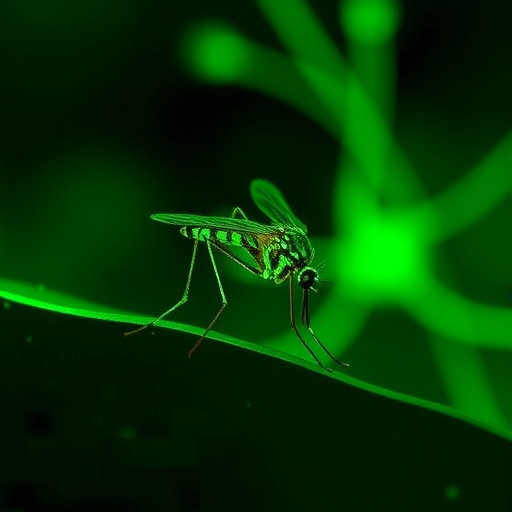
Female mosquitoes are notorious vectors of debilitating diseases, responsible for transmitting pathogens that cause approximately 700 million infections worldwide each year. Their ability to home in on human hosts is a complex process, involving the integration of multiple sensory stimuli during flight. To unravel the intricacies of mosquito host-seeking behavior, researchers have developed a novel, automated behavioral assay system known as the HOST assay, which provides a highly controlled and quantifiable method for studying mosquito attraction to cues characteristic of human hosts.
At the core of this innovative system is the precise measurement of mosquito landing and walking behaviors on designated target areas, which emit specific human-associated signals such as body temperature, elevated levels of carbon dioxide (CO2), and human skin odor. This assay offers a multifaceted approach by enabling scientists to dissect the individual impacts of thermal infrared radiation and convection, thereby distinguishing thermal-driven attraction from other sensory modalities. The fine resolution provided by this technique marks a significant advancement over previous host-seeking assays, which often lacked the capacity to separate these elements.
The experimental setup begins with mated female mosquitoes housed in specialized cages designed to facilitate recovery and maintain controlled conditions prior to testing. Instead of releasing the subjects directly into a large behavioral arena, the assay employs an innovative cage-lowering mechanism into the arena where the mosquitoes are exposed to the host-associated cues. This strategic method prevents mosquito escape, enhances throughput, and allows for more consistent behavioral observations across replicates.
During each HOST assay, female mosquitoes are subjected to a combination of stimuli that mimic natural host signals. The thermal cues replicate human body warmth through infrared emission, while controlled concentrations of CO2 simulate the breath exhaled by humans—a powerful attractant for mosquitoes. Additionally, the assay incorporates authentic human skin odors collected and emitted at regulated intensities. The interplay of these stimuli creates an environment closely resembling real-world conditions, allowing the mosquitoes’ sensory processing to be observed and recorded authentically.
Central to the assay’s functionality is an automated video recording system that continuously monitors mosquito behavior over the target zones. The recordings are subsequently processed using a custom software package, V-HOST, which efficiently analyzes landing frequencies and walking patterns on the target areas. This automation eliminates observer bias and drastically reduces the time required to quantify preference indices, essential metrics that detail the mosquitoes’ relative attraction to the different sensory cues.
The HOST assay protocol’s modular design enables rapid iteration and diverse experimental conditions. Interchangeable cages facilitate swift transitions between experiments, permitting a single laborer to perform approximately 24 individual technical replicates within a four-hour window during the critical early circadian time (ZT0–ZT4). This high-density throughput capability represents a leap forward in behavioral assay efficiency, particularly for studies entailing large sample sizes or varying stimulus combinations.
Unlike conventional host-seeking assays that either focus solely on trapping rates or rely heavily on direct mosquito release into arenas, the HOST assay delivers greater experimental control while maintaining ecological validity. Its ability to isolate thermal infrared radiation effects from convective airflow is particularly groundbreaking, allowing researchers to disentangle how mosquitoes differentiate between the radiant heat of a host and the accompanying air currents that often carry odor cues.
The accessible nature of the HOST assay is a significant advantage for global research communities. Utilizing commonly available materials and equipment, the protocol can be readily adopted without the need for expensive or highly specialized apparatus. This democratization of method availability is crucial for expanding mosquito behavior research across various geographic locations, including resource-limited settings where vector-borne disease burdens are often highest.
Another compelling benefit of this methodology lies in its potential application in vector control strategies. By providing a detailed understanding of mosquito sensory integration and host preference, the assay can inform the development of more effective repellents, traps, or attractants. Specifically, parsing out the roles of thermal, olfactory, and CO2 cues may highlight novel intervention points that prevent mosquitoes from successfully seeking human hosts.
The automated analysis framework reduces labor intensity and increases reproducibility, key factors in scientific rigor and scalability. By producing quantifiable preference indices, the HOST assay offers a sophisticated readout of mosquito behavior that transcends qualitative descriptions. These metrics enable nuanced comparisons between different mosquito strains, environmental conditions, or chemical treatments, facilitating in-depth ecological and physiological studies.
Furthermore, the HOST assay’s capability to evaluate mosquito walking as well as landing behavior enriches the behavioral dataset. While landing frequency is a direct indicator of attraction, walking patterns on the target surface provide insights into the investigation phase prior to blood feeding. This level of behavioral granularity opens avenues for exploring decision-making processes in mosquitoes, potentially linked to sensory processing or neural mechanisms.
As the urgency to combat mosquito-borne diseases intensifies, innovative tools like the HOST assay are paramount in enhancing foundational knowledge. By combining an integrative sensory approach with automation, the methodology bridges traditional entomology with cutting-edge technological advancements. This synthesis is likely to accelerate discoveries in vector biology and guide translational research aimed at reducing disease transmission.
Overall, the HOST assay embodies a strategic fusion of behavioral science, engineering, and computational analysis, creating a powerful platform for mosquito research. Its design addresses longstanding experimental challenges—such as distinguishing sensory cue contributions and increasing throughput—while providing a user-friendly system deployable in a variety of laboratory settings. The introduction of this tool represents a noteworthy milestone, promising to reshape investigations into mosquito-host interactions and support global public health endeavors.
In conclusion, the HOST assay stands as a pioneering behavioral assay that effectively measures female mosquito attraction to critical host cues through a finely controlled and automated process. By delivering high-resolution behavioral data on landing and movement behaviors in response to thermal infrared, CO2, and human skin odor stimuli, it grants researchers an unprecedented window into host-seeking strategies. This level of detail will undoubtedly accelerate the development of targeted mosquito interventions and deepen understanding of vector-host dynamics.
Subject of Research:
Mosquito host-seeking behavior and sensory integration during host attraction.
Article Title:
The HOST assay: an automated video-based evaluation of mosquito attraction to thermal infrared.
Article References:
DeBeaubien, N.A., Chandel, A., Salgado, V.L. et al. The HOST assay: an automated video-based evaluation of mosquito attraction to thermal infrared. Nat Protoc (2026). https://doi.org/10.1038/s41596-026-01335-z
DOI:
https://doi.org/10.1038/s41596-026-01335-z


