


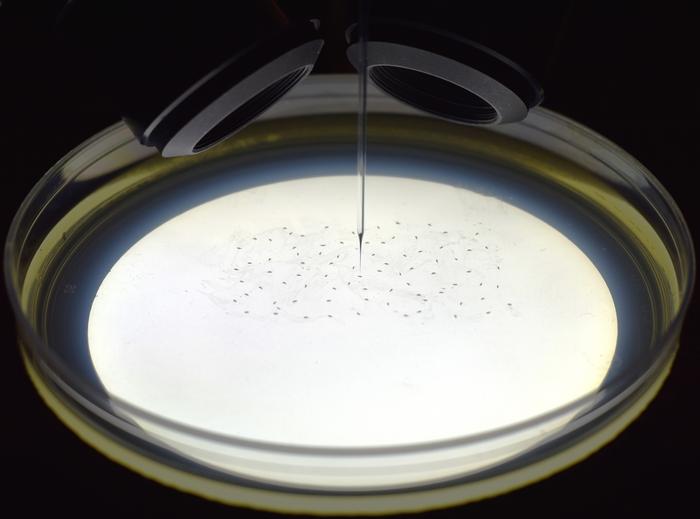
MINNEAPOLIS/ST. PAUL (04/26/2024) — University of Minnesota Twin Cities researchers have constructed a robot that uses machine learning to fully automate a complicated microinjection process used in genetic research.

Credit: Andrew Alegria, University of Minnesota Twin Cities
MINNEAPOLIS/ST. PAUL (04/26/2024) — University of Minnesota Twin Cities researchers have constructed a robot that uses machine learning to fully automate a complicated microinjection process used in genetic research.
In their experiments, the researchers were able to use this automated robot to manipulate the genetics of multicellular organisms, including fruit fly and zebrafish embryos. The technology will save labs time and money while enabling them to more easily conduct new, large-scale genetic experiments that were not possible previously using manual techniques
The research is featured on the cover of the April 2024 issue of GENETICS, a peer-reviewed, open access, scientific journal. The work was co-led by two University of Minnesota mechanical engineering graduate students Andrew Alegria and Amey Joshi. The team is also working to commercialize this technology to make it widely available through the University of Minnesota start-up company, Objective Biotechnology.
Microinjection is a method for introducing cells, genetic material, or other agents directly into embryos, cells, or tissues using a very fine pipette. The researchers have trained the robot to detect embryos that are one-hundredth the size of a grain of rice. After detection, the machine can calculate a path and automate the process of the injections.
“This new process is more robust and reproducible than manual injections,” said Suhasa Kodandaramaiah, a University of Minnesota mechanical engineering associate professor and senior author of the study. “With this model, individual laboratories will be able to think of new experiments that you couldn’t do without this type of technology.”
Typically, this type of research requires highly skilled technicians to perform the microinjection, which many laboratories do not have. This new technology could expand the ability to perform large experiments in labs, while reducing time and costs.
“This is very exciting for the world of genetics. Writing and reading DNA have drastically improved in recent years, but having this technology will increase our ability to perform large-scale genetic experiments in a wide range of organisms,” said Daryl Gohl, a co-author of the study, the group leader of the University of Minnesota Genomics Center’s Innovation Lab and research assistant professor in the Department of Genetics, Cell Biology, and Development.
Not only can this technology be used in genetic experiments, but it can also help to preserve endangered species through cryopreservation, a preservation technique conducted at ultra-low temperatures.
“You can use this robot to inject nanoparticles into cells and tissues that helps in cryopreservation and in the process of rewarming afterwards,” Kodandaramaiah explained.
Other team members highlighted other applications for the technology that could have even more impact.
“We hope that this technology could eventually be used for in vitro fertilization, where you could detect those eggs on the microscale level,” said Andrew Alegria, co-lead author on the paper and University of Minnesota mechanical engineering graduate research assistant in the Biosensing and Biorobotics Lab.
In addition to Kodandaramaiah, Gohl, Alegria, and Joshi, the team included several researchers from the University of Minnesota’s College of Science and Engineering and the University of Minnesota Genomics Center’s Innovation Lab. The team recently won the University’s “Walleye Tank” life science competition. This life science pitch competition provides education and promotional opportunities for emerging and established medical and life science companies.
This research was completed in collaboration with the Engineering Research Center for Advanced Technologies for the Preservation of Biological Systems (ATP-Bio) and the University of Minnesota Zebrafish Core.
The paper was funded by the National Institute of Health, Minnesota Sea Grant, and the National Science Foundation. Additional support was provided by the University of Minnesota Diversity of Views and Experiences (DOVE) fellowship and Minnesota’s Discovery, Research, and Innovation Economy (MnDRIVE) fellowship from the University of Minnesota Informatics Institute (UMII).
To read the entire research paper titled, “High-throughput genetic manipulation of multicellular organisms using a machine-vision guided embryonic microinjection robot,” visit the GENETICS website.
Journal
Genetics
Method of Research
Experimental study
Subject of Research
Cells
Article Title
High-throughput genetic manipulation of multicellular organisms using a machine-vision guided embryonic microinjection robot
Article Publication Date
19-Feb-2024
Cite Scienmag News
Denise Maddox. (April 26, 2024). Automated machine learning robot unlocks new potential for genetics research. Scienmag. https://scienmag.com/automated-machine-learning-robot-unlocks-new-potential-for-genetics-research/
Denise Maddox. "Automated machine learning robot unlocks new potential for genetics research." Scienmag, 26 April 2024, https://scienmag.com/automated-machine-learning-robot-unlocks-new-potential-for-genetics-research/. Accessed 4 September 2026.
Denise Maddox. "Automated machine learning robot unlocks new potential for genetics research." Scienmag. April 26, 2024. https://scienmag.com/automated-machine-learning-robot-unlocks-new-potential-for-genetics-research/

