

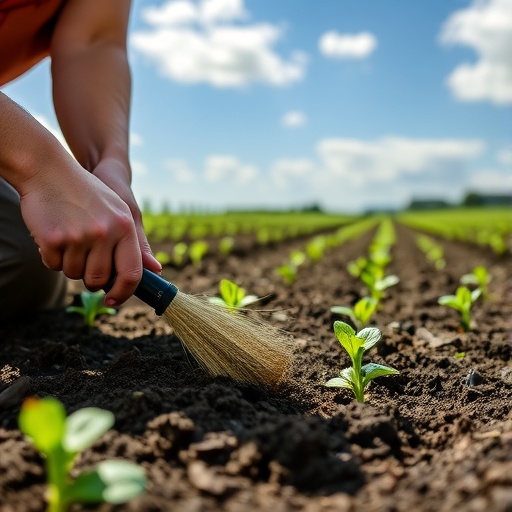
In the intricate world beneath our feet lies a complex ecosystem teeming with microscopic life forms that play a pivotal role in sustaining terrestrial environments. Recent advances in soil science have unveiled a groundbreaking approach to decoding the diversity of bacterial and fungal communities, with profound implications for assessing soil health and predicting ecological vulnerability. A study led by Viscarra Rossel and colleagues introduces a revolutionary method that harnesses the power of machine learning, specifically autoencoders, to distill the complexity of microbial richness into a unified, interpretable ratio. This novel metric promises to transform our understanding of soil ecosystems, paving the way for more precise environmental monitoring and sustainable land management.
Soil, often regarded as inert, is in fact a vibrant matrix hosting billions of microorganisms per gram, including bacteria and fungi that orchestrate critical biogeochemical cycles. These microbes regulate nutrient availability, organic matter decomposition, and plant health, thus directly influencing ecosystem productivity and resilience. However, quantifying this microbial diversity and linking it to soil functionality has historically been challenging due to the immense heterogeneity and vast biodiversity intrinsic to soil environments. Traditional approaches relying on species counts or diversity indices frequently fall short in capturing the nuanced interactions and functional potential of microbial communities.
The study spearheaded by Viscarra Rossel and colleagues addresses these limitations by employing autoencoders—a sophisticated class of neural networks conceived initially for data dimensionality reduction and pattern recognition. Autoencoders are designed to learn compressed representations of high-dimensional input data, effectively filtering out noise and accentuating meaningful features. By applying these to bacterial and fungal richness datasets, the researchers distilled complex community compositions into concise, latent variables that encapsulate underlying ecological information often obscured in traditional analyses.
This integrated metric, emerging from the autoencoder model, represents a unified ratio that correlates with both soil health status and ecological susceptibility. Soil health, a multifaceted concept, encompasses physical, chemical, and biological properties that sustain productivity, resilience, and environmental quality. Ecological susceptibility, on the other hand, refers to the vulnerability of ecosystems to perturbations such as climate change, pollution, or land use shifts. By linking microbial richness directly to these pivotal attributes, the research offers a quantitative bridge going beyond mere description towards predictive capability.
A key strength of this approach lies in its capacity to simultaneously decode bacterial and fungal communities, which often respond differently to environmental drivers and interact in complex symbiotic or antagonistic relationships. Prior studies have typically examined these groups independently due to methodological constraints. The autoencoder framework enables the integration of these data streams, thereby capturing inter-kingdom dynamics that are fundamental to soil ecosystem functioning.
The implications of this research extend far beyond academic curiosity, with practical applications in agriculture, conservation, and land management. For instance, farmers and land stewards could leverage this unified ratio as a rapid diagnostic tool to monitor soil health in real-time, guiding fertilization, irrigation, and crop rotation strategies that optimize microbial benefits and minimize ecological risk. Furthermore, policymakers could incorporate this metric into environmental assessment protocols to identify vulnerable landscapes and prioritize remedial interventions.
The methodology’s scalability is particularly noteworthy. Soil microbial datasets are notoriously vast and complex, often comprising millions of sequencing reads translating into thousands of operational taxonomic units. Autoencoders efficiently reduce this dimensionality without sacrificing biological interpretability, making the approach suitable for large-scale monitoring programs spanning diverse geographic regions and soil types.
Moreover, the study underscores how integrating artificial intelligence with ecological theory can revolutionize environmental sciences. While machine learning methods have gained traction in many disciplines, their application in soil microbial ecology has remained limited due to challenges in data quality and interpretability. Viscarra Rossel’s team sets a new benchmark by demonstrating that tailored neural network architectures can extract ecologically meaningful patterns, facilitating a deeper mechanistic understanding of soil microbial communities.
Intriguingly, the unified ratio derived via autoencoders also exhibits predictive power regarding ecological shifts under future scenarios. Climate change and anthropogenic pressures increasingly threaten soil biodiversity and function, yet forecasting these impacts has remained elusive. Through validation across varied ecosystems, the research reveals that this microbial richness ratio can act as an early-warning indicator, highlighting ecosystems at risk of losing resilience before visible degradation occurs.
This work also calls attention to the importance of maintaining microbial diversity as a cornerstone of ecosystem sustainability. While policy discussions often prioritize aboveground biodiversity and habitat preservation, this new metric quantifies the invisible microbial dimension underpinning terrestrial health, encouraging a more holistic conservation paradigm.
Furthermore, the autoencoder-based approach is adaptable to other microbial data types, such as metatranscriptomic or metabolomic profiles, potentially broadening its utility to encompass not just presence and richness but also microbial activity and functional potential. This versatility opens pathways for future research to decode the soil microbiome’s role in carbon cycling, pollutant degradation, and disease suppression with unprecedented precision.
The study’s comprehensive datasets derived from multiple soil types and climatic zones reinforce the robustness and generalizability of the findings. By capturing diverse environmental gradients, the model accounts for regional variability, enhancing confidence in its application to global soil health assessments.
While promising, the authors also acknowledge challenges ahead, including the need for standardized protocols in microbial sampling, sequencing, and data preprocessing to maximize comparability across studies. Additionally, further refinement of the neural network’s architecture could enhance interpretability, bridging computational outputs with ecological mechanisms more transparently.
Notwithstanding these challenges, the integration of cutting-edge AI with soil microbial ecology heralds a paradigm shift in environmental monitoring. This unified ratio, distilled from the hidden patterns of bacterial and fungal richness, equips scientists and land managers with a powerful tool to decode soil health and predict ecological susceptibility, thus fostering sustainable stewardship of the planet’s vital soil resources.
In summary, the study by Viscarra Rossel and colleagues marks a seminal advancement in soil science by demonstrating how autoencoders can unravel complex microbial richness data to yield a singular, interpretable metric with extensive ecological relevance. This approach not only enriches our understanding of the subterranean microbial world but also equips society with a practical gauge of environmental health and resilience in an era of rapid ecological change.
Subject of Research:
Article Title:
Article References:
Viscarra Rossel, R.A., Behrens, T., Bissett, A. et al. Decoding bacterial and fungal richness with autoencoders yields a unified ratio indicating soil health and ecological susceptibility. Commun Earth Environ (2026). https://doi.org/10.1038/s43247-026-03398-y
Image Credits: AI Generated
DOI: 10.1038/s43247-026-03398-y
Keywords: soil health, microbial richness, bacterial diversity, fungal diversity, autoencoder, machine learning, ecological susceptibility, soil microbiome, environmental monitoring, soil ecosystem functioning


