


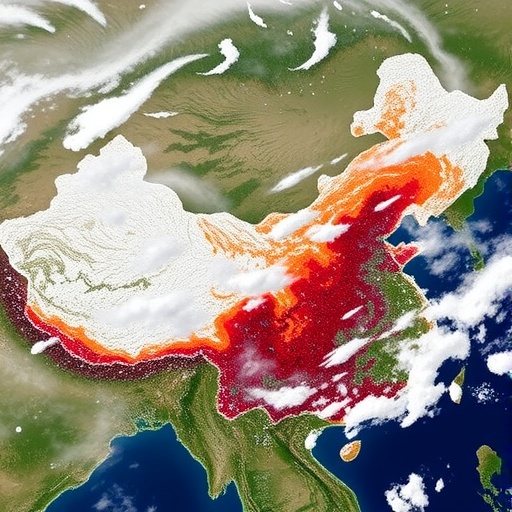
In the quest to deeply understand and effectively mitigate the carbon emissions generated by industrial heavyweight sectors, a groundbreaking study has emerged from researchers at South China University of Technology. Their research meticulously maps the carbon footprint of China’s massive pulp and paper industry plant-by-plant, utilizing a sophisticated multimodal fusion framework that integrates satellite imaging, advanced natural language processing, and detailed industrial data. This nuanced approach transcends traditional carbon accounting methods, revealing unprecedented disparities between individual factories, spatial functional zones, and potential for targeted decarbonization interventions.
Historically, carbon emission assessments in China’s pulp and paper sector have relied on aggregated national or provincial data, employing averaged emission factors or energy consumption metrics. While these strategies offered a broad-stroke understanding, they inevitably obscured significant heterogeneity among the 720 pulp and papermaking plants across the country. This lack of granularity translates into distorted emissions inventories and undermines the precision of policy directives. By failing to identify specific high-impact sources within plants or isolate processes responsible for emissions, earlier estimations limited the efficiency of reduction strategies.
The team’s novel framework leverages high-resolution remote sensing imagery combined with an AI-driven classification model based on BERT (Bidirectional Encoder Representations from Transformers) to parse vast textual industrial records. This multimodal fusion effectively categorizes plants into functionally relevant groups, accurately delineates their physical boundaries, and identifies internal zones such as raw material storage, wastewater treatment facilities, and energy production areas. This integrative methodology preserved spatial and operational complexity, enabling precise emissions quantification at unparalleled granularity.
With a rigorous validation protocol, the model achieved exemplary fit statistics, including R² values as high as 0.96 in correlating estimated carbon outputs against observed data points. The researchers quantified that in 2022, China’s pulp and paper industry emitted approximately 163.6 million metric tons of CO₂. Notably, emissions were heavily concentrated in coastal provinces, which accounted for over 60% of total emissions. Even more striking was the disproportionate contribution of a small fraction of facilities: the top 5% highest-emitting plants were responsible for nearly 43% of all emissions, underscoring the potential for disproportionate impact through targeted mitigation.
An insightful revelation emerged from analyzing emissions by internal functional zones. Wastewater treatment areas consistently emerged as significant carbon emission hotspots across diverse plant types—a facet largely underrepresented in conventional energy-centric accounting models. This suggests that legacy approaches have systematically underestimated the emissions embedded in specific process sectors within plants, preventing accurate targeting of emission sources and dampening mitigation effectiveness.
Beyond inventorying, the study simulated rooftop photovoltaic (PV) solar panel deployment potential to evaluate practical decarbonization scenarios. By modeling solar panel installation on available rooftop real estate under variable capacity assumptions, the team found that solar energy deployment could reduce annual CO₂ emissions by as much as 16.9 million tons, equating to over 10% of the sector’s emissions. This finding highlights a readily implementable renewable energy pathway that could be prioritized in industrial decarbonization roadmaps.
This work signals a paradigmatic shift in industrial carbon accounting. Moving from aggregate averages to plant-level, fine-scaled analysis permits policymakers to adopt precision regulation and incentives. The ability to identify and focus resources on the limited number of high-emission plants and high-yield zones inside them promises heightened efficacy in emissions reduction strategies. It also offers greater insights into the nuanced influence of raw materials, production variations, wastewater operations, and energy dynamics within heterogeneous industrial landscapes.
Technically, the fusion framework’s success derives from multiscale data integration and hybrid AI techniques. The remote sensing component captures geospatial signatures and structural features invisible through textual data alone, while BERT-driven natural language analysis extracts latent functional and operational classifications from unstructured industrial records. This multimodal synergy enhances classification accuracy and emission estimation fidelity beyond what any single modality can achieve in isolation.
China’s pulp and paper sector stands to benefit from this refined mapping approach in more than just emissions accounting. Plant-specific carbon mapping informs retrofit prioritization, guiding investments in cleaner energy technologies where they will achieve maximal benefit. The insights regarding wastewater treatment’s outsized carbon footprint could catalyze process redesigns or technology substitutions to curb emissions more aggressively.
Importantly, this study’s value extends well beyond China and the paper industry. The presented framework offers a transferable blueprint for carbon accounting in other complex heavy industries globally, where heterogeneous processes and facility diversity have historically challenged exact emissions quantification. By combining AI, satellite observation, and industrial data streams, it provides a cost-efficient and scalable route to high-resolution emissions tracking, a key enabler for effective climate policies in industrial sectors.
In conclusion, the pioneering research spearheaded by the South China University of Technology team demonstrates the transformative impact of leveraging state-of-the-art AI and remote sensing for plant-level carbon accounting. Their work not only exposes the uneven landscape of carbon emissions within China’s pulp and paper industry but also charts actionable mitigation pathways, particularly through renewable integration like rooftop solar. As industries worldwide grapple with the urgency of climate action, such fine-grained emission mapping holds immense promise to sharpen policy focus, optimize decarbonization efforts, and accelerate the transition toward sustainable industrial ecosystems.
News Publication Date: 11-Mar-2026
References:
DOI: 10.1016/j.ese.2026.100682
Keywords
Carbon accounting, pulp and paper industry, multimodal fusion, remote sensing, BERT text classification, industrial emissions, wastewater treatment emissions, rooftop photovoltaic, decarbonization strategies, China, AI-driven environmental monitoring, plant-level inventory
Cite Scienmag News
Denise Maddox. (March 20, 2026). AI and Satellite Data Reveal Carbon Emission Hotspots in China’s Paper Industry. Scienmag. https://scienmag.com/ai-and-satellite-data-reveal-carbon-emission-hotspots-in-chinas-paper-industry/
Denise Maddox. "AI and Satellite Data Reveal Carbon Emission Hotspots in China’s Paper Industry." Scienmag, 20 March 2026, https://scienmag.com/ai-and-satellite-data-reveal-carbon-emission-hotspots-in-chinas-paper-industry/. Accessed 3 September 2026.
Denise Maddox. "AI and Satellite Data Reveal Carbon Emission Hotspots in China’s Paper Industry." Scienmag. March 20, 2026. https://scienmag.com/ai-and-satellite-data-reveal-carbon-emission-hotspots-in-chinas-paper-industry/


