

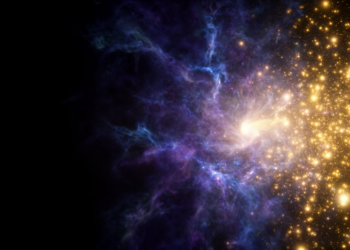
New Lumina simulation watches the universe emerge from the cosmic dark ages
The Lumina simulation, run on one of the world's most powerful supercomputers, tracks dark matter, galaxies, stars, and radiation across...

The Lumina simulation, run on one of the world's most powerful supercomputers, tracks dark matter, galaxies, stars, and radiation across...
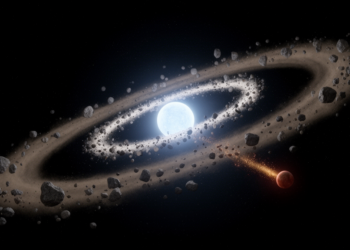
Astronomers have found a white dwarf encircled by two nested gaseous debris rings whose quadruple-peaked emission lines point to sculpting...
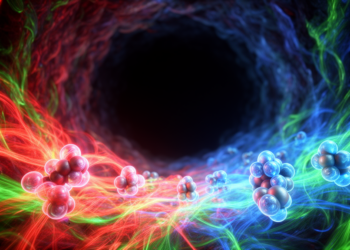
Researchers have proposed a theoretical explanation for unusual patterns observed in the production of light nuclei during high-energy heavy-ion collisions....

A user study found that an immersive spaceship interface did not change wrist-worn stiffness discrimination accuracy or sensitivity, but shifted...
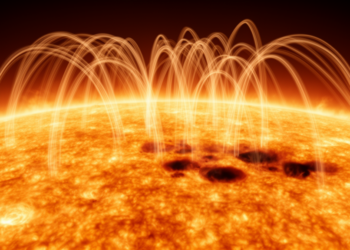
The research analyzes the early evolutionary stages of active regions to address a fundamental question in heliophysics: whether magnetic structures...
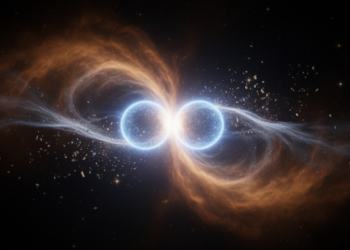
UCLA-led simulations show that extremely dense stellar systems in the early universe may have produced frequent stellar collisions, repeated mergers...
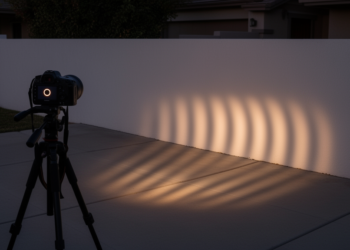
A new image-processing framework quantifies eclipse shadow bands from consumer-grade video, detecting statistically significant band activity that persists more than...
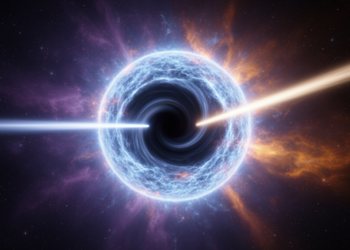
Every black hole predicted by classical general relativity hides a fatal flaw at its center: a spacetime singularity, a point...
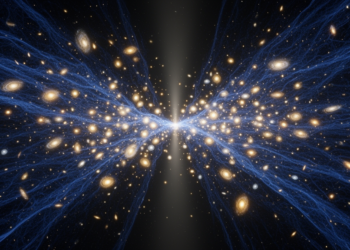
Applying the dipole fitting method to 313 X-ray galaxy clusters for the first time, researchers find faint hints of a...
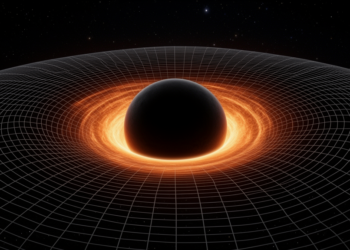
Theorists have built a regular black hole model with a flat core and a degenerate inner horizon in which the...


Embark on a thrilling journey of discovery with Scienmag.com—your ultimate source for cutting-edge breakthroughs. Immerse yourself in a world where curiosity knows no limits and tomorrow’s possibilities become today’s reality!