


Australian researchers are developing solutions to recycle solar panels and recover strategic metals including silver and copper.

Credit: RMIT
Australian researchers are developing solutions to recycle solar panels and recover strategic metals including silver and copper.
In Australia alone, it’s estimated more than 100,000 tonnes of solar panels will enter the waste stream by 2035, along with billions of dollars’ worth of materials that could be recaptured.
RMIT University is leading an international network of researchers working to advance the reuse and recycling of solar panels, which can contain valuable materials like lead and tin.
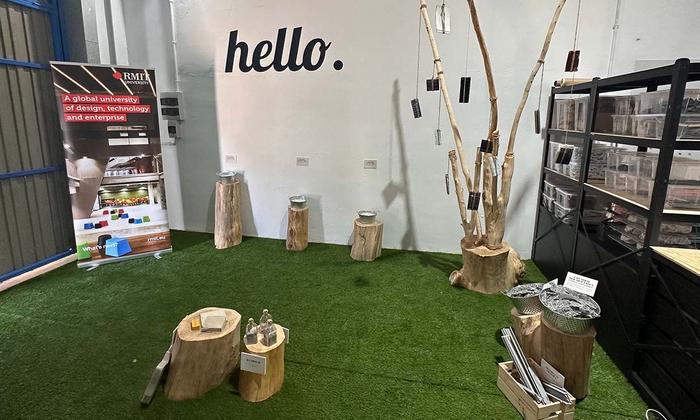
Thursday 13 June was the opening of a work and exhibition space at engineering company EDIPAE’s site in Tomelloso, Spain.
The space is a local hub for researchers and industry to collaborate on how best to recover, use and commercialise valuable materials extracted from recycled solar panels.
EDIPAE director Carlos Miralles Sánchez said as the network’s industry partner in Spain, his company was proud to contribute to a circular economy model for solar panels.
“We now have a physical space to work with researchers on a cheaper and easier recycling solution through this Australian technology,” he said.
“We also have a workshop with tools for creating prototypes so ideas can be developed as well as exhibited to the public.”
The facility houses a public exhibition of the different types of modules and the by-products obtained after recycling them.
EDIPAE will also work with local entities to provide employment and education opportunities.
Technological partner the University of Castilla-La Mancha will use the space to deliver training workshops and conduct research through its Renewable Energy Research Institute.
RMIT’s Dr Ylias Sabri said while solar panels are helping to reduce carbon emissions, the infrastructure to scrap and effectively recycle them once they reach their end of life has been lacking.
“Solar panels have a lifespan of 25 to 30 years and contain valuable metals including silver and copper,” he said.
“But there’s historically been little interest in recovering these strategic metals from discarded panels as it’s difficult and expensive to do, so they end up in landfill.”
It’s hoped technology being developed by Sabri and his team could be part of the solution to improve the economic viability of recycling solar panels.
“RMIT is in a prime position to support this large and growing market and consequent job creation,” Sabri said.
The Integrating End of Life Solar Panel Waste in Circular Economy network is funded by the Australian Government Department of Climate Change, Energy, the Environment and Water (ICIRN000011).
It involves multidisciplinary teams of researchers and industry partners, including New York University, University of Castilla-La Mancha, CSIR-National Physical Laboratory, King’s College London, EDIPAE, My Second Life Solar, HP Energy and others.
About RMIT
RMIT is an international university of technology, design and enterprise, with more than 90,000 students and over 11,000 staff globally. The University empowers people and communities to adapt and thrive across generations with education, research and civic engagement that are applied, inclusive and practical. Postgraduate, undergraduate, vocational education, foundation studies and online programs offer students a variety of work-relevant pathways.
Our three substantial campuses in Melbourne, Australia are located in the City, Brunswick and Bundoora, along with other Victorian locations. We also have two campuses (Saigon South and Hanoi) and an English language centre in Vietnam and a research and innovation hub in Spain. In addition, programs are offered through partners in Singapore, Hong Kong, Sri Lanka, Indonesia, India and China, with research and industry partnerships across the globe.
Cite Scienmag News
Courtney Benton. (June 13, 2024). Australian solar panel recycling tech on show in Spain. Scienmag. https://scienmag.com/australian-solar-panel-recycling-tech-on-show-in-spain/
Courtney Benton. "Australian solar panel recycling tech on show in Spain." Scienmag, 13 June 2024, https://scienmag.com/australian-solar-panel-recycling-tech-on-show-in-spain/. Accessed 3 September 2026.
Courtney Benton. "Australian solar panel recycling tech on show in Spain." Scienmag. June 13, 2024. https://scienmag.com/australian-solar-panel-recycling-tech-on-show-in-spain/

