


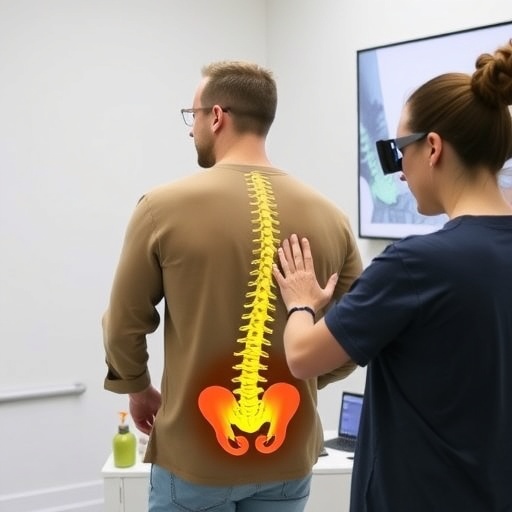
In a groundbreaking study published in BMC Medical Education, researchers explored the transformative potential of augmented reality (AR) combined with haptic feedback in advancing medical training, specifically focusing on the complex procedure of lumbar puncture. The study, led by renowned academics including Felten, Bigaut, and Wirth, sought to gauge the efficacy of these innovative technologies in improving not only the technical skills of medical practitioners but also their confidence in executing this critical procedure.
The lumbar puncture, a procedure involving the extraction of cerebrospinal fluid, is crucial for diagnosing various medical conditions. However, it is also a procedure that carries risks when performed incorrectly. As such, there has long been a need for enhanced training methodologies that could bridge the gap between theoretical knowledge and clinical practice. The introduction of AR and haptic technology may very well provide the answer that medical educators have been searching for.
The randomized controlled trial engaged participants across different levels of medical expertise. Medical students with varying degrees of experience were divided into two groups: one group utilized traditional training methods while the second was exposed to AR simulations paired with haptic feedback systems. This approach allowed the researchers to make a robust comparison between classical learning techniques and innovative digital solutions.
Haptic feedback technology emerged as a focal point of the research due to its remarkable ability to simulate real-life sensations felt during procedures. Participants engaging with the AR simulation reported heightened tactile sensations when performing virtual lumbar punctures, which closely mimicked what they would encounter in actual clinical settings. By incorporating these sensations into training, students could develop a deeper understanding of the procedure without the inherent risks associated with practicing on actual patients.
Another intriguing aspect of the study was the use of augmented reality overlays during practice sessions. This technology superimposes clinical data, anatomical structures, and procedural instructions directly onto the practitioner’s field of vision in real-time. By doing so, students are not merely performing a sequence of tasks; they are also integrating vital information that enhances their proficiency and clinical judgment.
The pilot study demonstrated compelling outcomes. Students who underwent training through AR and haptic feedback expressed a significant increase in confidence levels compared to their peers who followed traditional instruction. This finding is particularly relevant in a medical context, where confidence can greatly influence a practitioner’s performance under pressure. The study’s implications suggest that immersing students in enhanced training environments could foster not only skill proficiency but also a more competent workforce prepared to meet real-world challenges.
Feedback from participants also indicated that those who used the AR simulations retained information better than their traditionally-trained counterparts. Enhanced retention is crucial in the medical field, where practitioners must recall complex information rapidly during patient care. The visualization of anatomical structures and procedures through AR appears to provide an additional cognitive layer that aids memory.
In analyzing the data, the researchers noted that the AR group made significantly fewer errors during their practical examinations. This reduction in errors highlights the potential of these technologies to improve patient safety standards, an essential factor in any medical training program. The researchers emphasized that as medical education evolves, integrating such cutting-edge technologies could ensure a higher caliber of clinical training.
Despite these promising outcomes, the researchers acknowledge that further studies with larger sample sizes and longer-term follow-ups will be necessary to establish the full scope of benefits associated with AR and haptic feedback in medical training. They also call for a deeper examination into the cost-effectiveness of implementing such technologies across diverse medical education settings, especially in resource-limited environments.
In a world where technological advancements are continually reshaping various sectors, the medical field is now positioned to benefit from these innovations. The success of this study encourages educational institutions to consider an overhaul of their training methodologies, especially regarding practical procedures requiring high levels of skill and precision.
The birth of AR and haptic technologies in the medical training landscape signifies a shift toward more engaging and effective educational paradigms. As educators and institutions recognize the value of immersive learning experiences, we could witness a renaissance in how future practitioners are prepared for their roles in patient care.
In conclusion, this pioneering research underscores the vital role that technology can play in enhancing medical education, particularly through the use of augmented reality and haptic feedback systems. The initial findings suggest a positive trajectory toward improving both the confidence and competencies of medical trainees, ultimately leading to better outcomes for patients. As we move forward into a new era of medical training, embracing these technologies may very well be the key to achieving excellence in healthcare delivery.
Felten, R., Bigaut, K., Wirth, T. et al. Advancing medical training with augmented reality and haptic feedback simulator: outcomes of a randomized controlled trial on lumbar puncture.
BMC Med Educ 25, 1231 (2025). https://doi.org/10.1186/s12909-025-07536-6
Cite Scienmag News
Courtney Benton. (September 1, 2025). Augmented Reality and Haptics Enhance Lumbar Puncture Training. Scienmag. https://scienmag.com/augmented-reality-and-haptics-enhance-lumbar-puncture-training/
Courtney Benton. "Augmented Reality and Haptics Enhance Lumbar Puncture Training." Scienmag, 1 September 2025, https://scienmag.com/augmented-reality-and-haptics-enhance-lumbar-puncture-training/. Accessed 3 September 2026.
Courtney Benton. "Augmented Reality and Haptics Enhance Lumbar Puncture Training." Scienmag. September 1, 2025. https://scienmag.com/augmented-reality-and-haptics-enhance-lumbar-puncture-training/


