


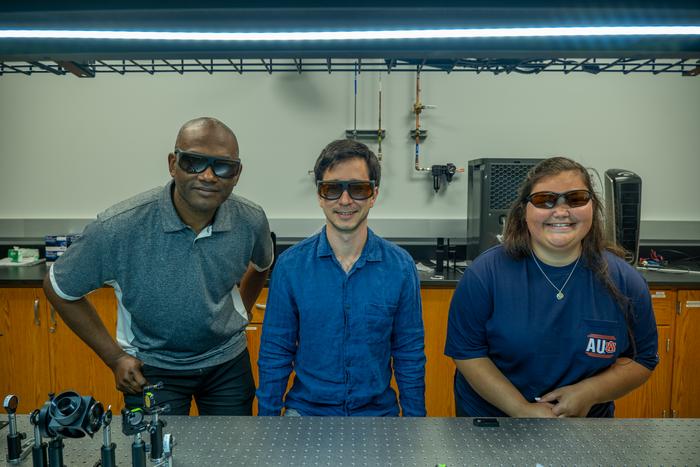
Paul Ohno, assistant professor in the Department of Chemistry and Biochemistry, is the recipient of a prestigious National Institutes of Health (NIH) award for $370,348 over the next two years.

Credit: Auburn University College of Sciences and Mathematics
Paul Ohno, assistant professor in the Department of Chemistry and Biochemistry, is the recipient of a prestigious National Institutes of Health (NIH) award for $370,348 over the next two years.
“Respiratory viruses exhibit different transmission rates due to environmental factors such as temperature and humidity,” said Ohno. “With this award, my lab, the Ohno Research Group, is developing and applying new techniques to characterize respiratory aerosols to help better understand the physical basis for these effects and ultimately inform approaches to mitigate respiratory virus transmission.”
The tiny particles studied by Ohno are around one micron in diameter or smaller. “Smaller particles stay in the air much longer than larger particles, allowing them to transport viruses over longer distances. However, being around 1/100th the diameter of a human hair makes it more complex to study and analyze these particles” added Ohno.
So, Ohno is building a new, innovative instrument to do just that.
“Fluorescence, or the emission of light by excited molecules, is one of the only techniques sensitive enough to study such small particles at realistic concentrations while they are suspended in air,” explained Ohno.
Because fluorescence is not inherently sensitive to properties of interest like pH, viscosity, and phase state, the Ohno Group first introduces into the particles specific molecules, known as probe molecules, that are sensitive to these properties.
“Then, we excite these molecules with a laser and detect the color of the light that comes out,” said Ohno. “For example, a more blueish color might indicate a particle that is phase-separated akin to oil and vinegar salad dressing, while a more reddish color might indicate a well-mixed particle.”
Recent research has suggested that the mixing state of the particles may play a key role in determining changes in virus viability at differing relative humidity levels, motivating the interest of the Ohno Group in this property.
The NIH award is through an R21 Technology Development Program that supports researchers to develop high risk, high reward approaches.
“Once we have good tools to measure the key properties of these aerosols under realistic environmental conditions, we and other researchers will be able to deploy them to directly connect these properties to virus viability and transmissibility,” Ohno explained.
Ohno is not the only researcher that was genuinely excited for this exploratory award.
“I am extremely proud of the work that third-year graduate student Angel Gibbons has done in my lab,” said Ohno. “She laid much of the groundwork for this award, and will be presenting her work at the annual meeting of the American Association for Aerosol Research in Albuquerque, NM this fall.”
Gibbons says that her initial inspiration came while hearing a talk that Ohno was giving.
“Dr. Ohno’s primary focus was on developing and applying in situ techniques to study environmental aerosols, and this triggered several ideas in my mind. I immediately thought about applying the same approach to characterize human respiratory aerosols. The backdrop of the COVID-19 pandemic, which had a profound impact on my family and close friends, heightened my curiosity about virus transmission,” said Gibbons.
The researchers hope to provide not only new research findings, but also new instrumentation that could be used in a lab or in public settings. “Fluorescence is a relatively simple experimental technique. We think that our instrumentation could ultimately be streamlined and deployed in a variety of settings, including in crowded indoor environments or on mobile platforms such as drones to study particles in the air,” Ohno said.
Cite Scienmag News
Kristina Jarvis. (August 7, 2024). Auburn researchers seek novel approach to study aerosols implicated in respiratory virus transmission. Scienmag. https://scienmag.com/auburn-researchers-seek-novel-approach-to-study-aerosols-implicated-in-respiratory-virus-transmission/
Kristina Jarvis. "Auburn researchers seek novel approach to study aerosols implicated in respiratory virus transmission." Scienmag, 7 August 2024, https://scienmag.com/auburn-researchers-seek-novel-approach-to-study-aerosols-implicated-in-respiratory-virus-transmission/. Accessed 5 September 2026.
Kristina Jarvis. "Auburn researchers seek novel approach to study aerosols implicated in respiratory virus transmission." Scienmag. August 7, 2024. https://scienmag.com/auburn-researchers-seek-novel-approach-to-study-aerosols-implicated-in-respiratory-virus-transmission/

