


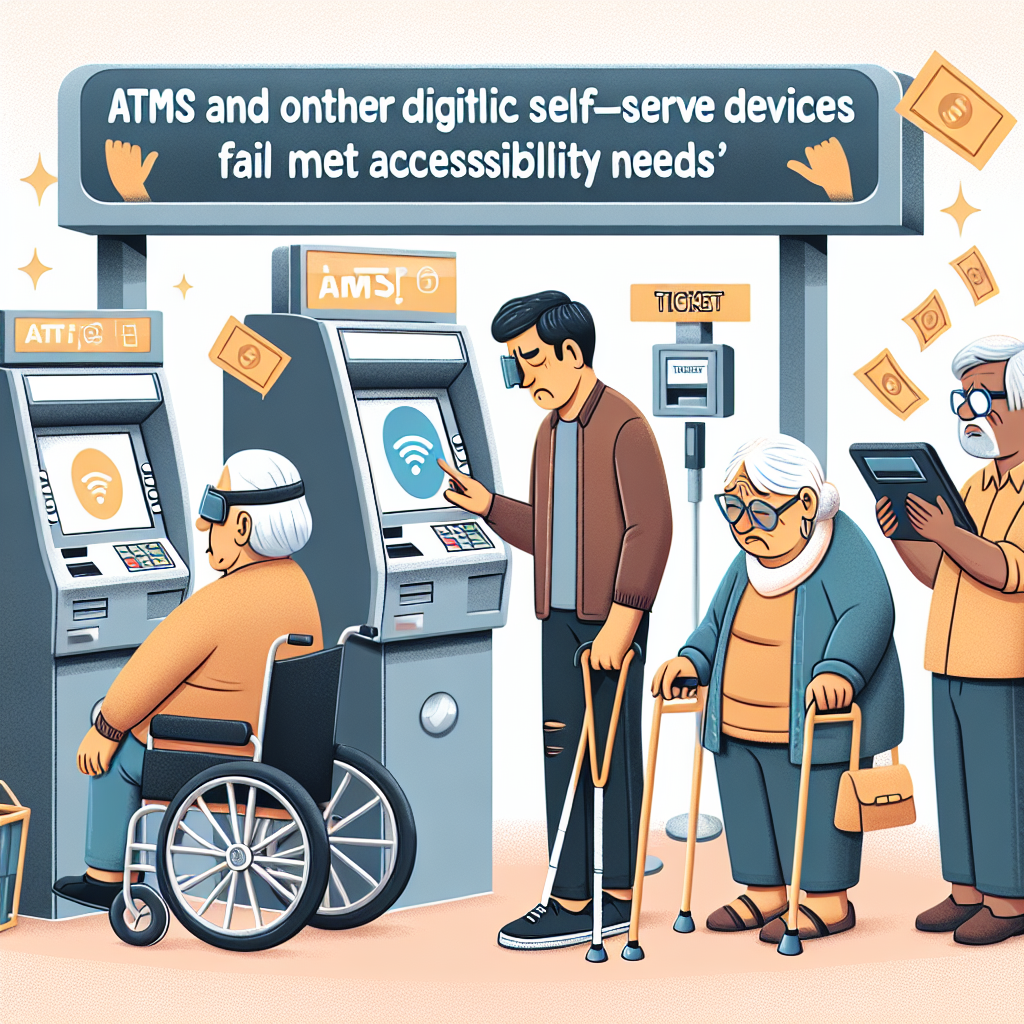
Most self-service interactive devices — kiosks, ATMs and other digital interfaces — don’t measure up to the accessibility needs of Canadians who report to have a disability, a new study has found.
Most self-service interactive devices — kiosks, ATMs and other digital interfaces — don’t measure up to the accessibility needs of Canadians who report to have a disability, a new study has found.
In partnership with the CSA Group (Canadian Standards Association), University of Waterloo researchers interviewed people with lived experiences of disability and received an overwhelming consensus that most self-serve devices have little to no accessibility features or they have trouble finding them.
More than one-quarter of Canadians aged 15 years and older identify as having a disability, according to the 2022 Canadian Survey on Disability.
“Regardless of one’s ability level, it’s important that people are able to use these devices correctly with minimal distress and have a consistent experience with access to consistent features,” said Gaya Bin Noon, PhD candidate at Waterloo’s School of Public Health Sciences and the study’s lead author.
Common concerns expressed by participants included the protection of personal information, privacy and security and the consistency and usability of these devices.
Participants also cited that their ability to use a self-service device is undermined if they need to seek assistance from a staff member, in addition to their concerns about revealing personal information.
“Independence is a big one for me,” said one participant. “It’s really important to be able to accomplish a task on your own independently, especially if it’s something confidential.”
One solution found in this study was to pair personal devices, or smartphones, to compensate for any accessibility shortcomings in self-service devices. A personal device would minimize the need for alternative accessible technology while maintaining privacy and security.
“Many smartphones already have personalized accessibility features attached, with screen readers and all of the user’s personal data already loaded in,” Bin Noon said. “They would be guaranteed to have something that they are familiar with and that works.”
Another theme in the researchers’ interviews with participants was the need to broadly promote accessible features and increase accessibility training for on-site staff. Participants noted that users frequently seek out accessibility information on company or organization websites, making it especially important that online resources clearly state any self-service devices’ accessibility features.
Waterloo researchers hope this study can help shape guidelines on optimal safety and usability for manufacturers of self-serve devices.
“We’re also trying to raise awareness as to what the gaps are and how it affects people who are just trying to live their lives, like going to the bank, encountering airport border control, ordering sushi or checking in at their doctor’s office,” Bin Noon said.
The study, Concerns regarding the accessibility of self-service interactive devices for people with disabilities, was recently published in Disability and Rehabilitation: Assistive Technology. Co-authors include Bin Noon, Dr. Plinio Morita, students Luka Ugaya Mazza and Gillian Morgan from Waterloo’s School of Public Health Sciences, as well as Stephanie Singh and Dragica Jeremic Nikolic from the CSA Group.
Journal
Disability and Rehabilitation
Cite Scienmag News
Ophelia Keating. (July 31, 2024). ATMs and other digital self-serve devices fail to meet accessibility needs. Scienmag. https://scienmag.com/atms-and-other-digital-self-serve-devices-fail-to-meet-accessibility-needs/
Ophelia Keating. "ATMs and other digital self-serve devices fail to meet accessibility needs." Scienmag, 31 July 2024, https://scienmag.com/atms-and-other-digital-self-serve-devices-fail-to-meet-accessibility-needs/. Accessed 11 September 2026.
Ophelia Keating. "ATMs and other digital self-serve devices fail to meet accessibility needs." Scienmag. July 31, 2024. https://scienmag.com/atms-and-other-digital-self-serve-devices-fail-to-meet-accessibility-needs/


