

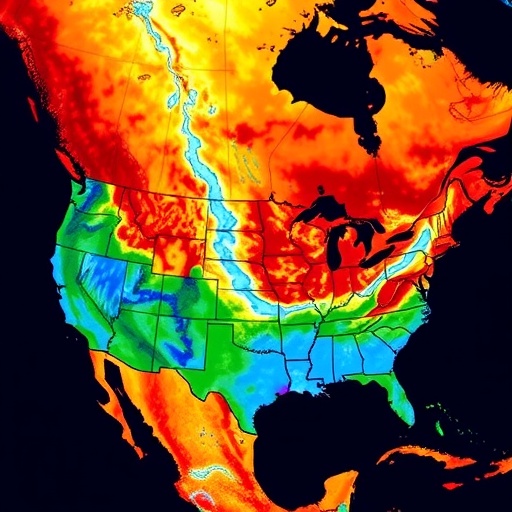
In a recent groundbreaking study, researchers Park and Ming have shed new light on the dynamics driving atmospheric river landfalls in the western United States, highlighting the key role of large-scale circulation patterns. This pivotal research, published in “Commun Earth Environ,” emphasizes the implications of these findings for understanding climate change and its impact on extreme weather events. Atmospheric rivers are narrow corridors of concentrated moisture in the atmosphere that can deliver substantial rainfall and cause severe flooding when they make landfall. The research underscores the importance of large-scale weather patterns in determining the frequency and intensity of these events.
The study reveals that large-scale circulation systems, such as the jet stream, significantly influence when and where atmospheric rivers form and make landfall. The authors employed advanced numerical models to simulate atmospheric conditions and observed how fluctuations in circulation patterns can lead to variations in moisture transport. This enhancement of atmospheric river activity during certain circulation regimes presents a substantial challenge for forecasting and anticipating their impacts on vulnerable communities.
Understanding these dynamics is critical considering the increasing frequency and intensity of atmospheric rivers tied to climate change. As global temperatures rise, the atmosphere can hold more moisture, amplifying the potential for heavy precipitation events. The researchers found that, while large-scale circulation patterns have always been a significant factor, their interaction with local weather phenomena can create a complex web of influences leading to extreme rainfall events.
Further, this study indicates that climate models may need to be refined to incorporate these interactions more accurately. Many existing models have struggled to predict the frequency and intensity of atmospheric rivers effectively, leading to potential misestimations in risk assessments and preparedness strategies. By focusing on the relationship between circulation patterns and atmospheric river activity, Park and Ming provide a new framework for improving predictions and enhancing community resilience against flooding.
The findings extend beyond mere academic interest; they carry profound implications for policymakers and urban planners in the western United States. Communities that regularly face flooding risks can benefit significantly from this research, as it provides insights into how to better prepare for severe rainfall events. Adjusting flood management practices and infrastructure planning based on improved predictions could save lives and reduce economic losses.
Moreover, the potential cascading effects of atmospheric rivers on water resources cannot be overlooked. While these weather events can replenish water supplies in drought-stricken areas, they can also lead to detrimental runoff, soil erosion, and contamination of water bodies. Understanding the nuances of precipitation patterns allows for better management of water resources, ensuring a balance between harnessing the benefits and mitigating the risks associated with heavy rainfall.
The researchers also addressed potential shifts in atmospheric river patterns due to climate change. Scenarios modeled by Park and Ming suggest that as the climate continues to warm, certain regions may experience a significant increase in atmospheric river activity. This projected shift poses a considerable risk for flooding and should be integral to any comprehensive climate adaptation strategies. By identifying hot spots where atmospheric rivers are likely to become more severe, communities can prioritize interventions.
Scientific collaboration was vital in the development of this study. Park and Ming utilized a combination of observational data and climate model simulations, integrating their findings with existing research on atmospheric dynamics. This multidisciplinary approach allowed them to construct a more robust understanding of the interactions at play. As climate science progresses, continued collaboration among meteorologists, hydrologists, and climate scientists will prove essential in managing the complexities of our changing environment.
The implications of this study extend far beyond the borders of the United States. Atmospheric rivers are a global phenomenon, affecting numerous regions around the world. By taking a closer look at the large-scale circulation influences, researchers can identify trends and patterns that apply to other areas, enabling a wider application of these insights. Cross-border collaborations among scientists globally could lead to a more nuanced understanding of atmospheric rivers, improving worldwide forecasting models.
As communities in the western United States grapple with the realities of climate change, the work by Park and Ming offers a roadmap for the future. Enhanced forecasting capabilities can empower decision-makers to initiate proactive measures, implement adaptive strategies, and foster public awareness about the risks associated with atmospheric rivers. This research underscores the urgent need for action and innovation in addressing the challenges posed by severe weather conditions.
Ultimately, the study reveals the intricacies of our atmosphere and the delicate balance of systems that govern our weather. Understanding how large-scale circulation drives atmospheric river landfalls provides a clearer picture of the global climate system that affects countless lives. The more we learn, the better equipped we become to face the challenges ahead and adapt to an ever-changing climate.
In conclusion, the publication by Park and Ming serves as a clarion call for greater attention to the dynamics of atmospheric rivers in relation to climate change. As this research begins to permeate the fields of meteorology, environmental science, and policy planning, it promises to enhance our understanding and response to one of the most significant weather phenomena of our time.
While our understanding of atmospheric rivers continues to evolve, one thing remains clear: robust scientific inquiry and evidence-based policy are crucial for navigating the path to resilience in the face of climatic uncertainties.
Subject of Research: Large-scale circulation patterns and their impact on atmospheric river landfall in the western United States.
Article Title: Large-scale circulation drives atmospheric river landfall in the western United States.
Article References:
Park, C., Ming, Y. Large-scale circulation drives atmospheric river landfall in the western United States.
Commun Earth Environ (2026). https://doi.org/10.1038/s43247-026-03281-w
Image Credits: AI Generated
DOI:
Keywords: Atmospheric rivers, climate change, large-scale circulation, weather patterns, extreme rainfall, flooding risks, climate models.


