

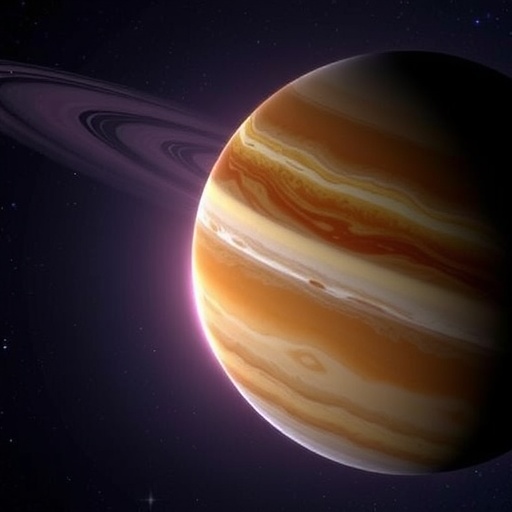
Recent advancements in our understanding of planetary formation have been underscored by groundbreaking findings regarding “super Jupiters,” massive exoplanets that orbit distant stars. Traditionally, it has been theorized that gas giants like Jupiter form through a process known as core accretion, wherein solid cores gradually attract surrounding gas and other materials. This mechanism has been largely accepted for planets within our solar system, but researchers have long speculated whether this same method applies to super Jupiters, which are substantially larger and often located far from their host stars.
To delve deeper into this question, astronomers have turned to the unprecedented capabilities of NASA’s James Webb Space Telescope (JWST). By analyzing spectral data from the HR 8799 star system—situated approximately 133 light-years away in the constellation Pegasus—scientists have discovered vital clues concerning the composition and formation of four super Jupiters that reside in its vicinity. Each of these planets, with masses five to ten times greater than Jupiter’s, orbits at staggering distances, ranging from 15 to 70 astronomical units (AU) from their star. For perspective, the closest of these planets lies a remarkable fifteen times further from its star than Earth is from the Sun.
Among the most striking findings to emerge from this research is the detection of sulfur in the atmosphere of one of the planets, HR 8799 c. The presence of sulfur is particularly significant because, unlike carbon and oxygen-bearing compounds that exist primarily in gaseous forms, sulfur presents itself as a solid in the cooler environment typical of a planet-forming disk. This discovery provides compelling evidence that HR 8799 c likely formed through core accretion, resembling the formation of Jupiter itself despite its considerably larger mass. Furthermore, data suggesting that all three innermost planets of the HR 8799 system are enriched in heavy elements—like carbon and oxygen—compared to their host star provides additional validation for the core accretion model as an explanation for their formation.
Jean-Baptiste Ruffio, co-lead author of the study and a research scientist at UC San Diego, emphasized the significance of these discoveries as they showcase the abilities of JWST to deeply analyze exoplanet atmospheres. He articulated the surprise among researchers regarding how even significantly massive planets—far beyond those found within our own solar system—can exhibit formation processes similar to those of their relatively smaller counterparts. This unexpected finding sets a new benchmark for understanding where in a planetary disk core accretion may favor the formation of rocky cores capable of attracting volatile materials.
One of the most remarkable challenges faced by the research team was the isolation of spectral data from the faint planets that are ten thousand times dimmer than their host star. The JWST, while a revolutionary telescope, was not originally designed to conduct such observations and required innovative methodologies to extract these faint signals. Ruffio was at the forefront of this analytical effort, spearheading the development of new techniques that ultimately allowed for the successful identification of sulfur and other crucial molecules within the atmospheres of these massive worlds.
Jerry Xuan, a co-lead author and a PhD fellow at UCLA, conducted extensive modeling of the atmospheric conditions surrounding these planets. In his pursuit, he refined existing atmospheric models to align with the data gathered by JWST, showcasing the telescope’s ability to detect molecules previously unseen. This meticulous approach culminated in the identification of several important compounds, including hydrogen sulfide, representing a landmark achievement in the study of exoplanetary atmospheres.
The implications of this research extend beyond mere academic curiosity. Charles Beichman, a co-author and senior faculty associate at IPAC—Caltech’s science and data center—highlighted how these observations will provoke new discussions among theorists regarding the processes involved in planetary formation. It is a cyclical process wherein observational data inspire new theoretical frameworks, creating a continuous feedback loop that drives scientific inquiry forward.
As researchers evaluate these newfound insights, the emphasis remains on how JWST’s advanced technology transforms our understanding of complex astronomical phenomena. By seamlessly collecting and analyzing data from distant planetary systems, astronomers can glean patterns and characteristics of planetary formation processes that were previously obscured or misunderstood. Each new discovery adds depth to our expanding knowledge of the cosmos and alters the narratives we have constructed about planetary systems throughout the universe.
The collaboration involved in this research not only showcases the transformative power of advanced telescopes like the JWST but also exemplifies the collective efforts of multidisciplinary teams in astronomy. Researchers from Caltech, led by figures like Dimitri Mawet, Heather Knutson, and Thomas Greene, have contributed diverse expertise to unravel the intricacies of these distant worlds.
In summary, the exploration of super Jupiters and their formation processes represents a significant advancement in our understanding of planetary science. The findings underscore the importance of collaborative research and the innovative techniques emerging from the advancements in observational technologies, paving the way for future discoveries that could reshape our understanding of exoplanets and their formation across the universe.
Subject of Research: Formation of Super Jupiters
Article Title: Revelations About Super Jupiters: Insights Into Exoplanetary Formation
News Publication Date: [Date not specified in the provided text]
Web References: [Link to the original study not specified in the provided text]
References: Nature Astronomy, JWST Observations
Image Credits: Jean-Baptiste Ruffio
Keywords
Exoplanets, Super Jupiters, Core Accretion, NASA, James Webb Space Telescope, HR 8799, Astronomical Observations, Sulfur Detection, Planetary Formation, Spectroscopy, Astronomy Research, Exoplanet Atmospheres.


