

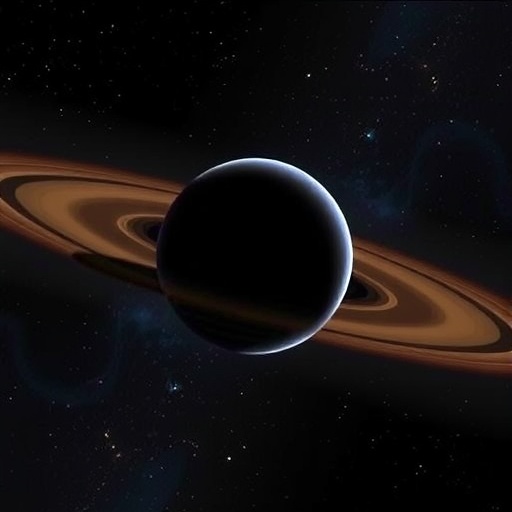
In a groundbreaking endeavor that challenges the long-held assumptions surrounding planetary formation, a global team of astronomers, led by researchers at the University of Warwick, has utilized the capabilities of the European Space Agency’s CHEOPS (CHaracterising ExOPlanet Satellite) to uncover an extraordinary planetary system orbiting a red dwarf star known as LHS 1903. This revelation marks a significant advancement in our understanding of the complexities involved in how planets come to be, particularly in relation to their positions and compositions within a solar system.
Historically, astronomical observations have indicated a typical pattern of planet formation within our Solar System. The inner planets, such as Mercury, Venus, Earth, and Mars, are predominantly rocky due to their proximity to the Sun, while the outer planets, Jupiter, Saturn, Uranus, and Neptune, are largely gaseous entities. This arrangement of rocky planets near their stellar source and gaseous giants further out has been consistently observed not only in our own solar system but also across countless exoplanetary systems located in the Milky Way galaxy. However, the observations made by this international team led by Dr. Thomas Wilson may just turn this conventional understanding on its head.
The study, published in the renowned journal Science, highlights the remarkable characteristics of LHS 1903’s planetary system, which consists of four known planets. The initial three planets closest to the star conform to the expected rocky-gaseous-gaseous pattern. However, it is the significant discovery of a fourth planet, positioned at the outer edge of this system, that has caught the attention of scientists worldwide. Contrary to what would typically be anticipated, this outer planet appears to be rocky in nature, resembling qualities found in terrestrial planets such as Venus.
In an intriguing examination of this bizarre planetary layout, the scientists employed various telescopes both in space and on Earth, allowing for meticulous observations and analyses. They discovered that the fourth planet orbits at a considerable distance from LHS 1903, which is a small and faint red dwarf star distinguished by its cooler temperatures and subdued luminosity compared to our Sun. The research team has classified this outermost planet as having characteristics more akin to terrestrial worlds, thus raising questions about the underlying mechanisms that facilitated such a peculiar arrangement of its planetary neighbors.
One of the more surprising elements of their findings was the realization that this rocky planet may not have a gaseous atmosphere. Traditional models of planetary formation generally assert that inner rocky planets form due to the intense radiation emitted by their host stars, which should strip away any gaseous envelopes, leaving behind solid cores. Conversely, gas giants develop in cooler, outer regions where gases can coalesce, forming expansive atmospheres. As described by Dr. Wilson, the presence of a rocky world far beyond the gaseous counterparts challenges this established narrative, leading scientists to ponder whether the outer planet had either lost its gaseous atmosphere or had never developed one in the first place.
As Dr. Wilson and his team delved deeper into the circumstances of this unique system, they began to contemplate alternative scenarios to explain the presence of a rocky planet situated so distant from its stellar origin. The researchers evaluated theories suggesting that the arrangement of rocky and gaseous planets could have been influenced by significant collisions or gravitational interactions that allowed them to swap positions over time. However, analyses of the data they gathered did not support these hypotheses.
Instead, their investigation led them to uncover a fascinating concept known as inside-out planet formation, where planets do not necessarily form simultaneously but rather sequentially, one after another. This theory posits that if LHS 1903 formed its planets in this manner, the process would yield differing environments for each planet over time. Consequently, the outermost planet could have been crafted in a gassier atmosphere that had either significantly depleted by the time of its formation or absent altogether. This scenario allows the fourth planet to emerge as a rocky body in a gas-poor environment, significantly deviating from academic perceptions of how planets are conventionally formed.
Through this lens, Dr. Wilson’s remarks underscore a crucial insight concerning the nature of this distant rocky planet. The conditions that typically encourage the development of planets by facilitating gas accumulation may have been irrelevant in this unprecedented context. It becomes evident that LHS 1903 challenges preconceived notions surrounding planet formation in diverse environments, shedding light on the evolution of planetary systems and the myriad ways they might differ from the Solar System model.
Isabel Rebollido, a Research Fellow at ESA, emphasized the implications of this discovery and how it forces scientists to re-evaluate theories rooted historically in our understanding of the Solar System alone. As researchers continue to discover exoplanets with characteristics that diverge from established paradigms, they are prompted to develop more flexible models that can accommodate these anomalies.
Maximilian Günther, a project scientist involved with CHEOPS, also highlighted the importance of such discoveries as they contribute to a broader effort to demystify the processes involved in planetary formation and evolution. As more systems like LHS 1903 are identified and analyzed, the astronomical community stands on the brink of potentially rewriting the books on planetary formation.
This notable research effort has not only provided insights into the peculiarities surrounding the LHS 1903 system, but it also raises critical questions pertinent to the evolution of planetary systems throughout the cosmos. As the team continues to investigate the complex dynamics that govern these diverse worlds, a burgeoning understanding of how both rocky and gaseous planets form and persist may emerge.
The publication of their findings represents a crucial step forward in unraveling the enigma of planetary existence in our universe. It calls for continued research and exploration into the depths of our cosmos, urging scientists to pursue inquiries into the myriad of alternate environments that might influence planetary development. With this persistent quest for knowledge, the pursuit of understanding what lies beyond our terrestrial home remains a fundamental driving force in contemporary astronomy.
As researchers pose new questions informed by the distinct systems they uncover, they refine theories that shape our understanding of the universe. The revelation surrounding LHS 1903 not only opens the door for further inquiries about rocky planets in gas-depleted systems but also invites deep contemplation regarding the contextual nuances which govern planet formation across the galaxy’s vast tapestry.
Subject of Research: Not applicable
Article Title: Gas-depleted planet formation occurred in the four-planet system around the red dwarf LHS 1903
News Publication Date: 12-Feb-2026
Web References: Science
References: 10.1126/science.adl2348
Image Credits: Credit: ESA
Keywords
Planet Formation, Exoplanets, LHS 1903, CHEOPS, Rocky Planets, Astronomy, Space Science, Planetary Systems, Stellar Evolution.


