
Wednesday, March 4, 2026
Science
No Result
View All Result
  • Login
  • HOME
  • SCIENCE NEWS
  • CONTACT US
  • HOME
  • SCIENCE NEWS
  • CONTACT US
No Result
View All Result
Scienmag
No Result
View All Result
Home Science News Technology and Engineering

Aston University researchers break ‘world record’ again for data transmission speed

June 28, 2024
in Technology and Engineering
Reading Time: 3 mins read
0
Dr Ian Philips
67
SHARES
605
VIEWS
Share on FacebookShare on Twitter
ADVERTISEMENT

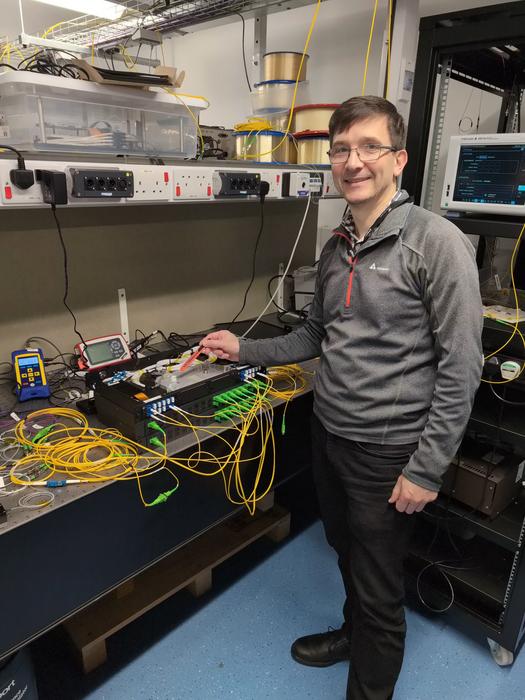
Aston University researchers are part of a team that has sent data at a record rate of 402 terabits per second using commercially available optical fibre.

Dr Ian Philips

Credit: Dr Ian Philips

  • Aston Institute of Photonic Research academics are part of a team that sent data at a rate of 402 terabits per second
  • This beats their previous record of 301 terabits per second
  • They constructed the first optical transmission system covering six wavelength bands.

Aston University researchers are part of a team that has sent data at a record rate of 402 terabits per second using commercially available optical fibre.

This beats their previous record, announced in March 2024, of 301 terabits or 301,000,000 megabits per second using a single, standard optical fibre.

“If compared to the internet connection speed recommendations of Netflix, of 3 Mbit/s or higher, for a watching a HD movie, this speed is over 100 million times faster.

The speed was achieved by using a wider spectrum, using six bands rather than the previous four, which increased capacity for data sharing. Normally just one or two bands are used.

The international research team included Professor Wladek Forysiak and Dr Ian Philips who are members of the University’s Aston Institute of Photonic Technologies (AIPT). Led by the Photonic Network Laboratory of the National Institute of Information and Communications Technology (NICT) which is based in Tokyo, Japan it also including Nokia Bell labs of the USA.

Together they achieved the feat by constructing the first optical transmission system covering six wavelength bands (O,E,S,C,L and U) used in fibre optical communication. Aston University contributed specifically by building a set of U-band Raman amplifiers, the longest part of the combined wavelength spectrum, where conventional doped fibre amplifiers are not presently available from commercial sources.

Optical fibres are small tubular strands of glass that pass information using light unlike regular copper cables that can’t carry data at such speeds.

As well as increasing capacity by approximately a third, the technique uses so-called “standard fibre” that is already deployed in huge quantities worldwide, so there would be no need to install new specialist cables.


As demand for data from business and individuals increases this new discovery could help keep broadband prices stable despite an improvement in capacity and speed.

Aston University’s Dr Philips said: “This finding could help increase capacity on a single fibre so the world would have a higher performing system.

“The newly developed technology is expected to make a significant contribution to expand the communication capacity of the optical communication infrastructure as future data services rapidly increase demand.”

His colleague Professor Wladek Forysiak added: ‘This is a ‘hero experiment’ made possible by a multi-national team effort and very recent technical advances in telecommunications research laboratories from across the world’.”

The results of the experiment were accepted as a post-deadline paper at the 47th International Conference on Optical Fiber Communications (OFC 2024) in the USA on 28 March.

To help support some of its work in this area Aston University has received funding from EPSRC (UKRI), the Royal Society (RS Exchange grant with NICT) and the EU (European Training Network).


Method of Research

Experimental study

Subject of Research

Not applicable

Article Title

402 Tb/s Transmission in a Standard Commercially Available Optical Fiber

Article Publication Date

28-Mar-2024

Share27Tweet17
Previous Post

Breakthrough research makes cancer-fighting viral agent more effective

Next Post

Penn researchers will investigate link between TBI and dementia with $10M NIH grant

Related Posts

blank
Technology and Engineering

Electron Microscopy Reveals ‘Mouse Bite’ Defects in Semiconductor Materials

March 4, 2026
blank
Technology and Engineering

Eating Vegetables First Boosts Mental Capital: A-CHILD

March 4, 2026
blank
Technology and Engineering

Flexible Spinal Bioelectronic Device with Dynamic Stiffness

March 4, 2026
blank
Technology and Engineering

Breaking Beyond Silicon: SKKU Team Unveils Indium Selenide Roadmap for Ultra-Low-Power AI and Quantum Computing

March 4, 2026
blank
Technology and Engineering

Powerful Mid-Infrared Optics Enabled by Liquid Glass

March 4, 2026
blank
Technology and Engineering

Prenatal Stress Impacts Neurodevelopment in Heart-Affected Toddlers

March 4, 2026
Next Post
Penn researchers will investigate link between TBI and dementia with $10M NIH grant

Penn researchers will investigate link between TBI and dementia with $10M NIH grant

  • Mothers who receive childcare support from maternal grandparents show more parental warmth, finds NTU Singapore study

    Mothers who receive childcare support from maternal grandparents show more parental warmth, finds NTU Singapore study

    27619 shares
    Share 11044 Tweet 6903
  • University of Seville Breaks 120-Year-Old Mystery, Revises a Key Einstein Concept

    1023 shares
    Share 409 Tweet 256
  • Bee body mass, pathogens and local climate influence heat tolerance

    665 shares
    Share 266 Tweet 166
  • Researchers record first-ever images and data of a shark experiencing a boat strike

    533 shares
    Share 213 Tweet 133
  • Groundbreaking Clinical Trial Reveals Lubiprostone Enhances Kidney Function

    518 shares
    Share 207 Tweet 130
Science

Embark on a thrilling journey of discovery with Scienmag.com—your ultimate source for cutting-edge breakthroughs. Immerse yourself in a world where curiosity knows no limits and tomorrow’s possibilities become today’s reality!

RECENT NEWS

  • NIH Grant Fuels Breakthroughs in Lupus Protein Research
  • Electron Microscopy Reveals ‘Mouse Bite’ Defects in Semiconductor Materials
  • Möbius-Inspired Surface Directs Light in Two Directions
  • Sugar Soothes Newborns Through Painful Medical Procedures, Study Finds

Categories

  • Agriculture
  • Anthropology
  • Archaeology
  • Athmospheric
  • Biology
  • Biotechnology
  • Blog
  • Bussines
  • Cancer
  • Chemistry
  • Climate
  • Earth Science
  • Editorial Policy
  • Marine
  • Mathematics
  • Medicine
  • Pediatry
  • Policy
  • Psychology & Psychiatry
  • Science Education
  • Social Science
  • Space
  • Technology and Engineering

Subscribe to Blog via Email

Enter your email address to subscribe to this blog and receive notifications of new posts by email.

Join 5,190 other subscribers

© 2025 Scienmag - Science Magazine

Welcome Back!

Login to your account below

Forgotten Password?

Retrieve your password

Please enter your username or email address to reset your password.

Log In
No Result
View All Result
  • HOME
  • SCIENCE NEWS
  • CONTACT US

© 2025 Scienmag - Science Magazine

Discover more from Science

Subscribe now to keep reading and get access to the full archive.

Continue reading