

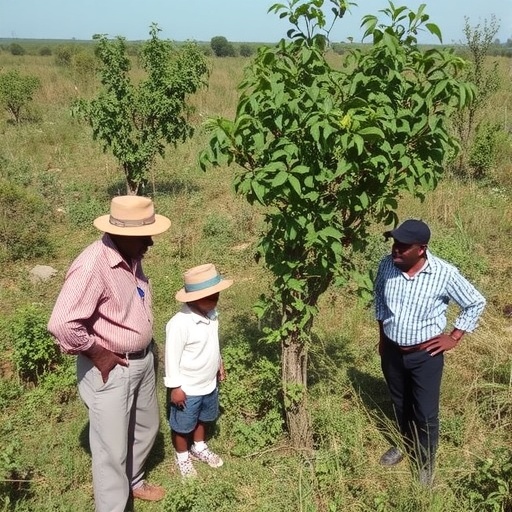
In recent years, the Chobe Enclave in Botswana has gained attention for its remarkable biodiversity and natural beauty. This region, characterized by diverse ecosystems, faces pressing environmental challenges due to various factors including climate change, agricultural expansion, and human encroachment. A recent study conducted by Mpalo, Basupi, and Tsidu explores these changes endemic to the region, using innovative analytical techniques to provide a clearer picture of land cover and vegetation changes over time.
The researchers employed a sophisticated combination of random forest classification and Markov chain analysis in their methodology. Random forest classification, a machine learning technique, enables the examination of large datasets and the identification of patterns that may otherwise go unnoticed. By applying this technique to satellite imagery, the researchers could effectively classify different types of land cover with high precision. The uniqueness of this study lies in the combination of random forest algorithms with Markov chain analysis, which helps in analyzing transitions between different states of land cover over specified time frames.
The findings of this comprehensive analysis reveal significant trends in land cover alterations over the last few decades. One primary observation made by the research team was the shift in land cover types, with a notable increase in agricultural land and a concurrent decrease in natural vegetation. This shift is not merely quantitative; it also carries implications for biodiversity and ecosystem health in the Chobe Enclave. As agriculture expands, it competes for resources that are vital for the survival of various plant and animal species in the area.
Moreover, the study underscores the importance of understanding these changes in the context of climate variability. The Chobe Enclave is subject to varying climatic conditions that influence ecosystem dynamics. The research highlights how these climatic fluctuations initiate both short-term and long-term effects on vegetation patterns. The interlinkage between agriculture and climate is a crucial area that warrants further exploration, as the impacts of these factors could have cascading effects on the flora and fauna of this biodiverse region.
Another aspect worth noting from the study is the socio-economic implications associated with these environmental changes. As agriculture continues to encroach upon natural habitats, local communities must navigate the challenge of balancing economic development with the conservation of their environment. This situation raises critical questions about sustainability and the future of land use policies in Botswana. The researchers call for integrated land management strategies that consider both human needs and ecological integrity.
The innovative methods introduced in this research could serve as a model for similar studies worldwide, offering insights into effective monitoring and assessment techniques. By utilizing advanced analytical methods such as random forest classification, researchers can create more robust models of ecological changes. Furthermore, the application of Markov chain analysis provides a temporal perspective, showing how ecosystems evolve and respond to external pressures over time.
One of the standout contributions of this research is its potential to influence policy decisions. Policymakers can benefit from the insights provided by the study, particularly in crafting regulations that promote sustainable land use practices. In regions undergoing rapid development, it becomes crucial to utilize data-driven approaches such as those demonstrated in this study to inform conservation efforts and guide responsible land management.
As our understanding of the Chobe Enclave’s environmental changes deepens through scientific inquiry, it also raises public awareness and advocacy for preserving this unique ecosystem. The study serves as a reminder of the delicate balance between development and conservation. Engaging local communities in monitoring and decision-making processes may enhance the effectiveness of conservation efforts, ensuring that the voices of those most affected are included.
In conclusion, the research conducted by Mpalo and his colleagues marks a significant advancement in the field of environmental monitoring. The integration of cutting-edge analytical techniques with an emphasis on practical applications highlights the need for collaborative efforts to address environmental challenges. As further studies build on these findings, the hope is that the Chobe Enclave can serve as a beacon of successful conservation practices that respect both human and ecological needs.
The study reflects a growing trend in environmental research, where data and technology converge to provide clearer insights into complex ecological phenomena. With continued exploration of such methodologies, scientists and conservationists alike can work towards innovative solutions to safeguard precious ecosystems for future generations.
As we move forward, it becomes imperative to recognize that the health of our planet is intertwined with human activity. The Chobe Enclave stands as a vital reminder of the responsibilities we bear toward nurturing our environment while pursuing economic growth and development.
Subject of Research: Assessing vegetation and land cover change in the Chobe Enclave, Botswana.
Article Title: Integrating random forest classification and Markov chain analysis to assess vegetation and land cover change in the Chobe Enclave, Botswana.
Article References: Mpalo, M., Basupi, L.V. & Tsidu, G.M. Integrating random forest classification and Markov chain analysis to assess vegetation and land cover change in the Chobe Enclave, Botswana. Environ Monit Assess 198, 165 (2026). https://doi.org/10.1007/s10661-026-15005-w
Image Credits: AI Generated
DOI: https://doi.org/10.1007/s10661-026-15005-w
Keywords: random forest classification, Markov chain analysis, vegetation change, land cover change, Chobe Enclave, Botswana, environmental monitoring, biodiversity, sustainable development.


