


Chronic Hepatitis B (CHB) is a significant public health concern that affects millions of individuals globally. The latest study published in the Journal of Clinical and Translational Hepatology illustrates the promising results associated with the use of Tenofovir Amibufenamide (TMF) as a treatment option for patients diagnosed with CHB. This multicenter and prospective cohort study highlights the effectiveness, safety, and overall patient outcomes linked to TMF, providing a compelling case for its role in managing this chronic viral infection.
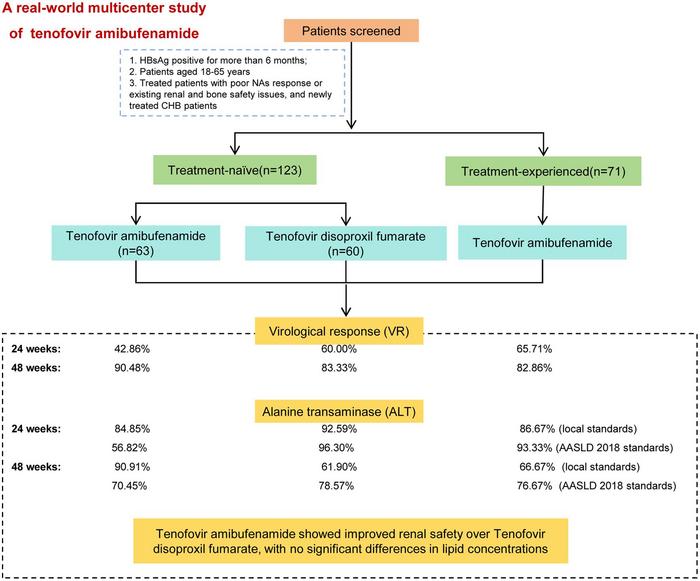
The study was conducted across four hospitals, enrolling a total of 194 patients diagnosed with CHB between August 2021 and August 2022. These patients were divided into two primary categories: treatment-naïve (TN) and treatment-experienced (TE). The TN subgroup was further stratified into those receiving either TMF or Tenofovir Disoproxil Fumarate (TDF), the latter being a conventional treatment option. The TE group consisted of individuals transitioning from prior antiviral therapies to TMF due to inadequate virological responses or safety concerns related to previous treatments.
Results from this study demonstrated significant treatment efficacy and safety for TMF. In the TN cohort, virological response (VR) rates at 24 weeks for TMF reached 42.86%, increasing to 90.48% by the 48-week mark. In comparison, TDF showed VR rates of 60% at 24 weeks and 83.33% at 48 weeks. These findings suggest that while both treatments are effective, TMF may offer superior long-term outcomes for patients new to therapy.
Additionally, the study monitored alanine transaminase (ALT) normalization rates as a key indicator of liver function and treatment success. Interestingly, TMF showed ALT normalization rates of 56.82% at 24 weeks and 70.45% by 48 weeks. In contrast, TDF produced slightly lower ALT normalization rates during the same time periods. This data further strengthens the argument for TMF as a preferable treatment option, particularly for those who may require improved liver function indicators.
In patients within the TE group, TMF’s effectiveness stood out even more. The VR rates climbed to 83.1% at 24 weeks and 91.55% at 48 weeks, signifying a robust response. The ALT normalization rates were similarly impressive, indicating that previously treated patients could successfully transition to TMF without compromising their antiviral outcomes. The transition not only showcased effective engagement with treatment but also improved overall liver health markers for those accustomed to prior antiviral therapies.
Safety concerns surrounding antiviral medications, particularly regarding renal function and lipid levels, remain prevalent in clinical discussions. This study highlighted TMF’s favorable risk profile, noting an improvement in renal safety compared to TDF. Patients treated with TMF experienced fewer adverse renal events, which is a crucial consideration given the long-term nature of CHB management. Furthermore, no significant differences were observed in lipid concentrations, providing additional assurance regarding the metabolic safety associated with TMF therapy.
This remarkable safety profile coupled with the enhanced effectiveness of TMF makes it a compelling candidate for primary use in the treatment of chronic hepatitis B, especially in populations that are either naïve to treatment or transitioning from less effective therapies. The implications of these findings extend beyond individual patient care; they present an opportunity for clinicians to reassess current treatment algorithms and consider adopting TMF as a first-line therapy in appropriate patient cohorts.
Furthermore, the ongoing importance of real-world evidence in the validation of treatment effectiveness cannot be overstated. The data presented from this comprehensive multicenter study reinforces the validity of TMF not only through controlled clinical outcomes but through its application in broader clinical settings. Such real-world information is invaluable in shaping treatment guidelines and informing health policy regarding hepatitis B management strategies.
The study also emphasizes the significance of collaborative efforts in clinical research. The multinational participation and contributions of various healthcare institutions enhance the robustness of the data and provide a wider lens through which to interpret the results. This joint endeavor underscores the importance of inclusivity in research to ensure findings are representative of diverse patient populations, ultimately leading to optimized health outcomes across different demographics.
In conclusion, the study leads to the assertion that Tenofovir Amibufenamide stands as a leading choice in the treatment landscape for chronic hepatitis B. Its comparable effectiveness to traditional therapies, combined with enhanced safety profiles, presents a paradigm shift in how clinicians may approach this complex health issue. With continued monitoring and research, TMF has the potential to play a critical role in decreasing the burden of chronic hepatitis B on a global scale and improving the quality of life for those affected by the disease.
Cite Scienmag News
Kristina Jarvis. (January 17, 2025). Assessing the Real-World Efficacy and Safety of Tenofovir Amibufenamide in Chronic Hepatitis B Treatment: Insights from a Multicenter Study. Scienmag. https://scienmag.com/assessing-the-real-world-efficacy-and-safety-of-tenofovir-amibufenamide-in-chronic-hepatitis-b-treatment-insights-from-a-multicenter-study/
Kristina Jarvis. "Assessing the Real-World Efficacy and Safety of Tenofovir Amibufenamide in Chronic Hepatitis B Treatment: Insights from a Multicenter Study." Scienmag, 17 January 2025, https://scienmag.com/assessing-the-real-world-efficacy-and-safety-of-tenofovir-amibufenamide-in-chronic-hepatitis-b-treatment-insights-from-a-multicenter-study/. Accessed 5 September 2026.
Kristina Jarvis. "Assessing the Real-World Efficacy and Safety of Tenofovir Amibufenamide in Chronic Hepatitis B Treatment: Insights from a Multicenter Study." Scienmag. January 17, 2025. https://scienmag.com/assessing-the-real-world-efficacy-and-safety-of-tenofovir-amibufenamide-in-chronic-hepatitis-b-treatment-insights-from-a-multicenter-study/


