

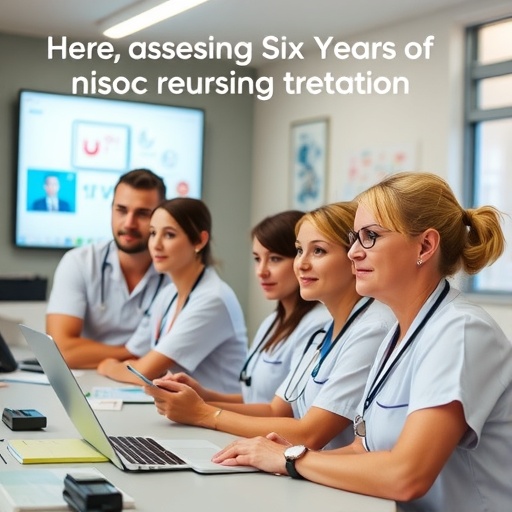
In an era where online education is becoming increasingly prevalent, the significance of Massive Open Online Courses (MOOCs) in the field of nursing cannot be overstated. The research conducted by Jiang, Zhao, and Li, which spans over six years, investigates the effectiveness of a specific nursing MOOC and aims to provide answers to the burning question of its long-term impact on nursing education. This study is a crucial addition to the evolving narrative surrounding online learning and its transformative potential within the health education sector.
The study begins by contextualizing the growing necessity for innovative solutions in nursing education. As the healthcare landscape shifts, there is an ever-increasing demand for qualified professionals equipped with contemporary skills and knowledge. MOOCs have emerged as a viable solution to bridge the gap between traditional education and the dynamic needs of the healthcare environment. The authors delve into this premise, laying the groundwork for their comprehensive evaluation of a nursing MOOC that has captured the attention of aspiring nurses and seasoned professionals alike.
Throughout the research, Jiang and his colleagues meticulously outline the structure of the MOOC under review. This particular course encompasses various modules designed to educate participants on essential nursing topics including patient care, clinical skills, and ethical considerations in healthcare. The flexibility afforded by this MOOC allows for a diverse learner demographic, ranging from those new to nursing to experienced practitioners seeking to augment their knowledge base. This adaptability is highlighted as a pivotal factor in its sustained popularity and user engagement over the six years of study.
To assess the effectiveness of this nursing MOOC, the researchers employed a robust methodological approach. Utilizing a combination of surveys, learning analytics, and participant feedback, the study aimed to capture a holistic view of the educational outcomes experienced by learners. This multi-faceted evaluation strategy ensures that various dimensions of the learning experience are explored, resulting in a well-rounded understanding of the MOOC’s impact. The authors emphasize that such comprehensive evaluation is crucial to inform future iterations of the course, as well as to contribute valuable insights to the broader field of online education.
One of the critical findings of the research is the improvement in participants’ knowledge and skills as a direct result of their engagement with the MOOC. Analyzing pre- and post-course assessment scores, the authors noted a significant increase in competency levels among participants. This evidence lends credence to the argument that MOOCs can be effective educational tools, especially when designed thoughtfully and curated with learner needs in mind.
Moreover, the study identifies other key benefits of the nursing MOOC, such as increased accessibility to education and the opportunity for lifelong learning in nursing practice. The flexibility of online courses enables individuals from various geographical and socio-economic backgrounds to access high-quality educational resources that may have previously been out of reach. This democratization of education is particularly significant in the nursing field, where disparities in access to training can have dire consequences for patient care and health outcomes.
Another noteworthy aspect of the research highlights the community-building potential of the MOOC environment. Participants reported feeling a sense of camaraderie and support through interaction with peers in discussion forums and collaborative activities. This sense of belonging fosters a unique shared learning experience that can enrich the educational journey and motivate learners to engage more deeply with the material. The authors point out that fostering such a community dynamic is essential for driving sustained interest and participation in online courses.
However, the authors also acknowledge the challenges associated with nursing MOOCs. While many participants benefited from the course, there were notable drop-out rates, particularly amongst those who faced competing responsibilities, such as work or family obligations. The study indicates that while MOOCs offer flexibility, the reality of balancing education with other life commitments can often hinder completion rates. The researchers call for a reevaluation of course design and support structures to better address these challenges and improve learner retention.
In addressing the future of nursing education, Jiang, Zhao, and Li urge stakeholders to consider the lessons learned from their study. They advocate for the continued evolution of nursing MOOCs, emphasizing the necessity for innovative teaching strategies that integrate emerging technologies and pedagogical advancements. Additionally, they stress the importance of ongoing research in this area to further refine and enhance online nursing education in response to the changing demands of the healthcare sector.
The implications of this research extend beyond individual learners; they reflect a broader trend in education that calls for a paradigm shift. As the healthcare landscape continues to evolve, so too must the methods of training and preparing the next generation of nurses. This study serves as both a thorough examination of a successful nursing MOOC and a clarion call for the integration of online education into the conventional frameworks of nursing training. With continued advancement and reflection, the future of nursing education may well lie within the digital spaces of MOOCs.
In conclusion, Jiang and his colleagues have provided an essential contribution to the discourse on nursing education through their longitudinal evaluation of a nursing MOOC. Their findings underscore the effectiveness of online learning platforms in addressing the educational needs of healthcare professionals while shedding light on the inherent challenges that must be navigated. The journey of nursing education is ongoing, and this research paves the way for a more accessible, effective, and forward-thinking approach to training in the nursing field.
The significance of Jiang and his team’s research lies not only in its findings but also in the broader context of education in modern society. As learners around the world adapt to the challenges of a fast-paced, ever-changing environment, the role of MOOCs will likely continue to grow. They offer a glimpse into what the future of education could resemble—one that is flexible, inclusive, and ultimately, transformational for individuals and communities alike.
In light of this study, educators and institutions are encouraged to embrace the possibilities offered by online courses, fostering a landscape in which knowledge can be shared more broadly and effectively. As we reflect on the impact of this nursing MOOC over the past six years, it is evident that the future of nursing education will rely heavily on integrating innovative online learning solutions that meet the demands of the profession and society.
Subject of Research: Effectiveness of a nursing MOOC over six years.
Article Title: Where do we go from here? Evaluating the effectiveness of a nursing MOOC over six years.
Article References:
Jiang, Y., Zhao, J., Li, K. et al. Where do we go from here? Evaluating the effectiveness of a nursing MOOC over six years. BMC Med Educ (2026). https://doi.org/10.1186/s12909-026-08679-w
Image Credits: AI Generated
DOI: https://doi.org/10.1186/s12909-026-08679-w
Keywords: Nursing education, MOOCs, online learning, healthcare training, educational effectiveness.


