


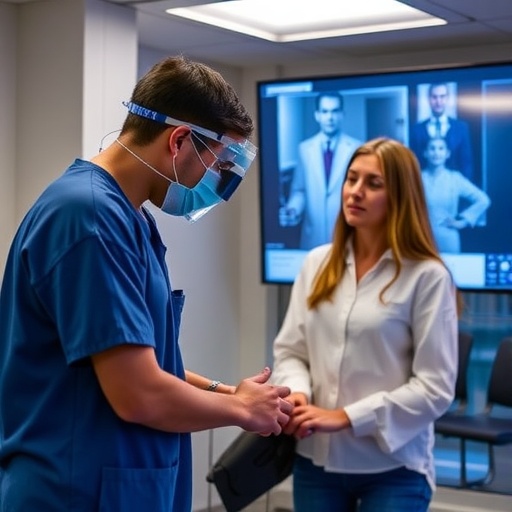
In the ever-evolving landscape of medical education, the integration of innovative teaching methodologies has emerged as a focal point for enhancing student engagement and skill acquisition. A new study led by Yu, J., Lee, S., Kim, M., and collaborators has shed light on the comparative effectiveness of three distinct simulation-based education methods: standardized patients, high-fidelity simulators, and virtual reality. This comprehensive evaluation seeks to determine not just the relative advantages of each approach, but how they specifically impact the confidence and engagement levels of medical students.
As the medical field continues to adapt to technological advancements, educational institutions grapple with how best to prepare future clinicians for the challenges they will face in practice. Traditional lecture-based instruction, while foundational, often fails to engage the sensory and emotional aspects crucial for developing practical skills. This research highlights the critical role of simulation in bridging that gap, emphasizing the impact of realism and interactive learning on educational outcomes.
Standardized patients have long been a staple of medical training. These trained actors simulate real patient scenarios, providing students the opportunity to practice history-taking, physical examinations, and communication skills in a controlled environment. The study’s findings suggest that this method fosters a high level of engagement among students, as they can interact and receive immediate feedback in real-time. This hands-on experience not only improves practical skills but also boosts students’ confidence in their abilities to manage actual patient encounters.
In comparison, high-fidelity simulators represent the pinnacle of technical advancement in medical education. These sophisticated mannequins can mimic physiological responses, allowing students to experience life-like medical emergencies. The study underscores the unique advantage of these figures, particularly in teaching high-stakes procedures where hands-on experience is crucial. The use of high-fidelity simulators effectively immerses students in realistic medical scenarios, offering them the chance to practice critical thinking and decision-making under pressure.
Virtual reality (VR) technology, while newer to the medical education scene, is rapidly gaining traction. By immersing students in a 3D environment that replicates real-life medical situations, VR provides an exciting alternative to conventional training techniques. The findings from this evaluation reveal that VR not only enhances students’ engagement but also offers unique opportunities for experiential learning, where learners can repeat scenarios to build competency without the fear of compromising patient safety. This innovative approach represents a shift towards more interactive and personalized learning experiences.
The results of this study indicate that each method has its own set of strengths and weaknesses, and their effectiveness can depend on various factors, including the learning objectives and the specific skill set being taught. While standardized patients excel in enhancing communication skills and gaining empathetic understanding, high-fidelity simulators shine in teaching technical procedures and crisis management. VR finds itself straddling a unique position, blending these elements to potentially create a more comprehensive training modality.
Equally important is the study’s exploration of students’ confidence levels, which is a critical aspect of medical education often overlooked in traditional assessment methods. The ability for students to feel confident in their skills directly correlates to their performance in real-world clinical situations. Engaged and confident students are more likely to seek out challenging cases, push their boundaries, and develop into resourceful medical professionals. Understanding how each simulation method impacts this aspect could inform educators on how to tailor their curricula to better suit the needs of budding physicians.
Furthermore, the implications of this research extend beyond academia. As healthcare increasingly adopts advanced technology, the need for medical professionals who are well-versed in these innovations has never been greater. Incorporating methods like VR into the curriculum may prepare graduates not only to excel in their roles but also to be advocates for innovative practices within the healthcare system. This alignment between education and practical application is vital in cultivating a workforce equipped for the future of medicine.
The study’s authors emphasize the importance of a balanced approach in the medical curriculum, integrating these simulation methods to harness their unique strengths. By doing so, medical schools would not only enhance educational efficacy but also prepare their graduates to be more adaptable in a rapidly changing medical environment. As technology progresses, further research will be needed to continually evaluate and adapt teaching methods to ensure that they align with the evolving demands of the healthcare landscape.
In conclusion, the findings of this study advocate for a deeper exploration of simulation-based education’s role in medical training. With the potential to shape how future clinicians are educated, the effective implementation of standardized patients, high-fidelity simulators, and virtual reality could significantly impact the quality of healthcare delivery. Moreover, the heightened engagement and confidence that result from these methods are crucial in producing not only competent practitioners but also lifelong learners who are prepared to face the complexities of modern medicine.
As the medical education community looks towards the future, embracing new methods that enhance student interaction and understanding will be critical. By leveraging the strengths of simulation-based education, institutions may not only improve educational outcomes but also contribute to the development of a healthcare workforce ready to meet the challenges ahead.
Looking ahead, ongoing research and collaboration between educators, technologists, and healthcare professionals will be essential in refining these approaches and assessing their long-term impact on medical training. As innovation continues to drive the field forward, the bridge between education and practice will become increasingly significant in shaping the future of healthcare.
Yu, J., Lee, S., Kim, M. et al. Evaluating medical students’ engagement and confidence across three simulation-based education methods: standardized patient, high fidelity simulator, and virtual reality.
BMC Med Educ (2026). https://doi.org/10.1186/s12909-026-08634-9
Cite Scienmag News
Courtney Benton. (January 25, 2026). Assessing Medical Students’ Confidence in Simulation Methods. Scienmag. https://scienmag.com/assessing-medical-students-confidence-in-simulation-methods/
Courtney Benton. "Assessing Medical Students’ Confidence in Simulation Methods." Scienmag, 25 January 2026, https://scienmag.com/assessing-medical-students-confidence-in-simulation-methods/. Accessed 5 September 2026.
Courtney Benton. "Assessing Medical Students’ Confidence in Simulation Methods." Scienmag. January 25, 2026. https://scienmag.com/assessing-medical-students-confidence-in-simulation-methods/


