

PHILADELPHIA – With NASA data showing that July 22, 2024, was the hottest day on record and indications that July may have been the hottest month, an Annenberg Public Policy Center survey conducted in mid-July found that most people know three of the symptoms of a heat-related illness but do not know the location of their nearest cooling center. At the same time, increasing numbers of people think that heat waves are becoming more frequent and intense and affecting their daily activities.

Credit: Annenberg Public Policy Center
PHILADELPHIA – With NASA data showing that July 22, 2024, was the hottest day on record and indications that July may have been the hottest month, an Annenberg Public Policy Center survey conducted in mid-July found that most people know three of the symptoms of a heat-related illness but do not know the location of their nearest cooling center. At the same time, increasing numbers of people think that heat waves are becoming more frequent and intense and affecting their daily activities.
Knowledge of cooling centers in the case of extreme heat
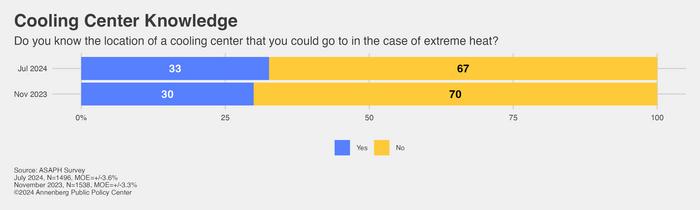
Although the locations of cooling centers, or indoor air-conditioned facilities such as libraries, community and senior centers, schools are publicized by city governments on hot days, many of those surveyed report being unaware of where to find one. Two-thirds of respondents (67%) say they do not know the location of a cooling center to which they could go to in case of extreme heat, a number statistically unchanged from last November. “Communities must do a better job of making the public, especially the most vulnerable, aware of these centers,” said Ken Winneg, managing director of survey research at APPC.
More today see link between extreme heat and climate change.
When compared with an APPC survey in November 2023, significantly more people now say that climate change is increasing the risk of heat-related illnesses, respiratory diseases, and insect-borne diseases. Two-thirds (67%) hold this view vs. just under 6 in 10 (58%) in November 2023.
More people indicate that heat waves in the United States are becoming more frequent and intense than in the past. About two-thirds (65%) believe heat waves are becoming more frequent and intense. Fifty-eight percent (58%) felt this way in November 2023, when we last asked the question. About a quarter (24%) believe heat waves are about as frequent and intense as they have always been, statistically unchanged from our earlier survey.
At the same time, the proportion of people who say extreme heat has often or frequently affected their typical daily activities in the past year has increased significantly. Forty-three percent (43%) say extreme outdoor heat has often (22%) or frequently (21%) affected their daily activities, an 8-point increase compared with November 2023 (35% in total said either “often” or “frequently”).
Signs of heat-related illnesses
Notably, most people also know three of the telltale signs of heat-related illnesses:
- Dizziness (89% compared to 86% in August 2022)
- Nausea (83% compared to 79% in August 2022)
- Hot, red, dry, or damp skin (72%, statistically unchanged from August 2022)
- Cold, pale, and clammy skin (42%, statistically unchanged from August 2022).
Public understands some extreme heat risks better than others
Thinking about the next 10 years, just under 6 in 10 (58%) think that people in their community will be more likely to experience heat stroke caused by extreme heat waves. This is significantly higher than in November 2023 when just over half (52%) said they thought people in their community would be more likely to experience heat stroke caused by extreme heat waves in the next 10 years.
However, only 3 in 10 (30%) know that a pregnant person in the U.S. who is exposed to extreme heat is more likely to deliver their baby early than a pregnant person who is not exposed to extreme heat. About a quarter (23%) incorrectly say that a pregnant person in the U.S. is either less or just as likely to deliver a baby early. Forty-seven percent (47%) are unsure which is correct.
Broad awareness that heat-related deaths are most common among seniors
Two-thirds (67%) know that heat-related deaths are most common among older adults, aged 65 or older, slightly but significantly higher than in August 2022 (62%).
Preventing heat-related illnesses
Nearly all (92%) know that drinking water is better to prevent heat-related illnesses than drinking sugary drinks.
APPC’s ASAPH survey
The survey data come from the 20th wave of a nationally representative panel of 1,496 U.S. adults, first empaneled in April 2021, conducted for the Annenberg Public Policy Center by SSRS, an independent market research company. This wave of the Annenberg Science and Public Health Knowledge (ASAPH) survey was fielded July 11-18, 2024, and has a margin of sampling error (MOE) of ± 3.6 percentage points at the 95% confidence level. All figures are rounded to the nearest whole number and may not add to 100%. Combined subcategories may not add to totals in the topline and text due to rounding.
Download the topline and methodology statement.
The policy center has been tracking the American public’s knowledge, beliefs, and behaviors regarding vaccination, Covid-19, mpox, flu, maternal health, climate change, and other consequential health issues through this Annenberg Science and Public Health (ASAPH) knowledge survey panel for over three years. In addition to Winneg, the APPC team includes senior data analyst Laura Gibson; research analyst Shawn Patterson Jr. and Patrick E. Jamieson, director of the Annenberg Health and Risk Communication Institute.
The Annenberg Public Policy Center was established in 1993 to educate the public and policy makers about communication’s role in advancing public understanding of political, science, and health issues at the local, state, and federal levels.
Method of Research
Survey
Subject of Research
People

