

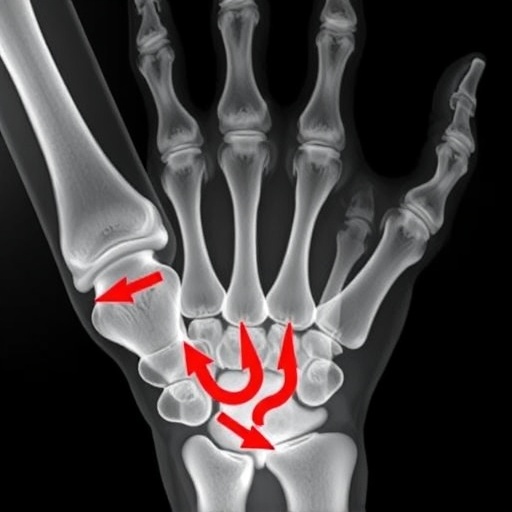
In a groundbreaking study set to transform orthopedic practices, researchers have ventured into uncharted technological territory by employing augmented reality (AR) to guide corrective osteotomy procedures for malunited distal radius fractures. This innovative approach not only promises to enhance the accuracy of surgical interventions but also serves as a textbook example of how modern technology can synergize with traditional medical practices to improve patient outcomes. The research, spearheaded by a team led by Kodama et al., illustrates the potential of AR to streamline complex surgical procedures that have historically posed significant challenges to orthopedic surgeons.
Malunited distal radius fractures, which occur when a fracture does not heal correctly, are a common affliction in orthopedic medicine. Such fractures often lead to long-term complications, including chronic pain, loss of function, and reduced quality of life. Standard treatment for malunited fractures often involves corrective osteotomy—a surgical procedure aimed at realigning the bone. However, the success of this surgery heavily relies on precise planning and execution, which are made all the more complex due to the intricate anatomy of the wrist. Here is where augmented reality steps in as a game changer.
The integration of AR technology into the surgical workflow provides a visual overlay of critical anatomical structures directly onto the surgeon’s field of view. This feature enhances spatial awareness and serves as a guide that helps mitigate human error during the surgical process. With the use of an AR osteotomy guide, surgeons can visualize the patient’s anatomy in three dimensions, which allows for more accurate pre-surgical planning and intraoperative alignment. The benefits of such technology could lead to fewer complications and better overall surgical outcomes.
The research team conducted a series of experiments to assess the effectiveness of the AR-assisted osteotomy guide in human subjects. In a meticulously controlled environment, the researchers made use of 3D imaging technology to construct virtual models of the distal radius of patients suffering from malunited fractures. These models were then programmed to interactively guide the surgeons through the osteotomy procedures by projecting the anatomical dimensions and angles onto the actual surgical field. The early results of these experiments show promise, suggesting that surgeons experienced a significant improvement in the accuracy of their cuts and realignments.
Moreover, this innovative process reduces the duration of surgical procedures, thereby minimizing anesthetic risks and potentially influencing overall hospital costs. In traditional osteotomies, time is a critical factor; prolonged procedures often lead to increased complications and recovery times. By reducing the complexity of the surgery through such intuitive technology, patients may find themselves facing fewer post-operative issues, ultimately expediting their path to full recovery.
Another noteworthy aspect of this research is its implications for surgical training. The visual and interactive nature of augmented reality can serve as a vital educational tool for medical students and resident surgeons. They can practice and refine their skills in a simulated environment, where they can gain hands-on experience with the guidance of digital overlays showing crucial anatomical landmarks. As such, augmented reality not only serves current patients but also sows the seeds for a new generation of skilled orthopedic surgeons.
While the initial findings are encouraging, the researchers emphasize the necessity for further investigation. They point out that larger clinical trials will be required to fully validate the efficacy and long-term benefits of this technology. Additionally, they highlight the importance of refining the AR systems for use in more complex orthopedics scenarios, which will yield deeper insights into the technology’s role in enhancing various surgical practices.
The adoption of augmented reality in orthopedic surgery stems from a broader movement within medicine to utilize technology for better diagnostics and treatment planning. As systems evolve and become more sophisticated, the future seems bright for innovations that enhance patient care. By harnessing the power of augmented reality, surgeons might soon possess tools that empower them to approach surgeries with a level of precision and confidence that has been previously unattainable.
In conclusion, the application of augmented reality in corrective osteotomy for malunited distal radius fractures is a prime example of how innovative thinking can reshape medical procedures. The research led by Kodama and colleagues opens doors not only for enhanced surgical practices but also for a future where technology and medicine are intricately woven together. As the orthopedic community braces for the implications of this advancement, it prepares for a new era defined by precision, efficiency, and improved patient outcomes.
This leap in surgical technology marks a pivotal moment for orthopedic surgeons globally, paving the way for further research into augmented reality applications across various medical disciplines. Enhanced visualization tools will likely become commonplace in the operating room, signaling a bright future where augmented reality does not merely assist but transforms orthopedic surgery into an art and science of unparalleled efficacy.
As we look ahead, it remains to be seen how quickly this technology can be implemented on a broader scale. The possibilities of augmented reality in medicine seem endless, and for orthopedic surgeons specifically, the prospects of combining digital guidance with their expertise may soon become standard practice. Thus, the journey of integrating AR into healthcare is just beginning, yet its potential could redefine what is achievable in the field of medicine.
Subject of Research: Corrective osteotomy for malunited distal radius fracture using augmented reality technology
Article Title: Corrective osteotomy for malunited distal radius fracture using an augmented reality (AR) osteotomy guide
Article References: Kodama, A., Munemori, M., Iwaguro, S. et al. Corrective osteotomy for malunited distal radius fracture using an augmented reality (AR) osteotomy guide. 3D Print Med 11, 53 (2025). https://doi.org/10.1186/s41205-025-00303-9
Image Credits: AI Generated
DOI: https://doi.org/10.1186/s41205-025-00303-9
Keywords: Augmented Reality, Orthopedic Surgery, Distal Radius Fractures, Corrective Osteotomy, Surgical Innovation, Medical Technology, AR Osteotomy Guide.


