

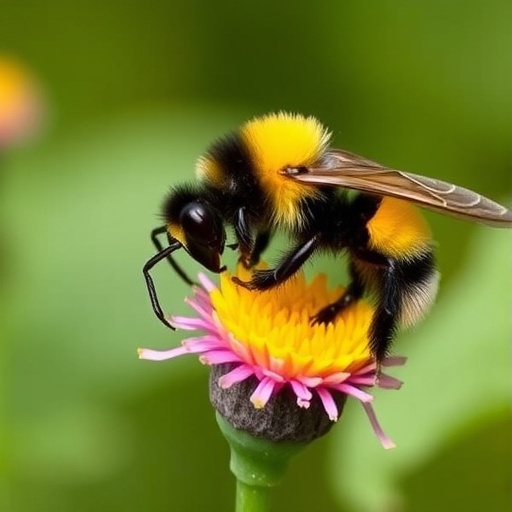
In the microscopic battleground of nectar foraging, bumble bees find themselves in escalating conflicts with invasive Argentine ants—an interaction with significant ramifications for both individual pollinators and their colonies. Recent research spearheaded at the University of California, Riverside, delves into this intricate dynamic, offering nuanced insights into how these “tiny nectar wars” influence bumble bee behavior and hive-level resource acquisition amidst emerging ecological threats.
Bumble bees, renowned for their critical role in pollination and agricultural productivity, are already besieged by multiple environmental pressures including habitat degradation, pathogen exposure, and pesticide toxicity. This latest study investigates an underexplored stressor: the aggressive competition posed by Argentine ants (Linepithema humile), an invasive species notorious for territorial dominance and prolific colonial expansion. Unlike stinging insects, these ants rely on biting and overwhelming numbers to assert control over food sources, creating a unique foraging challenge for bumble bees.
Conducted within controlled laboratory conditions overseen by entomologist Erin Wilson Rankin, the study meticulously monitored over 4,300 behavioral episodes involving more than 415 individual bumble bees across six distinct colonies. These bees were presented with foraging arenas containing feeders either accompanied by the presence of Argentine ants or left free from ant interference. This experimental design enabled precise quantification of bee responses to varying degrees of ant aggression and presence.
Observational data revealed a clear aversion: as ant density increased at a given feeder, bumble bees exhibited a corresponding decline in visitation attempts. The ant-infested feeders posed not only a physical threat through their biting behavior but also a deterrent effect, reducing bee foraging activity. While ant bites inflicted no lethal damage, they induced defensive reactions from bees, who employed their mandibles—their multifunctional “teeth”—to fend off attackers, occasionally resulting in decapitated ants. Interestingly, despite their ability to sting without fatal consequences, no stinging incidents occurred during these confrontations, underscoring mandible use as the primary defensive strategy.
Size disparity between the species emerges as a pivotal factor; larger bumble bees tended to dominate these one-on-one skirmishes, often repelling individual ants effectively. This territorial success at the individual level, however, masks a paradox with broader colony implications. Frequent encounters with aggressive ants provoked prolonged aggressive interactions that distracted bees from their primary objective: nectar collection. Instead of swiftly feeding and returning to the colony, bees often became mired in confrontations that consumed valuable energy and time.
This behavioral shift signals a potential net loss for the colony’s food intake. Aggression-induced distraction implies reduced nectar harvest, hampering the hive’s ability to sustain itself, especially for vulnerable youngest members who rely exclusively on food brought back by foragers. The researchers highlight an unresolved question critical to understanding colony resilience: whether hives compensate by dispatching additional foragers when returning bees come back short or whether these interactions contribute to broader nutritional deficits.
The ecological consequences extend beyond individual and colony health. As essential pollinators, bumble bees facilitate plant reproduction with far-reaching impact on biodiversity and crop yields. Argentine ants, by disrupting bumble bee foraging efficiency, may indirectly influence plant community dynamics and agricultural output. Such interspecies competitive pressures underscore the delicate balance within ecosystems facing invasive species incursions exacerbated by human activity.
This research not only elucidates the complexity of insect interactions within shared ecological niches but also emphasizes the importance of multifaceted conservation strategies. Protecting bumble bees requires addressing not only direct threats like pesticides and habitat loss but also indirect biotic stressors like invasive ant species. Managing Argentine ant populations may prove vital in preserving the functional integrity of pollinator communities.
Moreover, the behavioral plasticity of bumble bees, manifest in their modulated responses ranging from avoidance to active defense, showcases evolutionary adaptations that shape interspecies coexistence. Future studies spearheaded by Wilson Rankin’s lab aim to unravel the colony-level regulatory mechanisms that may buffer these stressors, exploring how social insects adjust forager deployment and energy allocation in the face of antagonistic competitors.
This compelling exploration of the microecological battle surrounding nectar resources offers a striking reminder of the interconnectedness of species and the cascading effects of invasive organisms. As research continues to dissect these interactions with increasing technical rigor, it also holds broader implications for ecosystem management, conservation biology, and sustainable agriculture.
Understanding the nuances of bumble bee and Argentine ant interactions serves as a critical step toward safeguarding pollinator health, ensuring food security, and maintaining biodiversity in a rapidly changing world. The battlefield at the flower’s edge is thus emblematic of larger environmental challenges requiring integrated scientific inquiry and proactive stewardship.
Subject of Research: Interaction dynamics between bumble bees and invasive Argentine ants during nectar foraging and its implications for pollinator behavior and colony resource acquisition
Article Title: Bees modulate behavior during nectar foraging in response to direct ant aggression (Hymenoptera: Apidae and Formicidae)
News Publication Date: 7-Nov-2025
Web References: http://dx.doi.org/10.1093/jisesa/ieaf076
Image Credits: David Rankin/UCR
Keywords: Bees, Ants, Hymenoptera, Insects, Arthropods, Invertebrates, Animals, Organismal biology, Wildlife, Pollinators, Animal pollination, Pollination, Pollen


