

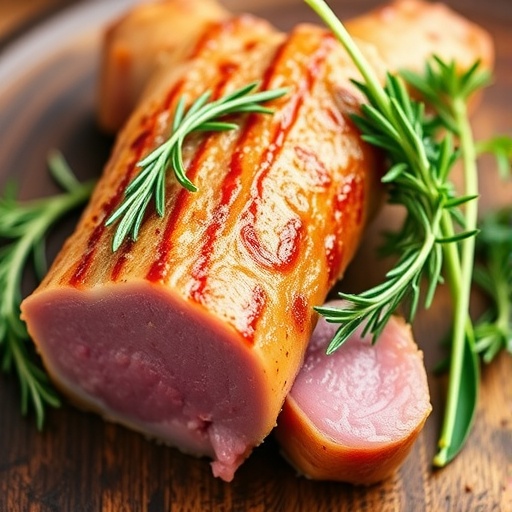
In a groundbreaking study recently published in Food Science and Biotechnology, researchers have unveiled compelling evidence on the potent antioxidant properties of decolorized rosemary powder and its practical application in enhancing the shelf life and quality of pork patties under refrigerated conditions. This innovative research offers new insights into natural food preservation methods, demonstrating not only the efficacy of rosemary-derived antioxidants but also the nuanced effects of pH variations on their performance, setting a new benchmark in food science.
Antioxidants play a crucial role in food preservation by inhibiting oxidative processes that lead to spoilage, rancidity, and the formation of harmful compounds. Rosemary, a herb long celebrated for its rich antioxidant content, contains bioactive compounds such as carnosic acid, carnosol, and rosmarinic acid, which have shown significant free radical scavenging abilities. However, the challenge has been to maximize these benefits in a form that integrates seamlessly into food matrices without impacting sensory qualities such as color and flavor, hence the exploration of decolorized rosemary powder.
The study meticulously evaluated the antioxidant capacity of this decolorized powder through a series of rigorous in vitro assays, confirming its superior scavenging activity against common reactive oxygen species. What makes the findings particularly noteworthy is that the decolorization process did not compromise the antioxidant constituents but instead yielded a product with enhanced purity and applicability. This opens avenues for its direct incorporation into meat products where color interference could deter consumer acceptance.
Taking the research from molecular assays to real-world application, the team incorporated varying concentrations of the decolorized rosemary powder into pork patties, a product highly susceptible to oxidative spoilage due to its lipid-rich composition. The patties were then stored under refrigerated conditions at different pH levels to simulate a range of processing and storage scenarios. By adjusting pH, the researchers sought to understand the environment’s influence on antioxidant effectiveness, a factor often overlooked in previous studies but critical in food systems with dynamic pH changes.
Results from this phase were illuminating. Pork patties treated with the antioxidant-enriched powder exhibited significantly reduced lipid oxidation compared to controls, as measured by thiobarbituric acid reactive substances (TBARS). The protective effect was most pronounced at slightly acidic pH values, aligning with the common pH range of processed meat products. This suggests that the bioactive compounds in rosemary powder might maintain or even enhance their activity under specific acidic conditions, potentially due to altered molecular interactions or stability profiles.
The implications for the food industry are profound. Natural antioxidants like decolorized rosemary powder not only meet increasing consumer demand for clean-label ingredients but also offer effective strategies to reduce reliance on synthetic preservatives, some of which carry health concerns and regulatory restrictions. Incorporating rosemary antioxidants can extend shelf life, preserve sensory quality, and improve the nutritional profile of meat products, contributing to both food safety and sustainability.
Moreover, the research provides a framework for further exploration into the interplay between food matrix conditions and antioxidant efficacy. By elucidating how pH modulates antioxidant capacity, future formulations can be tailored to optimize preservation effects tailored to specific product types and processing methods. This customized approach could revolutionize how we think about food preservation, moving beyond one-size-fits-all solutions toward precision food science.
From a biochemical perspective, the retention of activity in the decolorized powder highlights important considerations in processing methods for plant-derived antioxidants. Decolorization, often aimed at removing chlorophyll and pigments that may impart undesirable hues to foods, was thus demonstrated to preserve—and potentially concentrate—the key antioxidant molecules. This balance of refining extract purity while maintaining bioactivity is a critical advance for functional ingredient development.
The study’s rigorous design, combining detailed chemical analysis with practical food applications, creates a compelling narrative for food technologists and product developers alike. Its dual focus ensures that findings are not only scientifically robust but directly translatable into industry practice, accelerating the adoption of natural antioxidant solutions in meat preservation.
This new evidence could help address one of the enduring challenges in meat processing: the prevention of oxidative deterioration without sacrificing taste, texture, and appearance. Oxidative spoilage is not merely an aesthetic or quality issue but also a health concern, contributing to the formation of harmful lipid peroxides and aldehydes. By mitigating these changes, rosemary antioxidants contribute to safer, more appealing products.
In addition to nutrient preservation, extending shelf life through natural antioxidants also reduces food waste, a critical component of environmental sustainability efforts. Meat waste is particularly impactful due to resource-intensive production processes, so innovations that prolong freshness have downstream benefits for ecological footprints.
Consumer acceptance is a key factor in the commercial success of such natural additives. The decolorized nature of the rosemary powder addresses common sensory challenges, ensuring that meat products retain their familiar appearance while gaining valuable oxidative stability. This subtlety could facilitate smoother market entry relative to conventional plant extracts that sometimes impart strong herbal notes.
Mechanistically, the study hints at synergistic interactions between individual phenolic compounds within the rosemary extract. These interactions could stabilize free radicals and metal ions more efficiently under the tested conditions, underscoring the advantage of using whole-plant powders or minimally processed extracts over isolated antioxidants.
The timing of antioxidant addition also emerged as critical, with early incorporation into meat matrices allowing for more uniform distribution and contact with susceptible lipid sites. Such process optimization insights are vital for scale-up and commercial implementation, ensuring that theoretical benefits translate into real-world efficacy.
Beyond meat products, the implications of this research extend broadly across food categories prone to oxidative stress, including dairy, snacks, and ready-to-eat meals. The principles elucidated here regarding antioxidant stability, pH influence, and sensory neutrality can guide the development of natural preservation approaches across the food spectrum.
Looking forward, further studies should investigate the long-term storage performance, interactions with packaging atmospheres, and potential effects on microbial stability to fully characterize the multi-faceted benefits of decolorized rosemary powder. Additionally, consumer sensory testing will be essential to validate market acceptance and inform formulation tweaks.
This research represents a pivotal step in merging traditional botanical knowledge with cutting-edge food science, reinforcing the value of natural compounds in modern food systems. As demand for cleaner labels intensifies alongside regulatory pressures to limit synthetic additives, nature-inspired solutions like decolorized rosemary antioxidants stand poised to redefine shelf life extension paradigms.
In conclusion, the innovative research from Nam and Chin not only substantiates the potent antioxidant activity of decolorized rosemary powder but also provides a deep dive into the modulating effects of pH on its application in pork patties. By bridging fundamental science and applied food technology, this work charts an exciting course toward safer, more natural, and consumer-friendly food preservation strategies with broad industrial relevance.
Subject of Research: Evaluation of antioxidant activity of decolorized rosemary powder and its application to pork patties at different pH during refrigerated storage.
Article Title: Evaluation of antioxidant activity of decolorized rosemary powder and its application to pork patties at different pH during refrigerated storage.
Article References:
Nam, Y., Chin, K.B. Evaluation of antioxidant activity of decolorized rosemary power and its application to pork patties at different pH during refrigerated storage. Food Sci Biotechnol (2026). https://doi.org/10.1007/s10068-026-02088-x
Image Credits: AI Generated
DOI: 10.1007/s10068-026-02088-x (Published 16 January 2026)


