


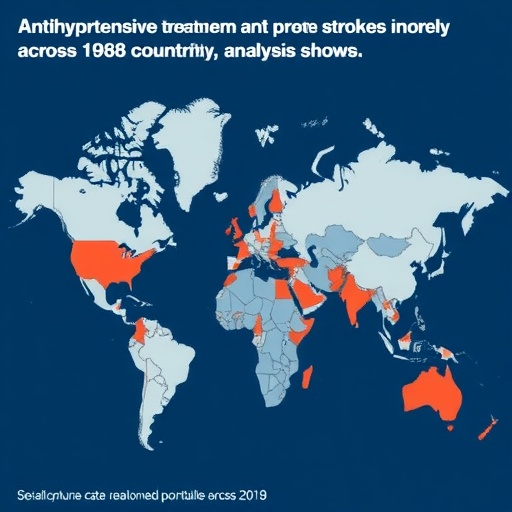
Antihypertensive treatment has prevented a substantial and growing share of strokes worldwide over the past three decades, but the benefits remain strikingly uneven across countries, sexes, and age groups, according to a new population-level analysis covering 198 countries between 1990 and 2019. The study, published in the European Journal of Epidemiology, estimates that in 2019 alone, roughly 0.96 million model-estimated strokes were averted globally as a result of blood pressure lowering treatment patterns observed at the population level. Yet in low-income countries, the proportion of strokes prevented by treatment was only about half that achieved in high-income nations, revealing a persistent global divide in realized stroke prevention.
The research, led by Gonghua Wu, Huan Xu, and Xing Zhao of the West China School of Public Health at Sichuan University, together with collaborators at Sun Yat-sen University, Wuhan University, and West China Hospital, addresses a critical question in global cardiovascular health: whether decades of progress in hypertension detection and drug therapy have actually translated into equitable stroke prevention for entire populations, rather than for treated individuals alone.
Stroke remains one of the leading causes of death and disability worldwide, and high blood pressure is its single most important modifiable risk factor. Decades of randomized trials and individual participant data meta-analyses have established beyond doubt that lowering blood pressure with medication reduces stroke risk across a wide range of baseline blood pressure levels, in both primary and secondary prevention, and in men and women alike. What has been far less clear is how much of this protective effect has actually been “realized” at the population scale, where treatment coverage, adherence, and health system capacity vary enormously between countries and over time.
To quantify this, the team constructed a modelling framework that integrated country-, sex-, age-, and year-specific estimates of hypertension prevalence and treatment coverage with stroke incidence data for adults aged 30 to 79 years in each of 198 countries. The central metric of the analysis is the prevented fraction for the population, or PFP, defined as the proportion of strokes averted under the observed treatment patterns relative to a counterfactual scenario in which no one received antihypertensive treatment. In essence, the PFP answers the question: of all the strokes that would have occurred in a world without treatment, what fraction did existing blood pressure management actually prevent?
This counterfactual approach distinguishes the study from traditional population attributable fraction analyses, which typically estimate the burden caused by a risk factor rather than the burden already removed by an intervention. By anchoring the calculation in real-world treatment coverage drawn from population-representative surveys, including pooled analyses of 1,201 studies with 104 million participants and World Health Organization Global Health Observatory data, the researchers were able to track how the preventive yield of hypertension care evolved across three decades and how it differed by national income group as classified by the World Bank.
The results reveal a story of genuine progress shadowed by profound inequity. Between 1990 and 2019, the median PFP rose from 8.8 percent to 15.9 percent among women and from 5.1 percent to 11.8 percent among men. In practical terms, by the end of the study period, treatment patterns in a typical country were preventing roughly one in six strokes that would otherwise have occurred in women and nearly one in eight in men, compared with a no-treatment counterfactual. The researchers summarized these temporal trends using average annual percentage change and age-period-cohort analyses, statistical techniques that separate the effects of ageing, calendar time, and generational shifts in risk.
Low-income countries recorded the fastest annual increases in realized stroke prevention, a signal that many of the world’s poorest nations have been expanding hypertension treatment from a very low baseline. But the acceleration was not enough to close the gap. In 2019, the prevented fraction in low-income countries remained approximately half that of high-income countries, meaning that even after three decades of catch-up growth, the share of strokes averted by treatment in poorer nations still lagged dramatically behind the levels achieved in wealthier settings. The disparity reflects well-documented barriers in low- and middle-income countries, including limited availability and affordability of blood pressure lowering medicines, gaps in clinical practice guidelines, weaker hypertension care cascades from detection through control, and higher rates of medication nonadherence, all of which have been documented in large international cohorts and recent systematic reviews.
The sex differences in the analysis were consistent and persistent across the entire study period. Women showed higher prevented fractions than men in every year examined, a pattern the authors attribute to a combination of factors including higher rates of hypertension awareness and treatment-seeking among women, differences in healthcare contact, and possibly sex-specific prescription patterns, since systematic reviews have shown that women are sometimes less likely than men to receive cardiovascular medications even when clinically indicated. The finding underscores that although women benefit more from treatment at the population level, the gap itself points to under-treatment of men, who experience higher stroke incidence at middle age in many settings.
Equally striking were the age patterns. The prevented fraction remained low in older adults, the group that carries by far the highest absolute burden of stroke, and was similarly low, or even lower, in adults aged 30 to 34 years. In older populations, the low PFP may reflect therapeutic inertia, multimorbidity, polypharmacy, and the complexity of managing blood pressure in frail patients, factors associated with uncontrolled hypertension in geriatric cohorts. Among the youngest adults, low prevention likely reflects low treatment coverage, since young adults with elevated blood pressure are less likely to be screened, diagnosed, or prescribed medication, even though stroke in young adults carries enormous lifetime consequences in terms of disability, lost productivity, and inability to return to work.
The authors are careful to frame their findings as model-estimated rather than directly observed. The PFP calculation requires linking observed treatment coverage with assumed treatment effects derived from the trial literature, and the resulting estimates carry uncertainty intervals that reflect variability in the underlying data. Nevertheless, the methodology builds on established epidemiological techniques for quantifying deaths averted by existing risk factor prevalence, such as previous analyses of physical activity and mortality using the same prevented fraction framework, and incorporates bias-correction methods developed for population attributable fraction estimation in the presence of confounding.
The implications for global health policy are considerable. The study arrives amid alarming trends in stroke epidemiology: the Global Burden of Disease 2021 analysis found that stroke burden remains enormous and increasingly concentrated in low- and middle-income countries, where ageing populations and rising exposure to risk factors are outpacing gains in prevention. Meanwhile, hypertension prevalence among adults worldwide has remained stubbornly high, with roughly half of hypertensive adults unaware of their condition and the majority not achieving controlled blood pressure. If the realized prevention gap between rich and poor countries persists, the absolute number of preventable strokes in low-income settings will continue to grow.
The findings also add momentum to calls for population-wide strategies that go beyond individual clinical treatment. The World Health Organization’s global report on sodium reduction, along with meta-analyses showing that dietary sodium lowering reduces blood pressure in a dose-dependent manner, supports the case for structural interventions, including reformulation of packaged foods, front-of-pack labeling, and national salt reduction strategies, which evidence suggests can complement pharmaceutical approaches. Because much of the world’s dietary salt comes from manufactured foods, national policies targeting food industry practices may reach populations that clinical care cannot.
For the researchers behind the new analysis, the takeaway is that antihypertensive treatment has corresponded to substantial but uneven model-estimated stroke prevention worldwide. The three-decade trend is genuinely encouraging: millions of strokes have likely been averted, and the trajectory of improvement has been steepest where the need is greatest. But the half-fold gap between low- and high-income countries, the persistent disadvantage among men, and the low prevention achieved in both the oldest and the youngest adults together chart a clear agenda. Closing these gaps, the study suggests, will require not merely more antihypertensive drugs, but stronger health systems that can find, treat, and retain the patients who currently fall through the cracks, from the 30-year-old who never gets screened to the 75-year-old whose blood pressure remains uncontrolled despite a prescription.
The study was funded by the National Natural Science Foundation of China and the Postdoctoral Fellowship Program of the China Postdoctoral Science Foundation. The authors report no competing interests.
Cite Scienmag News
Phoebe Ingram. (September 10, 2026). Antihypertensive treatment prevents strokes unevenly across 198 countries, analysis shows. Scienmag. https://scienmag.com/antihypertensive-treatment-prevents-strokes-unevenly-across-198-countries-analysis-shows/
Phoebe Ingram. "Antihypertensive treatment prevents strokes unevenly across 198 countries, analysis shows." Scienmag, 10 September 2026, https://scienmag.com/antihypertensive-treatment-prevents-strokes-unevenly-across-198-countries-analysis-shows/. Accessed 10 September 2026.
Phoebe Ingram. "Antihypertensive treatment prevents strokes unevenly across 198 countries, analysis shows." Scienmag. September 10, 2026. https://scienmag.com/antihypertensive-treatment-prevents-strokes-unevenly-across-198-countries-analysis-shows/


