


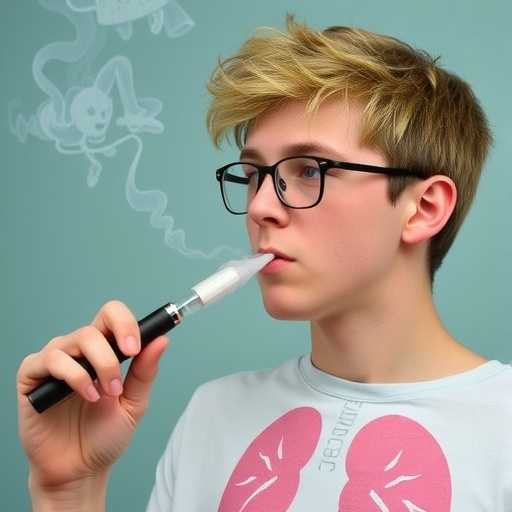
A groundbreaking study conducted by researchers at the University of California San Diego’s Herbert Wertheim School of Public Health and Human Longevity Science has unveiled critical factors that precipitated a remarkable reversal in youth vaping trends in the United States. This comprehensive investigation reveals that the synergy between strategic anti-vaping public health campaigns and intensive media coverage of the e-cigarette or vaping product use-associated lung injury (EVALI) outbreak dramatically reshaped adolescent vaping behavior starting in 2019. The findings, published in BMC Public Health, shed light on how media dynamics can strongly influence public health outcomes at a population level.
Between 2017 and 2019, youth vaping prevalence in the U.S. alarmingly surged from 8.1% to a staggering peak of 20%. However, this upward trajectory met an unprecedented turning point in 2019, from which began a sustained decline that brought youth vaping rates down to 5.9% by 2024. This epidemiological decline—against the backdrop of a growing vaping epidemic—prompted researchers to delve into the complex mechanisms that motivated adolescents to quit and deterred non-users from initiating vaping, uncovering a rare example of rapid behavioral change influenced through media channels.
Central to this shift was the convergence of two powerful media forces. First, aggressive anti-vaping advertising launched by key federal entities like the Food and Drug Administration (FDA), complemented by organizations such as the Truth Initiative and state programs like California’s Tobacco Control Program. These campaigns were designed to raise awareness of vaping risks and motivate cessation attempts among teens. The second, and perhaps more impactful, was the extensive news coverage of the EVALI outbreak, a severe respiratory illness linked initially to vaping products that resulted in over 2,800 hospitalizations and 68 deaths, predominantly affecting young individuals. Between July 2019 and March 2020, media outlets published nearly 20,000 articles dedicated to EVALI, amplifying public concern.
Leveraging two cycles of the California Student Tobacco Survey, a large, representative biennial study including grades 8, 10, and 12 students, researchers juxtaposed adolescent vaping behaviors before and during peak anti-vaping messaging and EVALI reportage. The 2017–18 cycle captured baseline behaviors prior to the launch of national campaigns, including over 117,000 students, while the 2019–20 cycle assessed over 143,000 students amidst these intensified public health efforts and media coverage. This robust data set enabled analytical detection of shifts in quit attempts, quitting intentions, and susceptibility to vaping initiation among never-users.
The data illuminated striking behavioral transformations. Among current adolescent vapers, those reporting quit attempts nearly doubled from 28.8% in 2017–18 to 53.2% in 2019–20. Additionally, intentions to quit surged from 56.9% to 79.1% over the same museum cycle interval. Correspondingly, among teens who had never vaped, susceptibility to future vaping initiation lessened from 30.3% to 25.7%. These trends signify a pronounced impact of public messaging and media exposure in reshaping youth perceptions and motivations surrounding vaping.
Analytical models further affirmed that both exposure to formal anti-vaping advertising and awareness of EVALI independently predicted higher odds of quit attempts and quitting intentions among adolescent vapers. Importantly, EVALI awareness was uniquely associated with reduced susceptibility to vaping among never-users—an effect not attributed to anti-vaping advertisements. This asymmetry suggests that crisis-driven, real-time news coverage may exert distinct psychological influence beyond traditional health promotion campaigns.
This phenomenon is particularly remarkable given the fiscal context. National anti-vaping ad campaigns collectively expended over $100 million annually, representing a significant investment in behavioral change communication. In contrast, EVALI-related awareness surged organically through journalistic efforts at no direct governmental advertising cost. The wide reach and urgency of EVALI news coverage likely revitalized public attention and engendered skepticism and fear surrounding vaping, catalyzing behavioral shifts in adolescents.
The initial lack of clarity regarding EVALI’s etiology intensified media scrutiny. Early reports framed the outbreak broadly as a vaping crisis, though subsequent investigations pinpointed black market THC vape products as the primary cause. Notably, many adolescents who became aware of the outbreak incorrectly believed that nicotine vaping was responsible for the lung injuries, illustrating how initial misinformation can have powerful, sometimes unintended, public health consequences. Determining whether these misperceptions persisted and influenced long-term behavior remains an open question for future inquiry.
Contrasting international observations deepen the significance of these findings. Countries like England, where youth vaping has not experienced similar reversal and continues to rise, may differ in regulatory frameworks, media environments, and policy responses. Comparative studies across these diverse sociopolitical contexts could illuminate best practices and pitfalls in tobacco control, informing next-generation interventions.
The implications of this research extend well beyond vaping. Population-level quit attempt rates typically exhibit stability, rarely shifting markedly across short intervals absent significant intervention or environmental change. The confluence of targeted advertising and widespread media coverage of an acute health crisis demonstrated in this study exemplifies a powerful model for influencing adolescent health behaviors en masse.
Senior author Shu-Hong Zhu, PhD, highlighted the exceptional nature of this behavioral shift, emphasizing its rarity and the potential lessons it holds for public health messaging strategies. First author Jijiang Wang, PhD, whose doctoral dissertation focused on the topic, remarked on the profound implications of changing the media environment and its capacity to motivate such widespread behavioral change rapidly.
This study was funded by the California Department of Public Health and reflects collaboration among leading academics, including Anthony C. Gamst and Yue-Lin Zhuang from UC San Diego. Taken together, these findings mark a significant advance in our understanding of how multiple media strategies can synergistically drive substantial population-level public health improvements, offering hope for future efforts to curb youth tobacco use and associated harms.
News Publication Date: Not explicitly provided in the original content.
Web References:
– Study link: https://link.springer.com/article/10.1186/s12889-026-27209-3
– DOI: 10.1186/s12889-026-27209-3
Cite Scienmag News
Ophelia Keating. (April 24, 2026). Anti-Vaping Campaigns and Lung Injury Reports Drive Decline in Teen Vaping, Study Finds. Scienmag. https://scienmag.com/anti-vaping-campaigns-and-lung-injury-reports-drive-decline-in-teen-vaping-study-finds/
Ophelia Keating. "Anti-Vaping Campaigns and Lung Injury Reports Drive Decline in Teen Vaping, Study Finds." Scienmag, 24 April 2026, https://scienmag.com/anti-vaping-campaigns-and-lung-injury-reports-drive-decline-in-teen-vaping-study-finds/. Accessed 3 September 2026.
Ophelia Keating. "Anti-Vaping Campaigns and Lung Injury Reports Drive Decline in Teen Vaping, Study Finds." Scienmag. April 24, 2026. https://scienmag.com/anti-vaping-campaigns-and-lung-injury-reports-drive-decline-in-teen-vaping-study-finds/


