


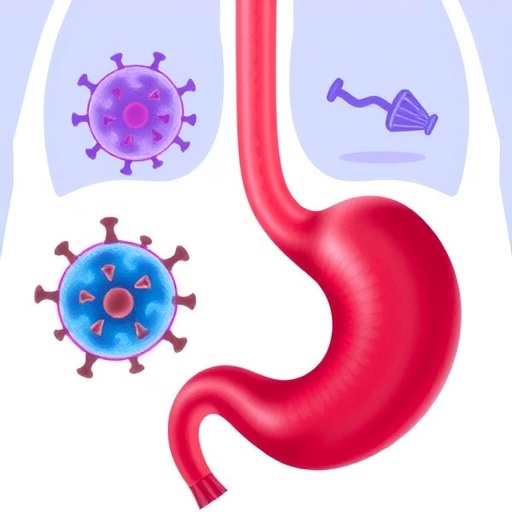
In a groundbreaking development that could reshape therapeutic strategies in oncology, recent research has demonstrated that anti-PD-1 immunotherapy yields significantly improved outcomes in gastric cancer patients who are also afflicted with chronic hepatitis B (CHB). This revelation opens new avenues for understanding the intricate interplay between viral infections and cancer immunotherapy efficacy, suggesting that the immune microenvironment shaped by hepatitis B virus (HBV) infection may potentiate responses to immune checkpoint blockade.
Gastric cancer remains one of the leading causes of cancer-related mortality worldwide, with therapeutic options often limited by tumor heterogeneity and resistance mechanisms. Immune checkpoint inhibitors (ICIs), particularly antibodies targeting programmed death-1 (PD-1) and its ligand PD-L1, have revolutionized treatment paradigms across multiple cancer types. However, their efficacy in gastric cancer has displayed considerable variability. The impact of comorbid viral infections like HBV on ICI responsiveness, until now, has been uncertain.
This study meticulously analyzed clinical data from 89 gastric cancer patients treated with anti-PD-(L)1 therapies. Crucially, patients were stratified into three distinct cohorts based on HBV infection status: those with chronic hepatitis B infection (13 patients), those with resolved hepatitis B infection (49 patients), and individuals without evidence of HBV infection (27 patients). Such stratification enabled a direct comparison of immunotherapy outcomes relative to viral status, a factor often overlooked in previous oncological trials.
Remarkably, the overall response rate (ORR) and disease control rate (DCR) observed under anti-PD-(L)1 therapy showed no statistically significant differences across the three patient groups. This finding suggests that the initial tumor responsiveness does not differ substantially due to HBV infection status. However, deeper survival analyses unravel a more compelling narrative regarding progression-free survival (PFS) and overall survival (OS).
In patients harboring chronic HBV infection, progression-free survival times were significantly extended compared to both HBV-uninfected and resolved HBV patients. Specifically, median PFS in CHB patients was not reached during the study period, in stark contrast to 7 months and 6 months in HBV-negative and resolved HBV cohorts, respectively. These differences were statistically significant, with hazard ratios indicating a roughly 60-70% reduction in the risk of disease progression among CHB patients receiving anti-PD-(L)1 therapy.
Similarly, overall survival outcomes favored the CHB cohort. Median OS was not reached in these patients, whereas it was 15 and 16 months in HBV-negative and resolved HBV groups, respectively. The data underscore a robust survival advantage linked to chronic hepatitis B infection within this immunotherapeutic context, hinting at a fundamental biological mechanism modulating treatment efficacy.
The observed survival benefits in CHB patients are hypothesized to originate from alterations in the tumor immune microenvironment imposed by persistent HBV infection. Chronic viral infections can induce a state of immune activation and inflammation, leading to a more “inflamed” or immunologically active tumor milieu. This environment likely enhances antigen presentation and immune cell infiltration, prime conditions for ICIs to exert maximal therapeutic effects by reinvigorating exhausted T cells.
Moreover, the lack of increased severe adverse events across all groups indicates that anti-PD-(L)1 therapy maintains a favorable safety profile, even in patients with chronic viral hepatitis. This is a crucial consideration since viral infections often raise concerns about immune-related toxicity or viral reactivation during immune modulation therapies.
These findings challenge prevailing assumptions that chronic viral infections might complicate or diminish the efficacy of immunotherapies in cancer. Instead, they highlight that chronic HBV infection could paradoxically sensitize tumors to immune checkpoint blockade, potentially through sustained immunological crosstalk and microenvironmental changes.
The translational implications of this study are profound. First, stratifying gastric cancer patients based on HBV status could become an essential aspect of personalized oncology, guiding treatment selection and prognosis. Second, the insights gained into the immunological dynamics introduced by HBV infection pave the way for novel combinatory approaches, perhaps integrating antiviral therapies with immunotherapy to maximize clinical benefit.
Further mechanistic studies will be crucial to delineate the precise immune pathways modulated by HBV in the gastric tumor microenvironment. Understanding these could unlock new biomarkers for predicting ICI responsiveness and offer targets for novel immunomodulatory agents.
In the broader context, this research underscores the importance of considering viral infections in cancer immunotherapy trials and practice. Given the global prevalence of HBV and the burden of gastric cancer, integrating viral status assessment into clinical protocols could substantially enhance patient outcomes.
The evolution of immune checkpoint inhibitors as a mainstay in cancer therapy continues to unveil unanticipated dimensions of tumor-immune interactions. This study contributes a remarkable piece to that puzzle, showcasing how a chronic viral infection, typically viewed as a complicating comorbidity, might instead amplify immunotherapy effectiveness.
From a clinical standpoint, these findings advocate for the safety and efficacy of deploying anti-PD-(L)1 agents in gastric cancer patients with concomitant chronic hepatitis B. It encourages oncologists and hepatologists to collaborate closely when managing such complex cases, ensuring multidisciplinary approaches to monitoring and treatment.
Future research efforts may also explore whether similar patterns exist in other HBV-associated malignancies or in cancers linked with other chronic viral infections, such as hepatitis C or human papillomavirus (HPV). The concept that viral-induced immune modulation enhances checkpoint inhibitor responsiveness could be a universal phenomenon, broadening the horizon of immuno-oncology.
In conclusion, the intersection of chronic hepatitis B infection and gastric cancer presents a unique immunological landscape that anti-PD-(L)1 therapy can effectively exploit. This paradigm highlights the dynamic interplay between infectious diseases and cancer, advocating a more integrated view of patient biology in the era of precision medicine. As immunotherapeutic modalities advance, incorporating viral infection parameters promises to refine and optimize treatment algorithms, ultimately improving survival and quality of life for patients worldwide.
Cite Scienmag News
Nathaniel Bowman. (August 22, 2025). Anti-PD-1 Boosts Gastric Cancer with Hepatitis B. Scienmag. https://scienmag.com/anti-pd-1-boosts-gastric-cancer-with-hepatitis-b/
Nathaniel Bowman. "Anti-PD-1 Boosts Gastric Cancer with Hepatitis B." Scienmag, 22 August 2025, https://scienmag.com/anti-pd-1-boosts-gastric-cancer-with-hepatitis-b/. Accessed 3 September 2026.
Nathaniel Bowman. "Anti-PD-1 Boosts Gastric Cancer with Hepatitis B." Scienmag. August 22, 2025. https://scienmag.com/anti-pd-1-boosts-gastric-cancer-with-hepatitis-b/


