

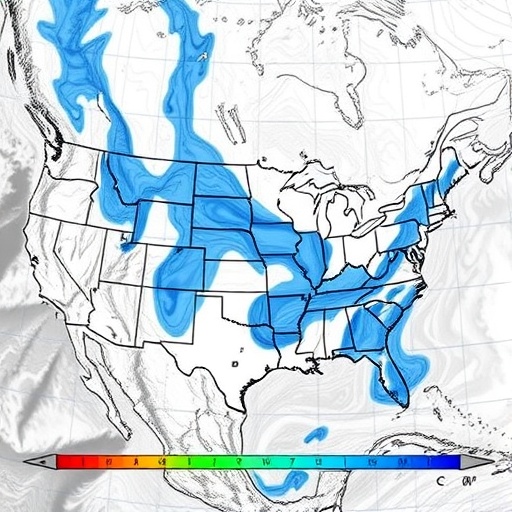
In recent years, atmospheric rivers have garnered increasing attention from the scientific community due to their substantial impact on global hydrology and extreme weather events. These elongated corridors of concentrated moisture transport can unleash torrential rains, often triggering severe flooding that threatens communities across continents. A groundbreaking study published in Nature Communications in 2026 sheds new light on the role of antecedent soil moisture in enhancing early warning capabilities for atmospheric river-induced flood hazards. This research, led by Webb, Albano, and Bozkurt, integrates advanced hydrometeorological analysis with novel modeling approaches, providing a critical leap forward in flood forecasting science.
Atmospheric rivers, sometimes described as “rivers in the sky,” act as massive conveyor belts transporting vast quantities of water vapor from tropical oceans toward mid-latitude landmasses. When this moisture encounters topographical barriers like mountain ranges, it condenses and falls as intense precipitation. The consequences are often catastrophic floods, landslides, and infrastructure damage. Despite significant advances in remote sensing and atmospheric modeling, predicting the precise timing and magnitude of flooding events associated with these rivers has remained elusive, largely due to the complex interplay between meteorological and terrestrial factors.
The crux of the new study lies in the premise that antecedent soil moisture—the amount of water already present in the ground before an atmospheric river event—plays a pivotal role in modulating flood hazards. Historically, flood forecasting models have prioritized atmospheric conditions, such as moisture content, storm dynamics, and wind speed. However, terrestrial factors, especially soil wetness, impact how much rainfall runs off into rivers and streams versus being absorbed. By systematically incorporating antecedent soil moisture data, Webb and colleagues demonstrate marked improvements in the lead time and accuracy of flood warnings.
Employing a multidisciplinary methodology, the researchers combined state-of-the-art satellite observations, high-resolution weather models, and in situ soil moisture sensors. Their analysis spanned multiple case studies across different climatic and geographical regions known for atmospheric river occurrences, including the U.S. West Coast, parts of Western Europe, and East Asia. These cross-regional studies underscored the universality of the findings, transcending local soil and vegetation variability. One key insight was that saturated soils could exacerbate flood risk by drastically reducing infiltration, triggering rapid surface runoff.
The technical advancement within this research lies in the integration of antecedent moisture metrics within hydrological forecasting frameworks. By leveraging machine learning algorithms trained on historical flood data and real-time soil moisture inputs, the system can dynamically adjust flood risk probabilities. This results in earlier alerts for emergency management agencies, offering precious extra hours to deploy mitigation resources and safeguard vulnerable populations. Such a proactive stance is crucial for minimizing human and economic losses associated with atmospheric river floods.
Further, the study highlights the nuanced feedback mechanisms between soil moisture and atmospheric dynamics. For example, wetter soils can influence local evapotranspiration rates, subtly modifying the microclimate prior to a storm’s landfall. This interplay can affect atmospheric river intensity and duration, creating a complex two-way interaction. Incorporating these bidirectional effects into predictive models is a daunting challenge, but it also opens avenues for more holistic and precise forecasts, according to the authors.
Importantly, the study emphasizes that antecedent moisture’s influence is not merely confined to soil wetness but extends to snowpack conditions in mountainous regions where atmospheric rivers often precipitate snowfall. Variations in soil moisture can affect snowmelt rates, thereby altering flood dynamics during the transition to warmer periods. This aspect is particularly salient given changing climate patterns, which are expected to increase both frequency and intensity of atmospheric river events alongside shifts in seasonal snow accumulation regimes.
The implications for climate adaptation strategies are profound. As anthropogenic climate change accelerates hydrological extremes, integrating antecedent moisture monitoring into national flood early warning systems could be a game-changer. Policymakers and disaster response organizations might soon rely on this integrated approach to craft more resilient infrastructure, design smarter water management policies, and optimize emergency response timetables. This study thus not only advances scientific understanding but also directly informs practical risk reduction measures.
Moreover, the findings spur further inquiry into improving remote sensing technologies for soil moisture detection at finer temporal and spatial scales. Satellite instruments are evolving swiftly, but challenges remain in penetrating dense vegetation and resolving subsurface moisture profiles critical for accurate flood modeling. The research team advocates for collaborative efforts between atmospheric scientists, hydrologists, and engineers to refine sensor capabilities and embed such data streams seamlessly into operational forecasting.
The study’s open-access publication ensures that global researchers, operational agencies, and stakeholders can access the methodologies and datasets to validate and extend the findings across diverse landscapes. Collaborative validation efforts are already underway in parts of South America and Australia, hinting at a new era of internationally coordinated flood hazard preparedness supported by antecedent moisture science.
Furthermore, this paradigm shift toward integrating land surface conditions underscores a broader trend in Earth system modeling, recognizing that atmosphere, biosphere, and hydrosphere are deeply interconnected components. By closing feedback loops between terrestrial moisture content and atmospheric moisture transport, models become more representative of real-world complexity, enhancing predictive skill and confidence.
In summary, the 2026 study by Webb, Albano, Bozkurt, and colleagues represents a compelling advance in atmospheric river flood hazard research. Through rigorous analysis and innovative modeling, it confirms that antecedent moisture is a critical missing piece in current prediction frameworks. This insight paves the way for more timely, accurate, and life-saving flood warnings globally—an urgent need as climate-driven hydrological extremes intensify.
The integration of hydroclimatic data streams, machine learning approaches, and earth system feedback mechanisms showcased in this research crystalizes a promising future for flood hazard mitigation. As communities worldwide confront mounting flood threats, this comprehensive approach could soon underpin the next generation of predictive tools that safeguard lives, property, and ecosystems from atmospheric river deluges.
This breakthrough study offers hope and practical solutions in the face of escalating climate challenges, reaffirming the power of interdisciplinary research to unravel complex environmental phenomena and translate insights into societal benefits. Future research will likely build upon these findings to refine predictive models, expand spatial coverage, and incorporate socio-economic vulnerability metrics, enhancing preparedness and resilience on a planetary scale.
Subject of Research: Early warning enhancement of atmospheric river-induced flood hazards through antecedent soil moisture integration.
Article Title: Antecedent moisture enhances early warning of atmospheric river flood hazards.
Article References:
Webb, M.J., Albano, C.M., Bozkurt, D. et al. Antecedent moisture enhances early warning of atmospheric river flood hazards. Nat Commun (2026). https://doi.org/10.1038/s41467-026-69286-3
Image Credits: AI Generated


