


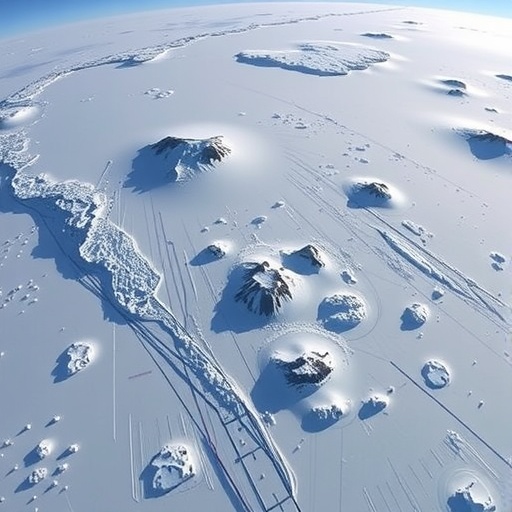
In a significant leap toward deciphering Earth’s past climate dynamics, a new study has revealed striking contrasts in how Antarctica’s colossal ice sheets responded to orbital variations approximately three million years ago. By meticulously analyzing geological records from regions neighboring both the West Antarctic Ice Sheet (WAIS) and the East Antarctic Ice Sheet (EAIS), researchers have uncovered compelling evidence that these two ice masses displayed distinctly different behaviors in response to the natural orbital rhythms that have paced Earth’s glacial and interglacial cycles. The results challenge previous assumptions regarding Antarctic ice stability and have profound implications for understanding past sea-level fluctuations during the Pliocene epoch.
The Earth’s orbit undergoes cyclical oscillations, primarily involving obliquity (axial tilt, with a periodicity of roughly 40,000 years), precession (wobble in the rotation axis, periodicity close to 23,000 years), and eccentricity (shape of the orbit, approximately 100,000 years). These orbital parameters intricately influence solar insolation and, consequently, global climate. While it has long been recognized that these variations drive glacial-interglacial transitions, the specific ice-sheet responses, especially in Antarctica’s diverse sectors, have remained elusive.
The team assembled data spanning the interval from approximately 3.3 to 2.3 million years ago, a pivotal window during the mid-Pliocene when Earth’s climate was warmer than today and Antarctic ice volumes saw significant fluctuations. Central to their methodology were sediment cores extracted from the Ross Sea, adjacent to the WAIS, which revealed concentrations of iceberg-rafted debris (IRD) – geological markers that trace episodic calving of icebergs from the ice sheet into the ocean.
These IRD records displayed a remarkably linear pacing aligned with orbital forcing at frequencies corresponding to both obliquity and precession signals. Furthermore, the influence of eccentricity modulated these cycles, effectively amplifying or dampening their climatic impact. This precise orchestration suggests that the WAIS was highly sensitive to external forcing mechanisms, particularly ocean-induced melt effects instigated by changes in Southern Ocean circulation patterns. Concurrently, atmospheric conditions, governed by variations in insolation driven locally by these orbital cycles, played an important role.
In compelling contrast, similar analyses of sediment records adjacent to the East Antarctic Ice Sheet painted a different narrative. The EAIS record conspicuously lacked a clear obliquity imprint, indicating that its mass balance was less strongly tied to changes in axial tilt-induced insolation variations. Despite the EAIS being a dominant contributor of meltwater to the global oceans during this period, the evidence points toward a relative resilience or inertia to orbital-scale atmospheric forcing, implying differing internal dynamics or geographic factors limiting its responsiveness compared to WAIS.
To contextualize these empirical observations, the researchers conducted sensitivity experiments with advanced ice-sheet models. These simulations underscored that the WAIS’s unique configuration and proximity to the warming Southern Ocean rendered it more dynamically responsive to ocean-driven basal melting. On the other hand, the EAIS, nestled further inland and shaped by high elevation and colder temperatures, displayed less susceptibility to oceanic influences, corroborating the sedimentary data.
This spatial variability reinforces the conceptual model that Antarctic ice sheets function not as a monolithic entity but exhibit sector-specific responses to climate drivers, influenced by both atmospheric and oceanic mechanisms. It casts new light on the complexity of ice-sheet behavior under warming scenarios and challenges the simplified assumption of uniform Antarctic melt dynamics in paleo-sea level reconstructions.
Moreover, the study strengthens the hypothesis that atmospheric warming played a substantial role in mid-Pliocene sea-level changes, with both WAIS and EAIS contributing meltwater to the oceans albeit through distinct processes and timelines. This nuanced insight is critical for calibrating climate models that aim to forecast future ice-sheet responses and their consequent contributions to global sea-level rise under anthropogenic warming.
These revelations bear resonance beyond academic interest; the modern WAIS is currently among the most vulnerable ice masses under ongoing climate change, susceptible to melt from both atmospheric temperature increase and intensified ocean heat intrusion. Learning from its Pliocene dynamism enhances predictions of its potential future trajectories and informs policymakers about the risks associated with ice-sheet destabilization.
In essence, this research presents a detailed portrait of Antarctic ice sheets as living relics of Earth’s climatic past, their historical pulses encoded in ocean sediments, and their disparate rhythms shaped by shifts in Earth’s celestial dance. By fusing sedimentary evidence with cutting-edge modeling, the study delivers unprecedented resolution on how orbital variables operate through ice-ocean-atmosphere interactions at a continental scale.
As global temperatures continue to rise, insights gleaned from the Pliocene – a time of similar warmth – grant crucial vantage points to understand potential feedbacks in the Earth system and frame realistic projections about the future of polar ice sheets and sea-level rise. Future research building on these findings is poised to further unravel the intricate mechanisms that have sculpted, and will continue to sculpt, the frozen landscape at Earth’s southernmost frontier.
Cite Scienmag News
Violet Maxwell. (January 2, 2026). Antarctica’s Ice Sheets React Differently to Orbital Changes. Scienmag. https://scienmag.com/antarcticas-ice-sheets-react-differently-to-orbital-changes/
Violet Maxwell. "Antarctica’s Ice Sheets React Differently to Orbital Changes." Scienmag, 2 January 2026, https://scienmag.com/antarcticas-ice-sheets-react-differently-to-orbital-changes/. Accessed 6 September 2026.
Violet Maxwell. "Antarctica’s Ice Sheets React Differently to Orbital Changes." Scienmag. January 2, 2026. https://scienmag.com/antarcticas-ice-sheets-react-differently-to-orbital-changes/


